source : the age
To submit a letter to The Age, email letters@theage.com.au. Please include your home address and telephone number below your letter. No attachments. See here for our rules and tips on getting your letter published.
HIGH COURT
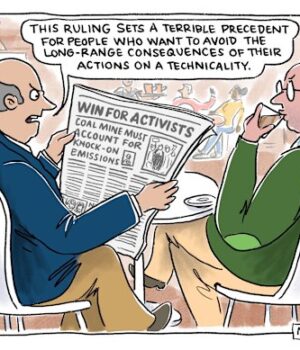
Your letters page (″Government needs to resist as miners dig in″ 9/10) demonstrates the division in opinion over the High Court’s decision to impose consequential effect analysis on coal miners when seeking planning approval. Chris Bowen keeps batting away questions over this decision by saying it’s merely a tweaking of NSW state planning laws, but the implications are enormous.
Thankfully, unlike the USA, where Supreme Court appointments have become intensely political, our High Court has remained independent with appointments usually receiving bipartisan support.
So, now we have a precedent for considering the consequences of all planning applications. It seems the question of whether projects will have deleterious effect here or globally must be a factor when granting planning permits.
Mining is obviously one industry where this will shape the future of our extractive industries but other controversial developments such as data centres, housing and commercial developments may also come under the spotlight.
For once, the question ‘Is this for the greater good of humanity?’ could be front of our planning.
Graeme Lechte, Pascoe Vale
No, court is not indulging in activism
Your correspondent (Letters, ″Astonishing activism″ 9/10) questions the reasoning of the High Court regarding coal export emissions, and accuses it of ″judicial activism at its zenith″. However, the legal basis of the decision was not on the merits of the coal exports. It was a ‘judicial review’ case.
Judicial review has long been a critical part of our legal system, ensuring that administrative decision makers (eg. government ministers) are accountable for following proper processes.
The High Court ruled that the minister had failed to consider a material and mandatory consideration (according to the NSW legislation), and by extension had departed from their democratically-granted power.
If those considerations need to be adjusted, the NSW parliament is now free to adjust them. A large factor in that decision will be the wishes of the NSW voting population. The High Court has played an important role in bringing the issue to their attention.
Michael Radywonik, Moonee Ponds
Supply and demand at work
Your Letters correspondent claims that our coal customers will find alternative suppliers and that “not a gram less will be burnt” (“What were they thinking?” 9/10). This is the same distorted reasoning used to justify inaction on illegal drugs, alcohol and tobacco. It also ignores the economics of supply and demand. Reducing supply, other things being equal, increases prices and reduces demand. Other suppliers may fill some of the gap, but to claim that Australian coal production has no effect whatsoever on global consumption is simply untenable. As for the economic benefits of coal exports, these will pale into insignificance when weighed against the environmental costs of ‘business as usual’.
David Fox, Beaumaris
THE FORUM
Not as friendly list
Anyone who thinks Melbourne is the world’s friendliest city clearly hasn’t travelled much. Would a Melburnian spontaneously buy four museum tickets for a small group of travellers in the ticket queue?
Would a Melburnian offer his home and a meal to six travellers who turned up on his doorstop out of the blue, or, quietly pay for an international visitor’s meal in a restaurant or tear his fresh bread in half to offer to a passing traveller? Or, go completely out of his way at night to walk three lost visitors to a location?
I can recall many more acts of kindness I have received from overseas strangers that I know would never happen in Australia. These few examples occurred in Iran, Mongolia, Syria and Morocco.
Julie Christensen, Blackburn Nth
Art and sport mix
My Australian history professor, Ian Turner, would have heartily agreed with Waleed Aly’s analysis of the strong connection between sport and art when he delivered The Ron Barassi Memorial at a packed out Robert Blackwood Hall at Monash University in the early 1970s.
His erudite, affectionate and humorous theorising about Aussie Rules still resonates, and highlighted to this country girl that the halls of academia can be as passionate about sport as they can be about the Arts.
To this day, I treasure the opportunity to walk from the ‘G after the footy to the Arts Centre and enjoy a production or exhibition there. And that’s Melbourne.
Brenda Innes, Camberwell
Convictions, not slogans
The main problem with things being the way they are at the moment, is that politicians have lost how to be politicians. All they want is the power and the prestige. Once they’re in – Tony Abbott and Scott Morrison-style – they have no idea what to do. Anthony Albanese seemed to be an old school type, someone who knew how to get the job, but has ended up proving himself as useless as the others.
The last politician to get anything real done was Julia Gillard, and we don’t have another of her on the horizon. So what do we do? If you really want to send a message, forget One Nation. Look – really look – at any independent candidates, teal candidates, people who really want to make change.
Give the balance of power to a David Pocock, or even a Jacqui Lambie; give us someone with real conviction, rather than a catchy slogan.
David Jeffery, East Geelong
Moses isn’t coming
I read another article this week and another journalist declaring people want change, that voters are searching for someone to fix their problems.
Reading between the lines, what they’re really describing is a hunger for a messiah. And when a politician inevitably turns out to be human, the media turns its considerable resources on their flaws, repeating them again and again until the flaws are all anyone remembers.
I have some grim news. Moses isn’t coming down the mountain. Pauline isn’t a prophet. No leader, from any party, is going to arrive with tablets of stone and set everything right.
Change doesn’t come from the top. It comes from us: house by house, street by street, suburb by suburb. It comes from neighbours sitting down to discuss, debate and decide what’s best for their schools, their roads, their hospitals, their town. That work is slow, unglamorous and often frustrating. But it’s the only kind that lasts.
Tom Pagonis, Hawthorn
Fast track doubts
Why would any planning minister so ruthlessly turn their back on local planning expertise when we have such an urgent need to adapt to global warming as well as increase housing? (“Yes, Minister”, 7/10).
We have an approved ‘Fast Track’ seven-level proposal near us where apartments have been advertised from $1,650,000 to several million. Those most dismayed and outraged were young workers in the pub opposite. They had naively believed they were looking at a plan for affordable housing.
Fast Track planning decisions have not provided affordable buildings where young people want and need to live. Locations with ready access to trams, buses and an abundance of local amenities should be earmarked for those wishing to go car-free and enjoy the reduced costs of an apartment without a garage. This is the congested inner-city, after all.
How long can we tolerate threats to Melbourne’s liveability without questioning who is benefitting from this planning fiasco?
Susan Mahar, Fitzroy North
Child crime
We can get to the moon, but it seems that as a community, we can’t even begin to realise that our youth has been contaminated, and we have lost control.
We are treating the children who are causing so much harm as “they”. We are distancing ourselves from them, and ultimately all children. We institute more and more rigorous disciplinary
measures which are not working.
Surely, there are leaders who will step up to point out the folly of allowing alternative ‘values’ which undermine social norms to seep into the minds of the emerging citizens of our community.
Australia, at least is trying to force some restraints on the tech companies whose tools allow vile ideas to penetrate our children’s psyches.
Means much more dramatic and effective have to be found to turn around the technology so that our children are imbued with the values we know, will keep society bonded and harmonious.
Geraldine Colson, Mentone
American values
We align ourselves with countries we decide are civilised and scorn those we consider barbaric.
In one country this week we have heard of a string of abuses of human rights regarding capital punishment. A woman who has served 30 years in prison waiting “on death row” was scheduled to be killed by lethal injection. She survived two injections and was taken to hospital to be revived. She has recovered consciousness and awaits her fate. Tragically, the state does not automatically commute the death sentence in such cases.
Then, the defence department of that same country has announced that the execution by firing squad of a mass murderer will be live streamed. Live streamed! This country is the US, one of our closest allies.
We are quick to call out human rights abuses in countries such as Iran; where is the outcry about these abhorrent practices in our “great friend”?
Pauline Brown, Woodend
Taking low road
The US is slipping into a dark age. First, a botched execution and the possibility that the prisoner will face a third attempt to kill her. And now, the public execution of a soldier who shot 13 of his compatriots.
US Defence Secretary Pete Hegseth says the execution by firing squad will be broadcast online. How much lower can America sink?
Damien Ryan, Berwick
AI for everyone
Artificial intelligence is usually discussed as either a technological miracle or an existential threat. The fundamental question is political: who will control it, and for whose benefit?
AI is being developed by corporations, governments and military establishments competing for profit and strategic advantage. At the same time, automation threatens capitalism’s dependence on wage labour.
If machines produce more with fewer workers, society becomes richer in productive capacity while many people lose the wages needed to live. Technology that could free us from drudgery instead threatens unemployment and poverty.
The answer is not to halt AI, but to bring it under democratic control. Frontier systems need independent safety testing and enforceable international standards.
Governments should establish publicly funded, open AI research centres and a universal digital library, giving everyone access to knowledge while fairly remunerating creators.
AI is the product of humanity’s accumulated knowledge and labour. It should become a global public utility, used to shorten working time, expand knowledge and improve human life – not to enrich a few corporations or strengthen military power.
Barry York, O’Connor, ACT
AND ANOTHER THING
A society of ills
America is a sick society. Christa Pike is shackled to her bed. The woman was on her way to dying – are they worried she may leap out of bed and attempt to escape? Meanwhile, Pete Hegseth has authorised the live streaming of the execution by firing squad of the Fort Hood shooter. How will the young and vulnerable be protected from the footage?
Pam McConnell, Boronia
Furthermore
Should I buy a bigger purse so that I can pay my tax to the ATO in cash?
Heather Barker, Albert Park
Please bring back the surcharge. My local cafe decided that dropping it enabled him to increase the price of a coffee from $5 to $6, whereas the previous cost including surcharge was $5.07. I’m no mathematician, but I’m tipping he’s taking us for a ride.
Paul Thomas, Essendon
Your correspondent’s letter (9/10) about Coalition rhetoric, “we need to take back our country” etc. could have just as easily been the ‘rhetoric’ that our First Nations people might have used when the settlers began spreading through the nation.
Pepe Salvatore, North Fitzroy
Re ″Greens kick off campaign with public supermarket plan″ (8/10). I am old enough to remember the ACTU store at the top end of Swanston Street in the 60s. It was a gallant attempt to provide goods at cheaper prices to the working class. It was doomed to fail. Marketing is best left to capitalists.
Dan Drummond, Leongatha
Cricket
Quote of the year from Travis Head: “I think it’s fairly unfairly judged a fair bit from a group of past players, pretty much that put the bullet through a lot of players, which I think is unfair” (“Test star hits out at ex-players”, 8/10). Fair call Travis. I think I have a fairly, fair grasp of your grievance.
Peter Thomson, Brunswick
Test not on free to air? That’s not cricket!
Luise Mock, Tawonga South
Finally
A 16-letter word (Letters 9/10)? A mere bagatelle. I have one with 28: antidisestablishmentarianism. It sounds deliciously subversive.
Jane Ross, San Remo
The opinion newsletter is a weekly wrap of views that will challenge, champion and inform your own. Sign up here.