


Source :- THE AGE NEWS
When Cameron Bancroft made the seismic decision on March 24, 2018, to take a small sheet of sandpaper out of his pocket and attempt to scuff up the ball, he should have known he would never get away with it.
Stationed around Newlands, one of the most picturesque venues in world cricket, were at least 30 cameras, many of them manned.
Not all were focused on the engrossing Test match that was slowly slipping through Australia’s fingers, or the imposing background of Table Mountain and Devil’s Peak, which overlook Cape Town. Some cut in between deliveries to the colour in the crowd or the bikini-clad women on the hill, others to players chatting on the field. The seemingly most mundane role produces shots that normally do not make the telecast – they did on this occasion.
“Every Test match, we follow the ball,” SuperSport’s head of production Alvin Naicker told this masthead.
“We have more than 30 cameras, 18 are manned cameras, the rest of them are on angles. There are so many cameras, I don’t know how people think they’ll get away with doing anything wrong.”
The now infamous vision of Bancroft working on the ball with what he initially claimed was yellow tape that had caught granules off the pitch was actually not aired live. It had occurred moments earlier, before the second ball of the 22nd over after lunch on the third day.
“One of the replay guys, he was recording it,” Naicker said. “He turned around and said, ‘Hey Al, have a look at this’. I looked at it on preview and said, ‘What happened there?’ He said, ‘Just have a look’.
“I look at it and go, ‘Wow’.”
The scandal not only rocked the world game but triggered a mass exodus from leadership positions in Australian cricket’s biggest crisis since World Series Cricket.
More than eight years later, as the Australian team returns to South Africa for their first Test series in the country since the scandal, starting on Friday, current skipper Pat Cummins would like to draw a line under the episode.
“It was a long time ago, and I don’t think there’s much more to add,” he said. “We’re concentrating on the tour ahead.”
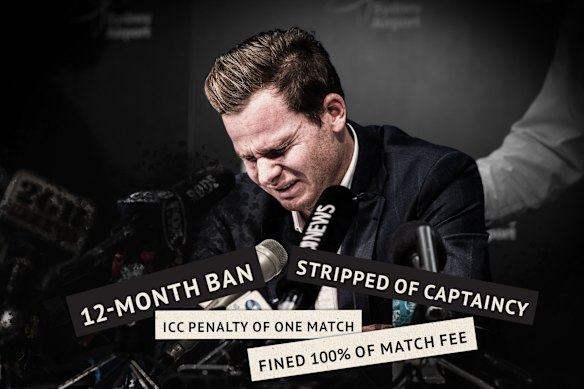
Steve Smith, who was stripped of the Australian captaincy and banned for 12 months for turning a blind eye to the plan when he could have stopped it, is the only one of the central trio who is still in the team.
Whatever Cummins’ views, there remains great intrigue over the events in Cape Town, what led up to them and what followed.
This masthead’s reporting draws on recent conversations with more than 20 members of the 2018 Australian touring party, administrators, player agents and commentators, who mostly spoke on the condition of anonymity, as well as previous discussions and on-the-ground observations eight years ago.
There are still differing versions of what went down in South Africa, and unanswered questions.
Who knew what and when? Were the teams tampering with the ball earlier in the series? Did the swift Cricket Australia investigation capture the full picture?
To gain a greater understanding of why and how the sandpaper scandal unfolded as it did at Newlands, one needs to first return to the previous match of the series, the second Test at St George’s Park, Port Elizabeth.
The teams convened there after a highly charged first Test in Durban won by Australia, but better remembered for a heated stairwell altercation between David Warner and Quinton de Kock.
Cricket Australia chief executive James Sutherland had phoned Smith in a bid to restore calm, and the Australian captain brought his teammates together for a players-only gathering in the Port Elizabeth dressing room before play started.
The temperature did not come down.
The Australians were furious at South African officials’ indifference towards crowd abuse directed towards Warner’s wife Candice, who was in attendance with their two daughters and her brother. At the same time, an underhanded game within a game developed as the ball swung dramatically over a dry wicket.
Reverse swing, which was usually generated by scuffing the ball on one side, had been a factor in the series from almost the outset and Australia grew suspicious about finger splints being worn by two of the South Africans, AB de Villiers and Dean Elgar, noticing they jogged off and on the field during play on several occasions.
The Australians had also been told that umpires had found a discarded finger splint during the previous Test at Kingsmead.
Warner, meanwhile, was increasingly agitated, believing the cameras of the host broadcaster, SuperSport, were following him in the field, looking up to see himself on the big screen time and again. His suspicions were well-founded.
One day after play he even made his way up to the office of the ICC match referee, New Zealander Jeff Crowe, to relay his frustrations at the focus on him.
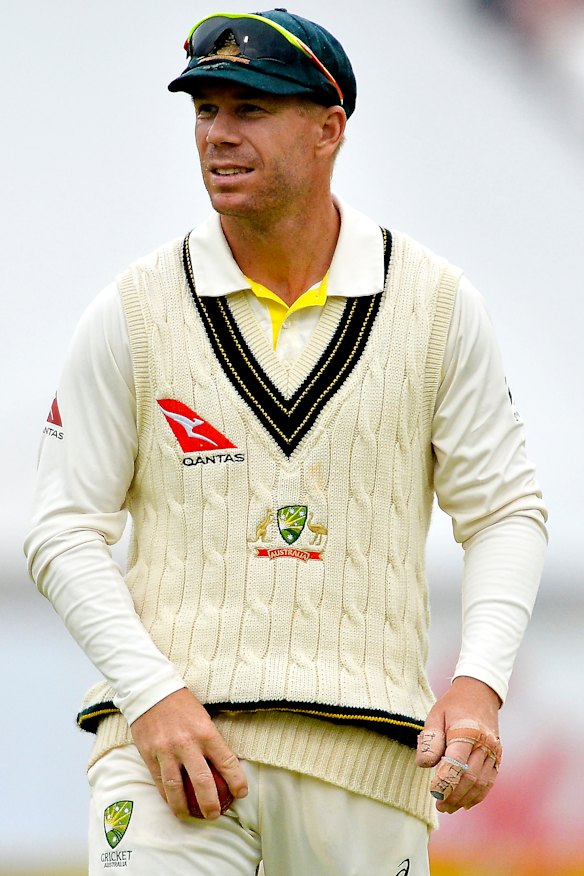
Warner was wearing strapping tape on his left hand, fingers and thumb, which he had broken in the past, and with the cameras trained on him, the inference was that he must be doing something other than shining the ball.
There have always been questions about whether the Australians were ball tampering in Port Elizabeth, too, but no one has come out and said it, nor that the South Africans were taking their own shortcuts despite the visitors’ belief that they were.
The broadcasters were more than curious as to why wickets fell in clumps with an older ball.
“We knew the ball was reverse-swinging, but we didn’t understand why it was reverse-swinging so early,” Naicker said.
The spotlight on Warner at St George’s Park explained why it was Bancroft, and not Australia’s vice captain and regular ball manager, who was tasked with using a foreign object in Cape Town. Unwittingly, Warner drew more attention to himself by writing the names of his wife and daughters on his hand and finger strapping.
“It gave us reason to believe we should watch something,” Naicker said. “Why would he do that? He was distracting from the fact he wasn’t doing anything with the ball, it was actually someone else.”
After a fiery second Test in which South Africa speedster Kagiso Rabada was charged for making physical contact with Smith, Crowe and the umpires took the two captains aside to demand they clean up their act 10 days later at Newlands with the series at 1-1.
Again, the edict went out the window and Australia, feeling a sense of injustice as Rabada somehow escaped suspension, careered closer to disaster.
“We could see through his pocket.”Supersport’s Alvin Naicker
What transpired in Cape Town has been well documented. Bancroft was sprung by the broadcaster’s cameras after lunch on day three with a small yellow object – later revealed to be sandpaper – and all hell broke loose.
The scrutiny had been on Warner, but suspicions piqued when he was moved from his customary fielding position in the ring to the boundary.
Bancroft had not been a person of interest for the host broadcaster until vision of him working on the ball with what he initially claimed to be yellow tape that had caught granules came to the attention of producers in SuperSport’s trucks.
“Not at all, zero, nothing, we didn’t have a clue,” Naicker said.
“Bancroft’s pure mistake was putting the sandpaper in his pocket and the cameraman zoomed in. We were watching it from glorious high definition trucks – you can see the yellow thing sticking it out of his pants.
“We could see through his pocket.
“What happened in Cape Town, to be honest with you, was pure luck. It had nothing to do with us going out deliberately looking for something.
“When Bancroft got the ball, he didn’t shine it on his pants. He started rubbing the ball on the palm. The cameraman stayed on Bancroft, he didn’t follow the ball to the next guy. When Bancroft put something in his pocket, the cameraman zoomed in.”
While SuperSport provided pictures from its broadcast truck for the big screen, it has no say what gets shown to the punters. As the footage of Bancroft carrying out his ill-conceived plan to hide the foreign object down his trousers was shown to the crowd, Naicker sensed an immediate mood change in the Australian team.
“You could see their shoulders drop, their body language, they knew there was something going on,” Naicker said.
Though Naicker is adamant SuperSport would have also exposed the home side if they had uncovered foul play, there was widespread distrust from the Australian team and ex-players, including former Australia Test paceman Brendon Julian, who was commentating for the host broadcaster.
“In terms of SuperSport, there’s no doubt they were following David Warner on that particular day,” Julian said. “I knew they were doing that. I was working with Graeme Smith, and [Shaun] Pollock. You know what the Saffers are like? They’re onto you all the time, even if you’re commentating.
“They knew Davey Warner was up to something. They suspected he was even doing something in the first Test. He had a lot of tape on his hands. He was playing it up to the crowd and showing them his hands.
“As soon as he went down on the boundary, they started following the ball. They put one camera on the ball. They followed the ball all the way around for the whole session. I was oblivious to it.”
“Just be careful – they’re on you, they’re trying to stitch you up with something.”Commentator Brendon Julian to coach Darren Lehmann.
Before play during a day of the first Test, as players and the commentary team mingled on the field to inspect the pitch during the warm-ups, Julian had relayed his concerns about SuperSport’s motives to coach Darren Lehmann, though he did not have ball tampering in mind.
“Just be careful – they’re on you, they’re trying to stitch you up with something,” Julian told Lehmann.
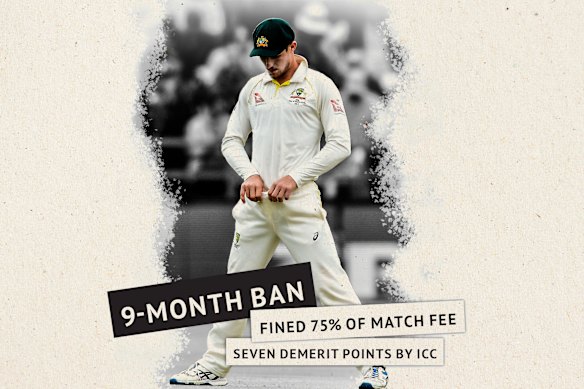
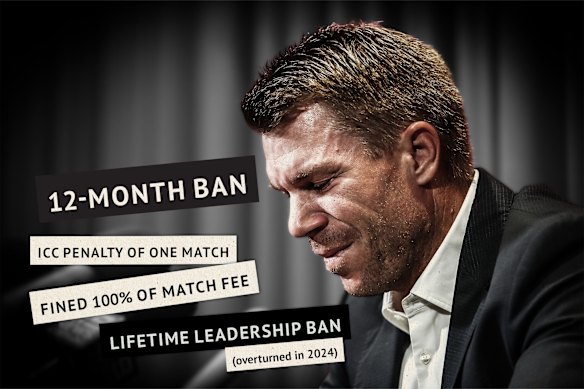
Warner would be fingered as the chief conspirator and rubbed out with Smith for 12 months, while Bancroft copped nine months, after a fast-tracked Cricket Australia investigation.
In the full glare of the watching public, it was an extraordinary gamble to take sandpaper onto the field. It backfired so spectacularly that the umpires, on inspection of the ball, didn’t even feel the need to replace it.
A match official told two sources the umpires did not change the ball as they believed South Africa’s was in worse condition. That assessment was a reflection of how poor a job Bancroft had done.
A more well-worn mode of ball tampering in Australian cricket was to rough up one side of the ball in the moments after one of the umpires dropped it near the rope when walking out to resume play, before whisking whatever device was being used off the ground.
This masthead has also heard examples of sandpaper being used in Sheffield Shield cricket but in more subtle fashion, with a tiny strip taped onto a finger or thumb, crucially in the standard brown colour rather than bright yellow. Sandpaper was commonly used in dressing-rooms to fix bats.
Privately, match officials in Australia described ball tampering as an “arms race”. Scratching of the ball had “been going on forever” at all levels of cricket, according to a player on the tour, with all kinds of methods deployed, from dried superglue on wicketkeeping gloves, to bottle caps.
At least one touring team to Australia applied superglue over the logo of their trousers to rub the ball on once the transparent adhesive dried and hardened. Lolly snakes were also in demand to stimulate thicker saliva with which to shine the ball.
The ICC penalty for ball tampering was effectively a speeding ticket – a fine of a few thousand dollars or a one or two-match suspension.
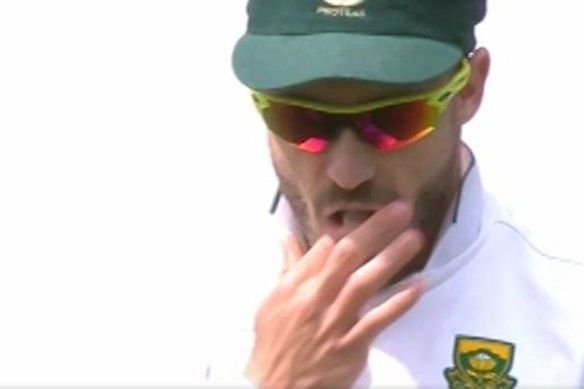
South Africa’s captain Faf du Plessis had twice been found guilty of tampering, for rubbing a ball on the zipper of his pants against Pakistan in 2013 and using a mint to shine the ball against Australia in 2016. He escaped a ban on both occasions.
“I remember even trying to use a nail back then and my nail broke … it was just part of the game,” he said in a podcast with former teammate Vernon Philander in August.
Watching the broadcast closely from the dressing room as cameras zeroed in on Bancroft, du Plessis was one of the first to cotton on to the West Australian working on the rough side of the ball.
“When I saw [Bancroft] do that I was like … ‘He doesn’t know what to do, he doesn’t know how to get the ball to reverse swing’,” Du Plessis said.
“Because taking a piece of sandpaper out of your pockets, with cameras, it’s not the cleverest thing to do.”
One theory is that Bancroft was never meant to take the sandpaper onto the field but, urged on at lunchtime in Australia’s desperation to get the ball shifting sideways, had taken the plunge.
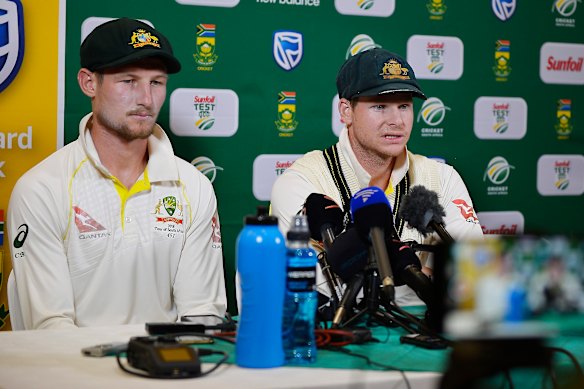
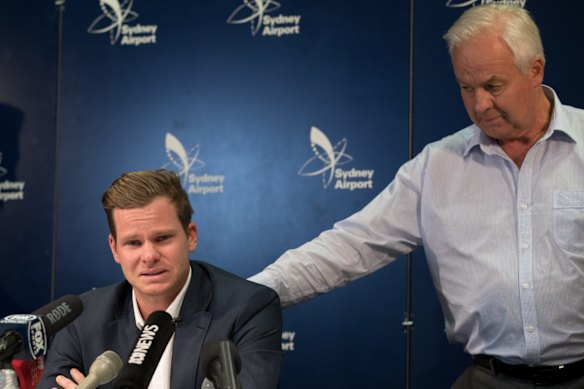
After Smith then ignored advice not to attend what would become an infamous press conference after the day’s play, alongside the opener, the blame game began. It was only added to by how Smith and Bancroft fibbed to the cameras that it had not been sandpaper, but yellow tape.
Back in Australia, Sutherland had turned his TV off before the scandal came to light, then was asleep and uncontactable until early the following morning, having left his phone in the study of his Toorak home.
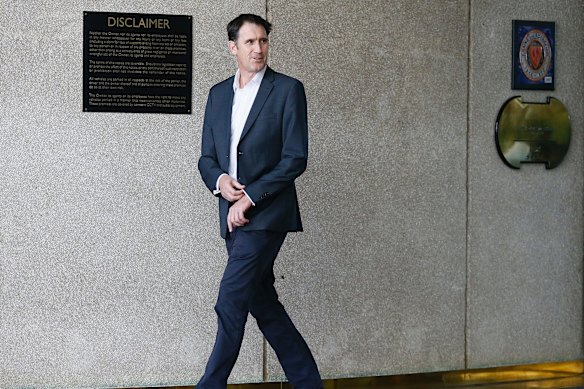
“It was a serious ‘WTF’ moment there,” he said in 2018. “I’d like to think that my judgment, and possibly influence, would have meant that the media conference would have gone slightly differently. As we know, the penalty and the severity of the penalty, was to some extent related to not telling the truth, or not telling the whole truth.”
Some players, among them Usman Khawaja, made the case for collective responsibility, the argument being that “they’re not going to sack us all”. But as they closed ranks, unaware of the gravity of what was unfolding, they didn’t go down that path.
“I do remember ‘Uzzy’ saying everyone has just got to stick together, but a lot of other people had other views,” recalled one member of the touring group.
Australia’s bowlers insisted they had no knowledge of the Cape Town plot – and issued another statement to that effect following a headline-making Bancroft interview five years ago.

Other divisions emerged. In Johannesburg, where the final Test was played, one coach privately pointed the finger squarely at another member of the support staff.
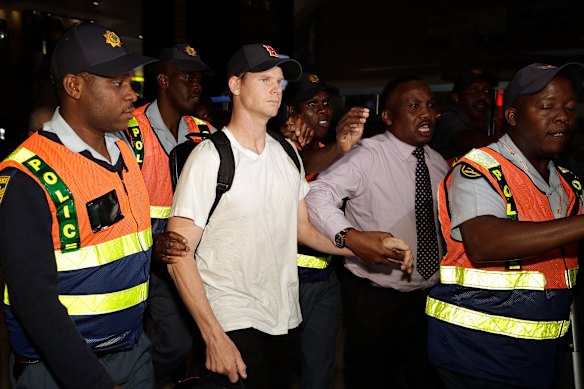
Head coach Darren Lehmann initially tried to hang onto his job, but resigned tearfully at the Wanderers after watching how Smith broke down after a jolting trip home. As one player lamented of Smith that week, “the bloke’s made one mistake in his life and been shot for it”.
In 2021, former bowling coach David Saker hinted that culpability may have been shared more widely than it was.
“Obviously, a lot of things went wrong at that time,” he said. “The finger-pointing is going to go on and on, and on. There was a lot of people to blame. It could have been me to blame, it could have been someone else. It could have been stopped, and it wasn’t, which is unfortunate.
“Cameron’s a very nice guy. He’s just doing it [the media interview] to get something off his chest … he’s not going to be the last. You could point your finger at me, you could point your finger at ‘Boof’ [Lehmann], could you point it at other people – of course you could.
“The disappointing thing is it’s never going to go away, regardless of what’s said. We all know that we made a monumental mistake. The gravity wasn’t as plain until it all came out.”
The South Africans, who took a more carefree attitude to tampering, were puzzled by the scale of the blowback, particularly criticism from former players. “We were sitting there going, ‘Come on, guys, it’s not like you guys never did it’,” du Plessis said.
“Everyone has done it at some stage of their career.”
Manipulation of the ball had never occurred as brazenly, of course, as in Cape Town.
But eight years later, some on the tour and within the Australian cricket hierarchy at the time believe the full story wasn’t told.
“We may not have been told everything – I suspect that’s the case.”A former Cricket Australia director
As an incredulous prime minister Malcolm Turnbull conveyed his disappointment at the team’s behaviour to a shocked nation, CA’s integrity boss at the time, Iain Roy, was in the air bound for South Africa to conduct their inquiry.
Over the next few days, members of the touring party were called to a room at the Southern Sun Cullinan hotel in Cape Town to be quizzed over the events at Newlands. The exact number who were interrogated is contested, but not all players were questioned.
Some interviews were brief. Those who were central to the episode spent well over an hour with Roy, whose report has never been publicly released and is under restricted access inside Cricket Australia’s system.
Those who have read the report do not believe the public narrative would change if it was released.
But one former CA director, who deliberated on the sanctions, said there was a view privately held by other board members this was not the team’s first instance of ball tampering, and that Warner was the instigator in those previous occasions.
This director, who has read Roy’s report, accepts the board was not given the full story.
“We may not have been told everything, I suspect that’s the case, but we acted appropriately on what we knew,” the director said on the condition of anonymity.
“I’m firmly of the view Warner was the instigator.”
Another director told this masthead they believed members of the team were aware the ball was being tampered with but did not know sandpaper was being used.
Players were told by Cricket Australia there was a confidential hotline they could contact anonymously to give more detail about the events in Cape Town, but it was not taken up.
“No one talked,” this director said. “We’ll never know.”
Next week: A reporter’s tale from the series the spirit of cricket forgot
Australian men’s Test series in South Africa
- First Test: October 9-13, Durban, 6.30pm
- Second Test: October 18-22, Gqeberha (Port Elizabeth), 7pm
- Third Test: October 27-31, Cape Town, 7.30pm (All times are AEDT)
- Australia Test squad: Pat Cummins (c), Scott Boland, Alex Carey, Cooper Connolly, Cameron Green, Josh Hazlewood, Travis Head, Josh Inglis, Matthew Kuhnemann, Marnus Labuschagne, Nathan Lyon, Michael Neser, Matthew Renshaw, Steve Smith, Mitchell Starc, Beau Webster.
News, results and expert analysis from the weekend of sport are sent every Friday. Sign up for our Sport newsletter.


