

SOURCE :- THE AGE NEWS
Beijing: It’s a Saturday evening and the Pyongyang restaurant in Beijing’s Korea town is doing a roaring trade.
I arrive with a Chinese friend just before 7pm, assuming we’d be seated straight away.
But it’s a full house and there’s a queue. No small achievement given China’s weak consumer economy has left many restaurants struggling to fill seats.
As we wait in line, a handful of North Korean waitresses in pale pink suits are darting between 20 or so tables spread across a sprawling dining room, serving up banquets of Korean barbecue with Pyongyang-style cold noodles and kimchi.
The diners are mostly Chinese families and groups, although there are a few eastern Europeans here too.
The Pyongyang Okryu-Guan restaurant has been operating since 2004, and is decked out with gold-trimmed furnishings and chandeliers, white tablecloths and gold seat covers. It’s a vibe of dated faux opulence rather than high-end dining.
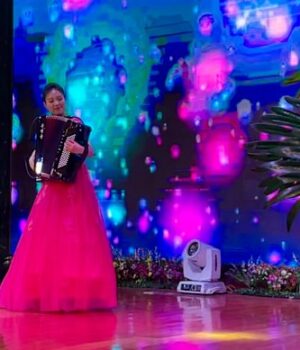
There’s a stage with a large screen showing grainy footage from a concert in Pyongyang, seemingly from the ’80s or ’90s, with singers belting out red songs about the motherland and socialism.
What is missing from the aesthetic is any tribute to the Kim regime. There are no North Korean flags or portraits of the country’s founder Kim Il-sung, and his son Kim Jong-il. This cult of leadership is not tolerated on China’s turf, it seems, despite Beijing’s close ties with Pyongyang.
The menu is quite pricey by China standards. But, for the most part, people are not here for the food.
What’s on offer is dinner with a show — and, depending on your outlook, an accompanying moral quandary.
It is a glimpse, however stage-managed, behind the curtain of the world’s most secretive country, and at those who have no choice but to live in strict subservience to the Kim regime.
The restaurant is a money spinner for the North Korean government, giving it access to much-needed foreign currency. Dozens of sister franchises operate across China, as well as in other parts of Asia, Russia and the Middle East.
The waitresses speak Chinese and are polite, but they don’t linger for chat and don’t want to be filmed or photographed. One employee tells us she will work here for three or four years, then scurries away before we can ask any further questions.
The exception is the 20-minute evening show, when diners are allowed to whip out their phones as the staff transform into talented accordion players, singers and dancers wearing colourful hanbok (traditional dresses).
On a cultural level, it’s engaging; on a human level, it’s jarring.
Little is known about the lives of the women who are dispatched to staff these restaurants. Testimonies gathered by human rights groups and researchers have shed some light, revealing these “jobs” are highly coveted and mostly given to young, beautiful and talented musicians from loyal, upper-class families.
For them, it’s an avenue out of North Korea, a window into the outside world, and a way to earn a small salary, although their movements are tightly controlled and their wages mostly confiscated by the regime.
In the pre-pandemic decade, a number of North Korean waitresses defected to South Korea, including one highly publicised and controversial case in 2016 involving 13 workers from a restaurant in southern China. The restaurant manager later claimed he had worked with South Korean intelligence agencies to dupe the women into defecting against their will.
Needless to say, suspicion towards South Korea runs deep.
“Are you a Chinese person?” a waitress asks my friend, apparently searching for confirmation that he is not an infiltrator.
She has overheard us discussing whether to order bibimbap, a quintessential Korean rice dish served with vegetables in a hot stone bowl. It’s called ban fan in Chinese, and using the Korean/English term has aroused suspicion.
Another waiter informs us that South Koreans are banned from dining “for the moment”. That moment seems unlikely to pass any time soon. In 2024, the North’s dictator Kim Jong-un renounced the country’s decades-long goal of reunification and designated the South as the “principal enemy”.
China maintains it complies with UN sanctions which prohibit the employment of North Korean workers — a measure designed to strangle the regime’s access to funding for its nuclear weapons program. It is widely suspected that waitresses and other workers are brought in on tourist or student visas.
The restaurant chain is part of a much larger overseas workforce of North Koreans, estimated by the UN to be about 100,000 workers across 40 countries, many of them deployed in construction and factories in suspected forced labor conditions. Along with IT hackers and cryptocurrency raiders, they have raked in billions for the Kim regime.
During the pandemic, North Korea became even more hermetically sealed off from the outside world, and it remains closed to all tourists except Russians, making it harder for analysts to glean what life is like inside the country.
Australian tour operator Rowan Beard is one of the few westerners who has entered the country since the COVID-19 era, making four recent trips, including last month as part of a business delegation. He says it feels more modern, more digitally connected, and significantly busier.
“The most striking changes have been the rapid development of Pyongyang, including new residential districts, growing ownership of private cars and traffic, and the widespread use of smartphones and domestic apps,” he says.
It adds to a picture, pieced together by analysts, of the regime’s coffers having been enriched by new revenue streams, including through massive arms sales to Russia for its war against Ukraine. Beard doesn’t expect Western tourism to resume any time soon, but Chinese tourists could get the green light in coming months.
Anticipation has ramped up after Chinese President Xi Jinping visited Pyongyang this month, and the two countries reopened a passenger train link between their capitals in March.
Until then, restaurants like the one in Beijing are as good as it gets for those curious about the North.
As for the food, it’s fine. Not great, not terrible.
The barbecue banquet arrives with generous servings of pork and beef, oily and unseasoned, though there’s a spicy dipping sauce. The cold noodles are tasty and so is the bibimbap, but it pales in comparison to similar feasts I’ve had in Seoul.
The standout is the Pyongyang-brewed Taedonggang beer. At 11 per cent potency and bottled in longnecks, it makes the food vital sustenance. In total, the meal for two cost 238 yuan (about $50).
The small bill doesn’t make this a guilt-free experience, for me at least. That’s all wrapped up in a much thornier debate: how to sanction a despotic regime without unduly punishing its people.
 Lisa Visentin is the North Asia correspondent for The Sydney Morning Herald and The Age based in Beijing. She was previously a federal political correspondent based in Canberra.Connect via X or email.