

Source : THE AGE NEWS
It is often said that some of the best real estate for finding gold is right next door to where it has already been discovered. Better still is to look beneath an old mine or rummage through the waste piles left behind by old-timers who chased only the richest ore in a far lower gold price environment.
After years of waiting for the right project to relight its exploration story, King River Resources appears to have found its centrepiece at Mindoolah. In this historic Cue goldfield, old mine dumps, a puzzling production mismatch and untested lode positions are now being revisited with smart methods and modern exploration tools.
The company has mobilised a reverse circulation (RC) drill rig to the project, 70km north-west of the historic town of Cue in WA’s Murchison region, to test whether the old goldfield can deliver a modern prize from near-surface stockpiles and deeper hard-rock targets below old shallow open pits, most of which were mined in the 1980’s.
Mindoolah has been the focus of a rapid reset since King River moved in this year, through its wholly owned subsidiary, Auradoolah. The company has framed the acquisition as a new chapter built around high-grade gold in a proven WA mining district, rather than another early-stage idea still looking for a point of difference.
‘Testing these deeper hard-rock targets from alternative, multi-oriented angles will allow us to validate historical logging.’
King River Resources managing director Graham Gadsby
King River also has a useful financial tailwind behind its Mindoolah push stemming from a holding of roughly 90 million shares in ASX-listed Tivan, received after selling its Speewah Dome vanadium project. With Tivan trading at 27.7c, the stake is worth close to $25 million.
The project has a long history of early 1900’s underground workings and later shallow open pits, with historical records pointing to high-grade production and company records indicating an average production of up to 19 grams per tonne (g/t) gold. King River says much of the old mining was constrained by the water table, with shallow mining depths down to just 20m and the higher economic cut-off grades of the day.
That history has left King River with two immediate questions. First, how much gold remains in the old stockpiles and waste dumps because of the high-grade cut-offs of the day? Second, did previous miners and drillers miss the true shape of the lodes by chasing what they could see at surface rather than the structures that fed and hosted them?
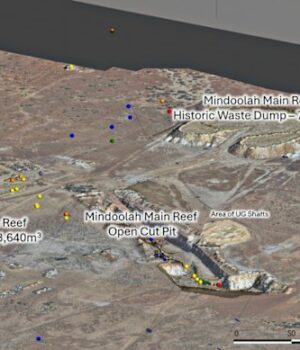
The stockpile question came to the fore after King River completed a LiDAR survey of the various dumps in May, coupled with volumetric calculations. The assessment pointed to a major mismatch between the 38,589 tonnes of officially reported 1980’s production and more than 1.08 million tonnes of material interpreted from the volume estimates to have been excavated from the old pits across Mindoolah.
Detailed surveys also put the remaining surface inventory at some 746,000 tonnes of excavated material across historic waste dumps and stockpiles. At the same time, the company has flagged a 339,000-tonne reconciliation discrepancy, which it believes may include gold-mineralised material left behind due to higher cut-off grades used during a much lower gold-price era.
The stockpile assessment component of the new drilling program will include 167 holes for 1690m across three main dumps. The Excelsior dump will take the lion’s share with 83 holes for 1017m, followed by Cundy with 38 holes for 380m and Mindoolah Main Reef with 46 holes for 293m. Bulk sampling and density characterisation are also underway to help firm up tonnage estimates and reconcile the historic volumes.
King River’s second target is the mineralised quartz vein systems beneath and around the old pits. The company is planning an estimated 1000m of RC drilling below the open pits and underground prospects, with holes generally to less than 120m and drilled from revised orientations to test whether earlier drilling was poorly lined up against the true lode geometry.
The company is also intrigued by the significance of a 1.8km-long monzonitic intrusive body in the core of a granitoid sitting just north of its Mindoolah mining centre The company says the structure could represent the heat source and mineralising engine driving the emplacement of gold into the various Mindoolah structures and may itself carry gold. A single historical diamond hole drilled into the body returned a solid 34m grading 0.64g/t gold.
At Cundy, King River is testing the theory that the original east-west pit may have cut across multiple north-south-trending lodes, potentially leaving parallel mineralised structures only partly tested. At Excelsior, the company wants to test mineralisation 30m below the pit floor and use a northeast-southwest-oriented “scissor” layout of opposing holes to assess lode geometry from a new angle.
The Bertram’s prospect is also being followed up for high-grade structural targets, supported by previous grab samples including 31.70g/t gold, 20.73g/t gold and 12.50g/t gold.
At the Mindoolah Main Reef, one RC hole is planned beneath a cluster of historic underground shafts, with broader drilling expected to wait for the results of the drone-based magnetic survey before finalising the program design for the next phase.
King River Resources managing director Graham Gadsby said: “This targeted campaign gives us a valuable dual opportunity to complete a systematic, high-density evaluation of the immediate near-surface potential across the historical waste dumps and stockpiles to determine if they contain meaningful residual gold mineralisation; and to execute critical first-pass drill testing beneath the historical pit floors and underground workings.”
The work is being supported by a high-resolution drone-borne aeromagnetic survey across some 9.5 square kilometres of the Mindoolah Mining Centre. The survey is being flown on tight, 25m-spaced north-south lines and is designed to pick up subtle magnetic breaks, structural offsets, lithological contacts and cross-cutting structures that may control gold-bearing quartz reefs.
King River is a modern exploration approach to a very old goldfield. The company has previously said it is not just looking to replicate historical results, but to determine whether the source of the rich historic gold reefs can be defined through systematic drilling and modern geophysics.
Initial assay results from the new drilling are expected within six to eight weeks. If the program can put firmer gold and tonnage numbers around the old stockpiles while also improving the hard-rock model beneath adjacent workings, Mindoolah could quickly shift from a historical curiosity to King River’s clearest modern exploration story.
Is your ASX-listed company doing something interesting? Contact: mattbirney@bullsnbears.com.au


