Source : the age
Labor has offered AI firms open use of Australian content for training if they strike deals with enough Australian companies, in an attempt to break an impasse with tech firms wanting to invest billions.
Copyright holders such as authors, musicians or publications could be given the right to opt out, but under the proposal, the AI giants would be free to use any other material.
The negotiations over Australia’s copyright laws are a pivotal component of the talks between the Albanese government and firms including Anthropic and OpenAI.
These firms view Australia as arguably the best location to train their models outside the US due to a combination of geography, political stability, renewable energy and space. Labor argues the investment represents Australia’s best chance of creating a new phase of growth like the mining boom.
However, Australia’s existing copyright laws, which are tougher than those in most other countries, including the US, expose AI firms to the risk of being sued by international rights holders in Australia. AI execs also do not want Australia’s laws to create an international precedent.
AI firms are chiefly worried they could be sued under Australian law by overseas copyright holders, bucking the common view that the US tech giants are most interested in finding ways to avoid paying for Australian content, which comprises only a tiny fragment of the content used to train models such as ChatGPT and Claude.
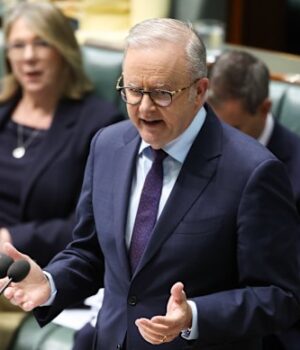
In his keynote speech on AI on July 15, Albanese signalled that Labor wanted to give local creatives control over whether their work was used.
“No company should use Australian books, music, art or news to build or train AI without the artist’s control. That includes the artist’s control of the price and value of their work,” he said. “Anything less is theft.”
Attorney-General Michelle Rowland’s department this month began consultations on copyright proposals to settle the deadlock.
One option, according to departmental documents released by Senator David Pocock, gives AI firms legal permission to use unprotected material from owners who have not formally opted out.
It follows plans within the proposed digital duty of care to allow adults to opt out of algorithmic social feeds, as the government seeks to regulate rather than block tech companies in Australia.
Firms would need to make payments to an organisation that would then distribute money to rights holders.
An alternative model would force tech companies to strike content deals with a minimum quota of Australian companies to receive legal rights to train on Australian content.
The document says a key objective of the proposals was to “uphold the prime minister’s commitment to a strong and vibrant Australian creative and media sector”.
On Tuesday, OpenAI said Australia would become the first country to host AI model training if copyright could be resolved.
Anthropic has offered similar suggestions and Deputy Prime Minister Richard Marles said in August that the investment window, which rests on the copyright negotiation, would run out in months rather than years because the technology was moving so fast.
“We are working at pace here,” Marles said on ABC’s 7.30 Report on Tuesday night, noting that “the opportunity for Australia economically is enormous” if the government can collaborate with the tech giants, but any deal needed “to come on terms which are in our national interest”.
Pocock, who has been arguing for a tax on AI firms, said he was deeply concerned by the proposals.
“It would mean putting companies’ interests over everyday Australians, giving AI companies access to all Australians’ content unless they opt out and they somehow put some sort of label on it to say, ‘please don’t use this for training’,” he said.
Shadow attorney-general Michaelia Cash described the opt-out proposal as “a text and data mining exception with an opt-out bolted on. It is precisely what the government said it had ruled out,” and demanded the government enforce existing laws and ensure deals were struck with all copyright holders.
The Coalition’s communications spokeswoman, Sarah Henderson, said: “This has all the hallmarks of a dirty deal to hand the intellectual property of Australian creators to global AI giants.”
Top AI execs this week called for a global slowdown in AI development due to safety fears. US President Donald Trump pushed back and said China, which is pushing for digital supremacy, would not slow down.
Prime Minister Anthony Albanese said on Tuesday that Abigail Bradshaw, of the Australian Signals Directorate, had raised the prospect of an “early warning system for advanced AI models” which would involve “companies working together with governments to identify and address AI immediately, rather than before it is too late.”
Cut through the noise of federal politics with news, views and expert analysis. Subscribers can sign up to our weekly Inside Politics newsletter.
 Paul Sakkal is Chief Political Correspondent. He previously covered Victorian politics and won a Walkley award and the 2025 Press Gallery Journalist of the Year. Contact him securely on Signal @paulsakkal.14.Connect via X or email.