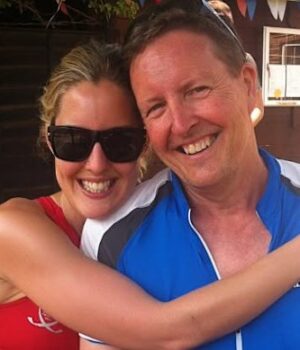
Source : the age
My older sister and I have a mental list of the places we’ve stood when she’s called to tell me, “Dad has cancer.” We’ve laughed about it, in the way you do when life has shown you so much darkness, and there is no other option.
The first time, I was a teenager at a theme park, queuing for a rollercoaster. Two years later, when it spectacularly recurred, I was on my way to a university lecture, while my sister was on a ferry. My dad had woken up unable to walk; a tumour had been discovered around the base of his spine.
We’re the lucky ones. After Dad endured years of gruelling chemo and a stem-cell transplant which, 20 years ago, was ground-breaking, our family has been gifted decades of “bonus” time, once unimaginable when his stage four non-Hodgkin’s lymphoma was first diagnosed.
Now 70, Dad has watched us get married and welcomed the birth of my three children. His three-monthly scans became six-monthly, then yearly – so normal, I stopped worrying about them at all. That is, until November 2025, when my sister and I added a new location to our list.
This time, I was standing in the clutter of my garage at 5am; with the time difference between the UK and Australia, I knew my dad would have received his scan results by then. As my kids slept, I had snuck out of the house and messaged my sister: “I’m ready.” I wasn’t ready, of course, even though I suspected what was coming.
On this occasion, there were two differences in our conversation: a “new” type of cancer – myelodysplastic syndrome (MDS), which can be caused by intense chemotherapy – and my actual geographic location.
Raised in the UK, I immigrated to Australia nearly 15 years ago. My sister lives a few hours’ drive from our parents’ home on the outskirts of London; I live 17,000 kilometres away, a 24-hour plane ride.
Our familial distance is increasingly common. According to the Australian Bureau of Statistics, 8.8 million people living in Australia were born overseas – 32 per cent of the population. That’s a lot of people living apart from their families.
Every immigrant has run the “cost analysis” in their head. In the NSW South Coast town where I’m based, I live the Aussie dream: surfing before school with my kids, writing in cafes by the beach, earning a wage that felt impossible in England.
But after a certain age, the downsides sharpen. In my 30s, expat friends started moving back to their home countries to raise their kids. In my 40s, British mates started buying one-way tickets back to be closer to ageing parents.
I’ve always known that, if my dad got sick again, moving back to the UK wasn’t an option.
And then there are people, like me, who stay.
As my dad’s news sank in, I found myself Googling “How to be a long-distance carer” at 2am – and discovering I’m far from the only one asking.
The question is: if you choose to stay in your “chosen” life while a loved one fights to survive, how do you help – without hating yourself for not doing more?
I’ve always known that, if my dad got sick again, moving back to the UK wasn’t an option. The socially acceptable reasons? My kids are settled at school; my surf-obsessed husband wouldn’t cope; the cost of living is lower here. But really, it’s because I’m scared of being too close – and I suspect my dad shares that fear.
In the past, proximity had been my coping mechanism. During our first rodeo with cancer, I wanted to do everything – to meet Dad’s little buddy in “chemo club”, to learn the alphabet of drugs he was taking, to disinfect every surface. Adrenaline and the novelty of fresh trauma carried me – until months became years.
Unlike my doting mum, who didn’t have the choice to leave, I did – and I needed to. I was “sick” in my own way, with an eating disorder that had become my coping mechanism. So, during a university summer break, I booked a flight to Sydney – a three-month trip that became a year, then a life choice.
Dad tried to ease my guilt: “It’s easier when I don’t have to worry about you, too.” Those well-meaning words became part of my identity.
Fast-forward to November 2025, and we both went through the motions again. “I can come back,” I messaged him. “It’s better you don’t,” he said, blaming his compromised immune system. “I won’t be able to see anyone anyway.”
Not for the first time, we made a pact: “I’ll see you on the other side.” At the end of this year, he’s scheduled for a bone marrow transplant: a perfect match, donated by a stranger in the US. If it “takes”, he’ll no longer be transfusion-dependent or immunocompromised, and he’ll be able to fly to Australia to see his daughter and grandchildren again.
We’d made a similar promise once before. When I left for my gap year, Dad was still learning to walk after his paralysis and on crutches at the airport. Before I went through the departure gates, he swore, “When you get back, I’m going to be standing on my own.” Twelve months later, he kept his word.
It’s proof that no decision is ever clear-cut – especially where life and death are concerned. Some will call my choice to stay in Australia selfish. I’ll admit it: there’s self-protection at play. But it also fits a dynamic my dad and I have danced with for decades.
Unlike my older sister, a scientist who works in medical trials, I don’t speak in facts; I speak in big feelings – and I know I can be a loose cannon because of it. I understand why, in the depths of healing, my dad doesn’t want his wildest child and her three young kids turning up on his doorstep.
The truth is, I have said goodbye to my dad a thousand times in big and small ways. However, that doesn’t erase the ache of being the absent one.
Right now, my dad is in the “honeymoon stage” of treatment, on a light kind of chemo. He chats to my kids on FaceTime and sends photos of his e-bike outings. That will change as he nears his transplant. We’ve been here before, and we remember it too well. Before he gets better, he’s guaranteed to get worse.
Of course, there are practical ways I can express care – letters from my kids, photos uploaded to his digital photo frame – but I know it can go deeper. And, so, I turned to an expert.
Casey Beros, author of Next of Kin: What to Expect When You’re Expecting to Care for Someone You Love, says the “do I stay, or do I go?” tug-of-war is common.
“I have complete strangers dropping into my DMs saying, ‘I’m based here but my parents are there, and I don’t know the right thing to do,’” she says. “I understand that angst. My first response is: there is no right decision.”
When her own dad was diagnosed with cancer in 2021, she “got straight on a plane” with her family, moving from Sydney to Perth until he died in 2023. But, as she points out, everyone’s circumstances differ. “It also depends on your context of grief,” she says. “This was my first experience with it. If you’ve walked through that fire before, it can be a different context.”
For long-distance carers, Beros offers three tiers of advice: harness technology, “support the supporter”, and realise that guilt is a wasted emotion.
“I recommend showing parents how to voice-note doctors’ appointments, especially when they’re high-stakes. Another role you can play from afar is being carer for the carer.” This can be as simple as a weekly text with a sibling, or a call with the other parent. “The patient is the star athlete and the carer is the coach – they need space to vent.”
Her final piece of advice may be the most pertinent: whatever you do, it might not feel like enough – so let yourself off the hook.
“I could not have juiced one more drop from the last year I spent with my dad, and it will still never feel like enough,” says Beros. “We all want a pure grief that doesn’t contain disappointment or remorse, but grief is messy. Anybody in this situation needs to ask: what can I live with?”
Get the best of Sunday Life magazine delivered to your inbox every Sunday morning. Sign up for our newsletter.