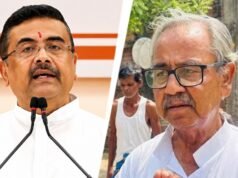
Source : INDIA TODAY NEWS
The Tamil Nadu Assembly has, for decades, witnessed intense political battles between the two Dravidian heavyweights, Dravida Munnetra Kazhagam (DMK) and All India Dravida Munnetra Kazhagam (AIADMK). In the new Assembly, the TVK government of CM C Joseph Vijay is facing dissent from a politician who doesn’t belong to the Dravidian giants and sits entirely alone.
M Bhojarajan, the Bharatiya Janata Party’s (BJP) lone MLA in the 234-member Tamil Nadu Assembly, emerged as the solitary voice opposing several key resolutions brought by Vijay’s TVK government during the ongoing Assembly session. While the principal opposition parties, the AIADMK and the DMK, backed the Vijay-led government’s positions on some of these contentious resolutions, the BJP’s Bhojarajan chose to stand apart.
advertisement
The 79-year-old MLA from Udhagamandalam constituency (the seat in and around the hill station, Ooty) has opposed the state government’s resolutions seeking the scrapping of NEET, withdrawal of the Foreign Contribution (Regulation) Amendment Bill, 2026, and opposed the proposed delimitation exercise. On these issues, the BJP’s position has effectively been represented by one man inside the House.
That makes Bhojarajan’s role unusual in a legislature. The 17th Tamil Nadu Assembly has 108 TVK MLAs, while the DMK has 59 and the AIADMK has 47. The BJP, which had four MLAs in the outgoing House, has been reduced to just one — Bhojarajan.
Yet, despite his numerical disadvantage, Bhojarajan has used the Assembly floor to put forward positions that differ from the broad consensus emerging among the larger parties in the state and their stand on the BJP’s policies.
WHO IS M BHOJARAJAN, THE ONLY BJP MLA IN DRAVIDIAN TAMIL NADU
Bhojarajan, born in 1946, is currently the senior-most member of the 17th Assembly by age. He hails from the Nilgiris and has a long association with the region’s tea economy. His professional identity is a combination of agriculture, business and law. He has worked as a planter and advocate and has been associated with tea estates and tea-related businesses in the Nilgiris region of northwestern Tamil Nadu.
Bhojarajan’s educational background is diverse. He studied at Government Arts College in Ooty before pursuing law at Madras Law College and a diploma in criminology from Madras Medical College.
Bhojarajan had earlier links with the Congress and was reportedly considered for a Lok Sabha ticket from the Nilgiris decades ago. He later entered the BJP around 2014 and contested the Udhagamandalam Assembly seat in 2021. He lost that election to Congress’s R Ganesh by 5,348 votes. Five years later, the political equation changed and Bhojarajan became the only BJP MLA to win in Tamil Nadu with a thin margin of 976 votes.
BHOJARAJAN’S DISSENT IN THE FORM OF WALKOUTS FROM THE HOUSE
The first major instance of Bhojarajan’s dissent in the Tamil Nadu Assembly came over NEET. The Vijay government moved a resolution urging the Centre to scrap the all India level test that provides entry to government medical colleges and allow undergraduate medical admissions in Tamil Nadu on the basis of Class 12 marks. Bhojarajan opposed the move.
His argument was different from the government’s. Rather than seeing NEET only as a barrier for Tamil Nadu students, he argued that the examination could create opportunities for students from the state and pointed to students from far-off places such as Pollachi who had cleared the test. His alternative was for the state to strengthen coaching facilities rather than demand the examination’s abolition.
After the speech, Bhojarajan walked out of the House, leaving the resolution to be passed with broad support from the ruling side as well as the major opposition parties.
The same pattern appeared over a resolution on the Foreign Contribution (Regulation) Amendment Bill, 2026.
The state government sought the Centre’s withdrawal of the legislation in its present form, arguing that it could have implications for charitable, minority-run educational and social-welfare institutions. Bhojarajan defended the Centre’s position, arguing that regulation of foreign contributions was intended to prevent misuse and ensure accountability.
The ruling TVK and major opposition parties backed the government’s resolution, which was subsequently passed. Bhojarajan opposed the move.
Then came delimitation, an issue with much larger political consequences for Tamil Nadu.
DELIMITATION: WHERE BHOJARAJAN BROKE WITH THE HOUSE
The resolution moved by the TVK government sought to protect the existing distribution of Lok Sabha seats among states by freezing the present 543-seat strength and retaining the current inter-state allocation ratio. It also sought to ensure that the proposed 33% reservation for women from 2029 would be implemented using the existing constituencies.
For the TVK and the Dravidian parties, there’s a political anxiety. They fear that the delimitation based substantially on population could reduce their relative representation because they have done better than many northern states in population control.
Vijay’s government positioned the resolution as a defence of Tamil Nadu’s political representation in the Parliament. The BJP’s Bhojarajan once again did not agree.
He argued that delimitation could not simply be opposed because it involved a change in representation. Population growth and the need for more effective representation, he suggested, had to be considered. He also rejected the framing of the issue as a straightforward North-South confrontation.
That put him against another broad political consensus in the Assembly full of MLAs of the TVK, the DMK, the AIADMK, and other allied parties.
LONE BJP MLA IS NOT A PERMANENT DISSENTER
The interesting part of Bhojarajan’s politics is not simply that he opposes the Vijay government. The larger opposition parties do that regularly. The distinction is that on these particular issues, the conventional lines of opposition have blurred in Tamil Nadu.
Tamil Nadu’s political history has long been shaped by battles between the DMK and AIADMK and, increasingly, by the BJP’s attempt to expand its footprint in the state. But the arrival of Vijay and TVK has disrupted that familiar arrangement. Vijay became chief minister in May after TVK emerged as the single biggest party and secured support from allies including the Congress, Left parties and T Thirumavalavan-led VCK.
In the new configuration, Bhojarajan’s dissent acquires a different meaning.
On NEET, the BJP MLA’s position is closer to the Centre’s approach than that of most parties in Tamil Nadu. On the FCRA amendment, he defended the principle of tighter regulation of foreign contributions while the state government sought its withdrawal. On delimitation, he refused to endorse the argument that the Tamil Nadu government should oppose the exercise to protect its existing parliamentary weight.
They are questions that touch directly on the BJP’s national political position. And because the BJP has only one MLA in the House, Bhojarajan is effectively the legislative face of that position in Tamil Nadu.
But, Bhojarajan can’t be reduced a permanent dissenter in the Tamil Nadu Assembly.
He did not oppose the resolution making the state song Tamil Thai Vazhthu mandatory at the beginning of official functions. It was adopted with broad support across parties, including the BJP. Nor did Bhojarajan mount an outright challenge to the government during its confidence vote in May. He abstained.
Tamil Thaai Vazhthu is Tamil Nadu’s official state song, now mandatory as the first song at government events and official programmes.
Bhojarajan’s politics inside the Assembly is not simply about saying “no” to Vijay. It is about choosing when to dissent and on some of the biggest ideological and constitutional questions before the House, his answer has been different from that of almost everyone sitting around him.
– Ends
SOURCE :- TIMES OF INDIA