Source : the age
If this year has made anything clear, it’s that we love “nuisance” animals.
When Neil, the elephant seal, visited Seven Mile Beach near Hobart, thousands of people flocked to see him, including interstate travellers. When Jimothy, an abnormally round raccoon, was spotted zipping around the suburban streets of Seattle, he became an unofficial mascot for the local baseball team. And when the filmmakers of A24’s documentary Nuisance Bear arrived in Manitoba, they found themselves filming alongside legions of tourists, all desperately hoping to capture footage of the region’s migrating polar bears.
But as adorable, funny or downright strange as it may be to see these wild animals encroaching on “human” spaces, Canadian filmmakers Jack Weisman and Gabriela Osio Vanden discovered there’s something more insidious going on beneath the surface.
“The more famous an animal gets, the more likely it’s going to die because there are just too many people harassing it,” says Weisman, co-directer of Nuisance Bear. “It will become too comfortable with humans, and then it will cross that line. It’s always the animal that loses.”
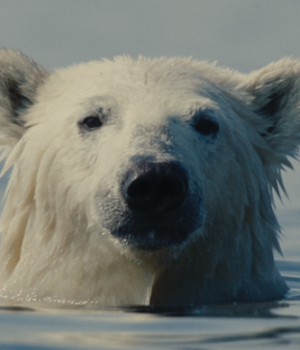
He encountered this harsh reality when filming Nuisance Bear, a 10-year project that won the Grand Jury Prize for US Documentary at Sundance, and is now screening at the Melbourne International Film Festival. Shot in Churchill, Manitoba – the “polar bear capital of the world” – and the nearby Inuit community of Arviat, the film explores the uneasy coexistence between humans and migrating polar bears, as climate change delays the seasonal freezing of Hudson Bay.
Just like Neil and Jimothy, the Manitoba polar bears attract major attention as they meander through populated towns. However, the documentary demonstrates how general wildlife appreciation can transform into spectacle, putting both ourselves and the animals at risk.
It goes beyond our actions – even our perception of wildlife is flawed. When picturing polar bears, most envision the pristine arctic, areas untouched by humans. But Weisman says this is a colonial idea used to push Indigenous people off the land.
“Before colonisation, there were nomadic people moving all around. There were always people interacting with animals everywhere, and so it’s a newer idea that there’s this separation between ourselves and the wilderness.”
It’s largely because of this constructed distinction that we’re so fascinated with “nuisance” animals. They appear mysterious and “other”, Osio Vanden says, and therefore something people want to immortalise on camera.
This, however, can transform into harassment or habituate animals to human spaces.
“On one hand, I love seeing [Jimothy] emerge from the woods and show that not all raccoons look the same,” Osio Vanden says. “Witnessing animals’ survival abilities is very inspiring. But all these things are a double-edged sword.”
Take Neil the seal, who, according to the Department of Natural Resources and Environment, racked up a damage bill of $45,674 thanks to his bollard-smashing and traffic-cone crunching antics. Meanwhile, some US wildlife officials have expressed concern over Jimothy fans desperately seeking selfies with the raccoon (who is believed to have a disorder called short spine syndrome) since this could disrupt his natural behaviours.
The irony, Weisman says, is that these “pest” animals are actually more like us than we realise. The ingenuity required to survive alongside humans and thwart our efforts to drive them away rivals only our own. We may not look like a 1000-kilogram seal, and we may not love rubbish as much as Jimothy, but Weisman believes they still trigger deep reflection about how we live on the land and take up space.
So, who is the real nuisance? It’s certainly not the animals, Osio Vanden says.
“The bear in our film is constantly being pestered by crackers and cars when it’s just trying to go along its migration path. I imagine for most animals trying to navigate a human world, it’s super complex … We’re always thinking about how these things affect us, but how do we affect them? We’re a huge problem for ourselves and for all the living things we share this planet with.”
Nuisance Bear doesn’t point a finger at anyone in particular. While the Indigenous and non-Indigenous communities differ in their approach – the former generally support sustainable polar bear hunting while the latter tend to capture and relocate – the documentary doesn’t “pick a side”, other than, perhaps, the bear’s.
Ultimately, Weisman hopes audiences never look at “nuisance” animals the same way.
“When engaging with wildlife, they’re not just a spectacle. They look back at us. They’re affected by our behaviour. They’re sensitive – much more sensitive than humans are. We like to think that animals are not as intelligent as us because it justifies our cruelty. I just hope that people will look at ‘nuisance’ animals in a more nuanced and deep way.”
Nuisance Bear will screen as part of MIFF on August 15 and 17.
Must-see movies, interviews and all the latest from the world of film delivered to your inbox. Sign up for our Screening Room newsletter.
 Nell Geraets is a Culture reporter at The Age and The Sydney Morning Herald.Connect via X or email.