SOURCE :- THE AGE NEWS
Agrigento: Domenico Rizzo, a baker in Sicily, long sweated out the heat. Through years of stifling Italian summers, Rizzo, 40, refused to install air-conditioning units in his bakery, fearing the cold air would make his muscles ache.
Three years ago, he finally surrendered, setting up one wall-mounted air-conditioner in the bakery, using the unit mainly to dehumidify the store rather than to cool it. (Air-conditioning, he said, dried out the bread.)
At home, he has also succumbed to the necessity of air-conditioning at night to cool down after a day pulling bread rolls and loaves out of ovens. Rizzo complains that the air “hurts my shoulders, my neck, and I have all kinds of cramps”.
But, he added, “How can you live without it?”
For generations, Italians shunned air-conditioning as a threat to their health, amid scientific research that found people who lived in air-conditioned environments reported more respiratory problems than those who didn’t. Many Italians shared the belief that a “colpo d’aria”, or “blast of air”, could give you a crick in the neck, tonsillitis, headaches, muscle cramps and all kinds of respiratory ailments.
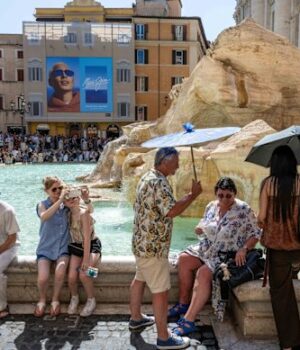
But with the country experiencing steadily rising temperatures – August was Italy’s hottest on record, according to the National Research Council, and scorching heat continued into September – an increasing number of Italians are adopting artificial cooling, even if they are convinced that such systems make them unwell.
The percentage of households in Italy that have installed air-conditioning grew to 56 per cent in 2024, the last year for which data is available, from just under 30 per cent in 2013, according to government statistics. During that time, Italy’s average August temperature rose more than 10 per cent, and the amount of energy Italian households used for air-cooling rose faster than in most other European countries.
In Sicily, the rise has been even steeper than the national average. About three out of four Sicilian households have installed air-conditioning units, up from roughly one in three in 2013.
The brutal reality of unstinting heat waves has forced a cultural shift in a country where home owners usually weather the summer sun with open windows and fans, diners prefer to eat outside even in the hottest months, and doctors advise patients to avoid getting too close to chilled air.
In Agrigento, a hilltop town in Sicily known for its temple ruins, rectangular air-conditioning boxes dot the walls of buildings.
Many residents, like Rizzo, are still begrudging of their acceptance.
Emilia Pisciotto, a beachside-bar owner, grew up without air-conditioning, and she said she still didn’t like it. When her husband turned the unit on at home, the air gave her a headache and stuffed up her sinuses, she said. But Pisciotto has to admit that as temperatures have skyrocketed, she needs it.
In times gone by, “We were used to the heat”, said Pisciotto, 65, sitting outside her bar as a warm sea breeze blew across the terrace. “But this is exceptional. For a few years, we just haven’t been able to breathe.”
There is medical science to back up the long-standing Italian gripes about air-conditioning. According to Giovanni Leoni, vice president of the National Federation of the Orders of Medical Doctors and Dentists, air-conditioning can dry out sinuses, causing sore throats, runny noses or headaches. Moving quickly from the hot outdoors to the extremely cold indoors, Leoni said, could induce muscle cramps.
The key, he said, was to keep rooms to about 25.5 degrees Celsius, and to avoid sitting too long or sleeping close to direct blasts of chilled air. As long as people used air-conditioning “correctly and in moderation”, Leoni added, “it’s essential these days”.
In the United States, people had long been more tolerant of the trade-off between the risks and benefits of air-conditioning, said Brad J. Uren, an associate professor of emergency medicine at the University of Michigan.
Air-conditioning might dry out the eyes, nose, throat, mouth and skin, Uren said, “but you consider the effects of heat-related illness and heatstroke, and that is deadly”.
The rise in air-conditioning in Italy also reflects the units’ increasing affordability.
“It used to be a luxury product,” said Vincenzo Principato, 52, owner of an electronics shop in Agrigento. Now, an influx of Chinese-made units has helped to lower the average cost of a fuel-efficient air-conditioner to less than $US350 ($485), Principato said – from the equivalent of $US1800 two decades ago.
“We were used to the heat. But this is exceptional. For a few years, we just haven’t been able to breathe.”
Emilia Pisciotto, a beachside-bar owner
Luigi Gabriele, president of Consumerismo No Profit, a non-profit that lobbies for consumer rights, said: “Anywhere in Italy, you grab an air-conditioner, plug it in, connect the hoses, and you’re off.”
“You can even buy them at the supermarket,” he added.
Although air-conditioning units have become cheaper, their broader usage has driven up average summer utility bills for consumers.
Italian households spent an average of nearly $US525 ($730) from late spring to the end of August on energy bills, up 25 per cent from 2021, according to data from the Italian Association of Utility Managers, a trade group. That surge was partly driven by higher electricity prices caused by the war in Iran – but Federico Bevilacqua, president of the association, said the higher bills were also clearly “a consequence of this scorching heat”.
To rein in electricity bills, most hotels and temporary rental owners in Agrigento had installed card-key systems that automatically turned off lights and air-conditioning when a guest left, said Michele Sodano, Agrigento’s mayor.
Air-conditioning also has a cost for the environment, energy and climate experts say: cooling units not only tax electricity grids but lead to more carbon emissions, which in turn can fuel more extreme weather.
Air-conditioning was a classic example of “maladaptation, where you adapt to the changing climate by essentially using a solution that increases the problem in the first place”, said Steven Bland, an urban expert at the World Resources Institute, a think tank in London that focuses on climate issues.
Cities and regions could lessen the need for air-conditioning by building with better insulation or planting trees in nearby streets, said Stéphane Quefelec, an energy expert with the European Environment Agency, a body run by the European Union. “The more you cool down the environment around the buildings, the less you need energy to cool inside the building,” he said.
Sodano, Agrigento’s mayor, said he hoped to plant 10,000 trees and install solar panels on top of public buildings in the city, including schools.
For now, a few air-conditioning holdouts remain in Agrigento.
Patrizia Prado, owner of a gallery filled mostly with her own artistic creations, said that she did not believe in air-conditioning for anything other than some hospital wards or people with heart issues.
Standing behind a table in her palpably stuffy shop, she said most people relied on artificial cooling “not because of a need, but because it’s convenient”. Air-conditioning, she added, was just “a habit that’s been formed”.
Instead of using cooling systems, she suggested that people should wear natural fibres, sweat out their toxins and enjoy “the flow of natural air”.
This article originally appeared in The New York Times.
Get a note directly from our foreign correspondents on what’s making headlines around the world. Sign up for our weekly What in the World newsletter.