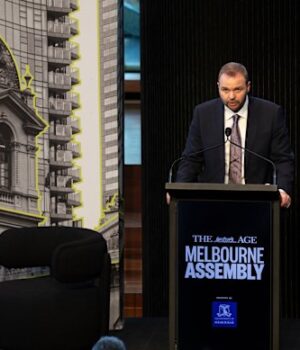
Source : the age
Thank you for joining our live coverage of the opening night of Melbourne Assembly, hosted by The Age and the University of Melbourne.
We heard thought-provoking ideas about our city’s future from the panel members. Here’s a breakdown of tonight’s highlights:
- World-leading urbanist, Professor Carlos Moreno, argued the concept of a 15-minute city was “absolutely possible” for Melbourne, as it hurtles towards a population of 9 million people by 2050. He cited climate change, loss of biodiversity and economic poverty as key challenges making cities harder for people to live in and navigate.
- Former New York City mayor Bill de Blasio declared the US was going through a “great American identity crisis”. He said police should their jobs in tandem with local communities to keep people safer.
- New University of Melbourne vice chancellor Carolyn Evans laid out her agenda as university leader in one of her first public speeches since her appointment. She described the federal government’s efforts to reduce the number of international student arrivals as “arrogant and short-sighted”, while calling for more funding towards research and development.
- De Blasio said leaders must significantly invest in social services and public infrastructure to reduce rates of street homelessness, warning it was “corrosive” to a city’s social fabric. He said higher and denser housing options were the answer to unaffordability challenges facing everyday people.
Our photographer Jason South is at The Edge at Fed Square, photographing the opening night of Melbourne Assembly. Take a look at his pictures below.
Melbourne Assembly continues over two full days from tomorrow.
On Tuesday, we will hear about two of the conference’s key pillars – shaping the city and innovation and education.
In the morning session, former New York City mayor Bill de Blasio will deliver a keynote address, followed by a Q&A session with The Age’s city editor Cara Waters.
Prime Minister Anthony Albanese will then address the conference.
Thank you for joining our live coverage of the opening night of Melbourne Assembly, hosted by The Age and the University of Melbourne.
We heard thought-provoking ideas about our city’s future from the panel members. Here’s a breakdown of tonight’s highlights:
- World-leading urbanist, Professor Carlos Moreno, argued the concept of a 15-minute city was “absolutely possible” for Melbourne, as it hurtles towards a population of 9 million people by 2050. He cited climate change, loss of biodiversity and economic poverty as key challenges making cities harder for people to live in and navigate.
- Former New York City mayor Bill de Blasio declared the US was going through a “great American identity crisis”. He said police should their jobs in tandem with local communities to keep people safer.
- New University of Melbourne vice chancellor Carolyn Evans laid out her agenda as university leader in one of her first public speeches since her appointment. She described the federal government’s efforts to reduce the number of international student arrivals as “arrogant and short-sighted”, while calling for more funding towards research and development.
- De Blasio said leaders must significantly invest in social services and public infrastructure to reduce rates of street homelessness, warning it was “corrosive” to a city’s social fabric. He said higher and denser housing options were the answer to unaffordability challenges facing everyday people.
After a lively and varied discussion, the panel members were asked to offer some final thoughts.
University of Melbourne vice chancellor Carolyn Evans envisions a future where everybody feels like they have the opportunity to succeed.
Evans says she wants to see Melbourne attract the “best across the world”, where divisions between the “haves” and “have nots” no longer exist.
Former New York City mayor Bill de Blasio points to the elephant in the room – artificial intelligence – which he warns poses the risk of “immense dislocation” due to its “equal opportunity” impact on employment.
Professor Carlos Moreno stresses the critical importance of the “AI of the present time”, adaptive intelligence, which includes issues such as climate change and economic inequality.
Victorian affairs editor Annika Smethurst asked our panellists what Melbourne could achieve by 2046 and to identify one mistake it could not afford to make.
Watch what John Harnden, Carolyn Evans, Bill de Blasio and Carlos Moreno said.
Former New York City mayor Bill De Blasio says leaders must significantly invest in social services and public infrastructure to reduce rates of street homelessness, warning it is “corrosive” to a city’s social fabric.
Likening the number of people seen living in the streets as a “powerful mirror”, De Blasio used New York City as a caution for the state of Victoria, which is dealing with its own homelessness crisis.
He said investing in mental health services was difficult and timely, but critical to improving a city’s health and wellbeing, as well as incarceration rates.
He pointed to the benefits of telehealth as one of the most powerful tools in addressing a society’s mental health.
“There are so many positive impacts. I’d say it’s one of the areas where you get the most impact for the dollars spent,” de Blasio says.
Watch the panel discussion on the future of public spaces below.
Professor Carolyn Evans described the federal government’s efforts to reduce the number of international student arrivals as “arrogant and short-sighted.”
The Albanese government has pledged to curb net migration by reducing visas for family members of students, while the Coalition plans to reduce the share of international students in universities to below 25 per cent of total enrolments.
Evans, who is participating in a Q&A session alongside Bill de Blasio, Carlos Moreno, and chief executive of Melbourne Park John Harnden, said she was “very concerned” about the policy while raising alerts about underfunding.
“We’ve seen governments successively divest from investment in higher education for domestic students – they’ve shifted more of the cost onto students, leading to greater inequality and less access to higher education for those from low socioeconomic, regional, Indigenous backgrounds,” she said.
Victorian affairs editor Annika Smethurst led a conversation with former New York City mayor Bill de Blasio and world-leading urbanist Carlos Moreno. Watch a video of the full session below.
Professor Moreno, who lives and works in France, argues a failure to facilitate a democratic dialogue between citizens struggling with a reduced quality of life and governments represents a failure in Western societies today.
He points to widespread student protests across France, that have resulted in rioting and violence, saying the absence of the government listening to its citizens creates difficulties for having a “real democracy.”