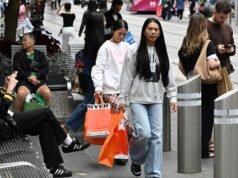


Source : Perth Now news
Labor and the coalition continue to blame each other for Australia’s migration rates.
Yet only a few years ago, both parties were pushing in the same direction.
In 2022, Labor was introducing measures to attract more migrants, while the coalition argued the government was moving too slowly to bring them in.
Such context is missing in recent rhetoric from both sides, including immigration minister Tony Burke speaking in parliament on May 25, 2026.
“Those opposite seem reluctant to acknowledge that, when the [net overseas migration] peak occurred, every single one of the settings were the settings they had left in place when the peak occurred,” Mr Burke said.
When asked for evidence for this claim, Mr Burke’s office pointed AAP FactCheck to Australian Bureau of Statistics (ABS) data showing Net Overseas Migration (NOM) peaked at 555,800 in the 12 months to September 2023.
In contrast, AAP FactCheck has debunked several similar claims from the coalition, laying blame for migration rates at Labor’s door.
But the current rhetoric is at odds with what both parties were saying when Labor came to power in 2022, amid concerns of a worker shortage during the COVID-19 pandemic.
Contrary to Mr Burke’s comments in parliament, several Labor policies were unveiled to encourage migration in September 2022.
That included lifting the permanent migration planning level, which sets the number of permanent visas the government plans to approve, raising it from 160,000 to 195,000 for 2022/23.
A government summary of the decision said the increase was focused on attracting migrants from outside the country to “help ease widespread, critical skills and workforce shortages”.
In 2023/24, the planning level was slightly reduced to 190,000, but remained significantly higher than the 160,000 places in 2021/22 under the coalition government.
The Albanese government also extended post-study work rights for international students and provided additional funding to resolve a visa backlog.
This policy came into effect on July 1, 2023, and ended in mid-2024.
In October 2022, the Albanese government also set and later achieved a goal of increasing the number of Pacific migrant workers by 10,600 by June 2023.
Official figures show 45 per cent of those on the scheme in September 2023 were long-term workers and would likely contribute to net overseas migration.
At the time, Labor ministers did not shy away from stating the intention of these policies was to increase the number of migrants.
One press release said the increase in permanent visas available was designed to address a severe worker shortage.
“The Albanese Government is committed to re-establishing immigration as a nation-building function of Government, in order to realise our full potential as a reconciled nation that harnesses its diversity,” then-immigration minister Andrew Giles said.
The coalition did criticise the Albanese government at the time, not because it was trying to bring more people in, but because it wasn’t acting fast enough to do so.
After the Albanese government announced policies to encourage migrants in September 2022, then coalition leader Peter Dutton said it was “too little, too late”.
“This is a decision that should have been made 100 days ago… we do need an increase in the migration numbers, but we’ll see what the government actually delivers,” Mr Dutton said.
“Because this can be many, many months if not a couple of years in the pipeline.”
Experts told AAP FactCheck that some policy settings introduced by Labor contributed to the migration peak.
However, they said those measures played only a minor role.
Peter McDonald, an emeritus professor in demography at ANU, said Labor’s increase to the permanent migration program would have increased NOM by about 26,000.
“This is a small increase, but it is an increase,” Professor McDonald said.
He said the surge didn’t occur because of coalition policies either, explaining that it was driven by a backlog of migrants created by pandemic border closures.
Abul Rizvi, a former deputy secretary of the government’s immigration department, has a different view, saying coalition policies did play a key role in the migration surge.
That included introducing unrestricted work rights for student visa holders, waiving visa application fees for international students and working holiday makers and introducing new temporary visas.
In contrast, Labor’s decision to increase the number of permanent visas available under the migration program had a “minimal impact”, Mr Rizvi said.
“Burke is around 90 per cent correct, but not 100 per cent in terms of the NOM level in 2022/23,” he added.
Both noted that the NOM outcome in 2022/23 and after was also influenced by the timing of subsequent Labor policies to reduce migration.
Prof McDonald said that a coalition-era pandemic event visa that allowed temporary migrants to stay in Australia while the border was closed remained open after the pandemic was “well and truly over”.
More than 200,000 of these visas were granted between June 2022 and March 2024, according to an October 2024 report in The Australian.
“The vast majority of these visa hoppers were already resident in Australia and so did not contribute to NOM arrivals,” Prof McDonald said.
“But if they had not been able to visa hop, many would have left Australia, which would have reduced NOM.”