
Source : the age
I arrive early at the Tropicana Caffe in Darlinghurst, but Richard Glover has got there first and is sitting smiling to himself in a corner booth, the happiest man in the room.
Glover explains that he is coming up for air after a year of “archive fever”. “The historian Clare Wright talks about the term. I’ve been able to spend a year, often in the state library, with the manuscripts and the books and the fever of ‘I’ve got to find this document’.”
Glover’s latest book, How to Ruin a Child, is the fruit of these monastic labours – a moving and often very funny examination of child-rearing in Australia, from the early days of absurd discipline to today’s mad mix of helicopter caregiving and internet-driven parenting fads.
After 26 years of live radio, Glover left the ABC in 2024, and for the first time has been able to plunge wholeheartedly into a project.
“There’s something wonderful about having the time to do research,” he says. “My other books were written by diving into the library for two hours and then going into work at 11 o’clock.”
He describes the thrill of uncovering century-old teaching notes, beautifully handwritten in copperplate, that shed light on the early thoughts of education researchers.
The biggest revelation, though, was that hardly any of the parenting experts had the faintest idea what they were doing.
“It is incredible how mad the ideas were,” he says. “Absolutely mad. The common thread, of course, was that hardly any of the experts actually had kids.
“The advice was very explicit – don’t cuddle. If they cry it is an exercise for their lungs, if you do cuddle them when they’re crying, it’s their first lesson in self-indulgence and they will become spoilt little tyrants.”
The conversation flows – with a one-year-old and a five-year-old at home, I’m all ears – and we forget to order.
But as the lunchtime buzz begins to grow, the waiter begins hovering and I pick up the menu and, given that we’re talking about kids, randomly ask for a banana milkshake.
“Oh well, if we’re in that territory,” Glover says, lighting up. “Wonderful. I’ll have a caramel milkshake, please. I haven’t had one in years. Yes, please.”
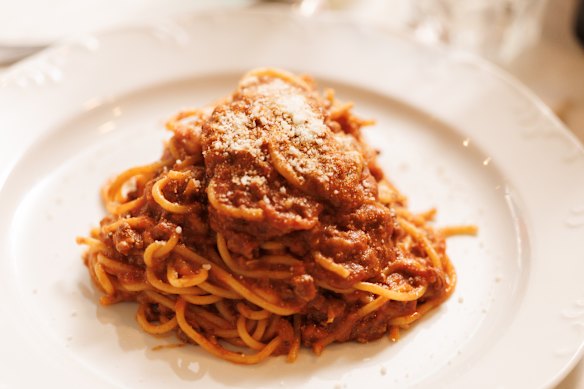
Glover opts for the pasta con gamberi as a main – malfadine pasta with king prawns, chilli, garlic white wine and tomato sugo – and I order the bolognese, a delicious braised beef ragu with tomato and parmagiano-reggiano, and we split a bruschetta entree.
Tropicana is a cheerful Darlo institution – Tropfest film festival was founded here, and at one stage it reportedly had an internal alarm that warned patrons when a parking inspector was lurking nearby – and the food is wholesome, fresh and fun.
As the bruschetta rapidly vanishes, Glover explains why he chose the venue.
“One of the things about this place is that it’s the last place I had lunch with James Valentine. I was driving him to the hospital and we stopped off here and had lunch. It was the last time we were really able to have a conversation.”


Mafaldine pasta, king prawns, chilli, garlic, white wine and tomato sugo.Oscar Colman
Valentine, the late ABC presenter and musician, died in April and Glover was among those who spoke at his memorial in Sydney Town Hall.
“He was the great piece of luck in my professional life,” Glover says. “I think we shared an ethos, an idea that people are important in themselves. That the little detritus of everyday life is worth recording. I’ve always felt this, and I think James was the same.
“Everything isn’t about geopolitics and gas supplies. That an argument about how you stack the dishwasher and the way that people talk about their partners and their children and their dogs is the reason why everything else is important, in a way. The idea that this isn’t important is wrong. It’s worth recording and it’s worth celebrating because it says that human life is important in itself.”
It’s a feeling that has shaped Glover’s writing, and especially the Saturday columns in the Herald through which generations of readers have followed the whimsical exploits of Glover, his long-suffering partner, Jocasta – writer Debra Oswald – their children, Batboy and Space Cadet, and the family pets.
“It’s a challenge to burrow down into everyday life, and it’s a challenge to be funny sometimes. A lot of things hammer on the door and demand to be listened to. But I always aspire to being funny, or try to.”
A cadetship at the Herald in 1983 trained Glover to write “straight” journalism, but he says he often felt drawn to documenting the lighter, less newsworthy, but often more rewarding side of life.
“You had to fight quite hard to get in the paper,” he says. “There was a thing called ‘news hold’, which was full of my stories.”
Glover rose to be a senior editor and a foreign correspondent at the paper, and carried his taste for everyday whimsy with him.
“There’s the view that journalism is printing what someone doesn’t want printed, and that’s true. But we need to give people, readers and viewers, an accurate sense of reality. That will include the politics and crime and corruption, but it will also include the everyday, the ordinary – the refugee soccer coach giving his time free to coach the team. I think I always had that view that you needed to work harder at that side of things.”
The humour writing bug bit him early.
“When I was about 11, I remember coming across Patrick Dennis’ novel Auntie Mame. It was the first properly funny book I’d ever read. And I was just captivated by this idea that printed words on a page, these little squiggles of ink, could actually trigger physical reactions from the reader and make you laugh out loud. What an amazing alchemy that was,” he says, while polishing off the milkshake.
“I remember at the same time reading an Alistair MacLean thriller, and I’d got about 300 pages in and the plot was building up to who did it and what’s going to happen, and I remember just thinking ‘I don’t care’, and throwing it on the ground.
“I think from a fairly early age I was just trying to trick a reader into laughter.
“But it translates across, of course, beyond comedy. It’s this weird thing with writing. Tolstoy has a great eye for human behaviour. This ink, mechanically placed on a page, can cause you to well up with emotion for someone you don’t know and don’t even like that much, a Russian aristocrat from a different time, yet here you are, choking up with emotion. Wonderful.”
The impulse to begin How to Ruin a Child came from Glover’s own upbringing which, in his words, “wasn’t great”.
Even in later life, there was a coldness and distance that at times felt almost comical. In the book he describes the scene when he brought his sons to visit his mother and her fear of children’s germs was so extreme that the boys sat back-to-back on a small plastic pouffe in the middle of a sheet spread on the ground to prevent the spread of their imagined contagion.
Glover had assumed that his parent’s attitudes were uniquely strange, and they do appear odd in the book, but his research showed that a lot of what happened was not just commonplace but officially sanctioned and promoted by governments.

“You read it and think, ‘Well where do these crazy ideas come from?’ And the answer is – from the government’s own booklets,” he says.
“They vary a little bit, but they do say that toilet training should start, some of them say, at two days of age. The more liberal ones say three weeks, and it should be completed in the first year. You wouldn’t want to be doing the laundry in that household.
“The uniform idea was you mustn’t praise them, you mustn’t spoil them. This was the official advice to thousands of mothers in NSW, Victoria and elsewhere every year.”
A common thread from Federation right through to the 1970s was that authorities from hospital staff to the government itself recommended distance and coolness between mums and their babies.
In 1974, the Gough Whitlam government commissioned a grandly titled Royal Commission on Human Relationships in an effort to understand and modernise family planning, parenting and the roles of women.
As well as medical experts, thousands of members of the general public shared their experiences, and Glover combed through all of them as he researched the book.
“Some of it made me angry,” he says. “There were a lot of times doing the research when I became quite choked up. I get angry at [experts], and at their certainty. Just the image of the baby in the room crying, and the mother crying on the other side of the door because it’s five to six and she’s been told she can’t go in and feed the baby until 6pm.”
Standard parenting advice remained remarkably harsh by contemporary Australian standards until about 1980, when the dams broke and the opposite extremes began to spill through in advice given to parents.
Suddenly, it was perfectly OK for young children to sleep in the parental bed, feed on demand and be showered with attention and affection.
“That goes along for a while, and then you do get this backlash in the late ’90s,” Glover continues. “And it’s a strange backlash because on the one hand you get people on the left who think this intensive parenting is turning women into slaves, and then people on the right, who have influence from evangelical Christianity, who think this parenting is permissive and is breaking the relationship they want children to have with Godly good behaviour.

“And that’s where we are now, right in the middle of a culture war.”
So what are young parents to do when everyone’s telling them that they’re doing it wrong?
“Once you see all this mad parenting advice from the past, you realise all these parenting ideas on the internet now have already been tried before, usually in about 1920, and found wanting,” he says.
“I think one of the conclusions of the book is that parenting is always difficult, and this idea that you can make it easier by being a disciplinarian just don’t work. They’ve all been tried. You don’t smack your way to peace.
“All these experts are so certain of themselves, and the language is so extreme and the outcomes are so dire.
“Yet most parenting happens somewhere in the middle, and the outcomes are usually a great human being. So parents can take great comfort in that.
“Most parents understand what children want. They want a system of reliable rules in which they feel comfortable, and they want a lot of love.”
Just ask Batboy and Space Cadet.
How to Ruin a Child by Richard Glover is out on September 29.