

Source : Perth Now news
Rescuers in Nepal are racing against time to reach hundreds of workers feared trapped inside massive hydropower tunnels as the scale of the catastrophic flooding across the Himalayan region continues to grow.
More than 950 people have now been killed across Nepal and China, while more than 4,400 remain missing, including 43 Australians whose whereabouts remain unknown.
In Nepal, attention has turned to hydropower projects devastated by the flash floods, with a private-sector association representing power companies reporting at least 900 workers remain unaccounted for across 12 sites in the Rasuwa and Nuwakot districts.
About 500 of those workers are believed to be trapped underground in tunnels used to control the flow of water.
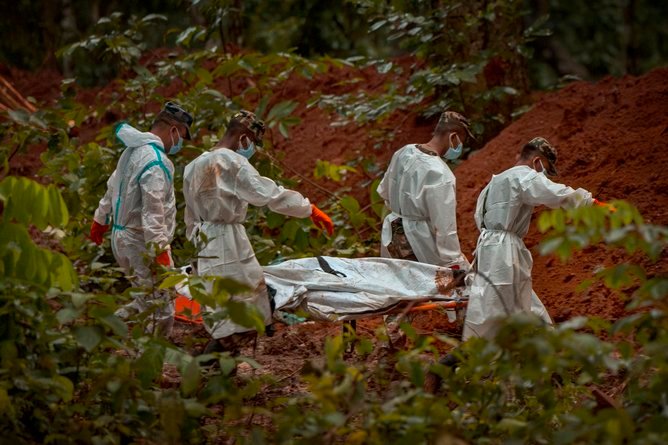
Four bodies have now been recovered from three mud-filled tunnels, according to Nepal’s army, as rescuers desperately try to reach those who could still be alive.
NSW man Michael Keats has become the first Australian confirmed to have lost his life in Nepal’s flash flood disaster.
He was travelling to India for a spiritual retreat, according to his heartbroken family, which is now asking for support.
His partner Emily Boyd posted a grim update to her GoFundMe, confirming the worst on Monday evening.
“My partner, Michael, was tragically killed in the devastating floods in Nepal,” Ms Boyd posted.
“Michael was my partner and an incredibly important part of our family. He was also my young son’s stepfather, although he was the only father he has ever known. His loss has changed everything for both of us.”
In her crowdfunding post, Ms Boyd said she was asking for funds to travel to India with the couple’s son to engage in a spiritual ritual to honour the South Coast man.
“There’s a bittersweetness knowing that there was nothing more that Mike wanted (than) to know God, and to merge with the divine,” Ms Boyd posted to Instagram.
“He was a mystic, a medicine man, a teacher, leader, partner, father, brother, son, uncle and dearly beloved friend.”
Some workers were able to make calls for help when the disaster struck last Wednesday, while survivors who escaped told authorities and relatives that many of their colleagues remained underground.
However, it remains unclear whether rescuers have established contact with any of those trapped since the initial calls.
Six days after the disaster, Independent Power Producers’ Association Nepal president Mohan Kumar Dangi said fears were mounting that some workers may have suffocated.
Race against time for workers trapped in tunnels
Geoscientist Jakob Steiner said the enormous size of the tunnels could offer some hope.
“These tunnels are big enough to drive trucks through,” he said.
“And from what we understand, they have managed to get oxygen to some of those stuck inside and are trying to rescue them now.
“It’s a race for time, though, as people need food and water.”
At the Upper Trishuli-1 Hydropower Project in badly hit Rasuwa, at least 576 people remain missing, with about 300 believed to be trapped inside the project’s tunnel.
Crews at the Trishuli-3 Hydropower Project are attempting to descend about 15 metres into another tunnel to reach workers feared trapped below.
Elsewhere, workers have been shovelling mud from a flood-ravaged power station in Dhading that provides a crucial electricity connection for more than 20,000 people.
Nepal’s disaster agency said on Monday that 939 people had been confirmed dead in the country and another 3,925 remained missing, including 592 foreigners.

Chinese authorities had reported 16 deaths and 546 people missing as of Sunday, with state media reporting 261 of those missing were foreigners.
Grave fears grow for 43 missing Australians
Australian Foreign Minister Penny Wong said there were now grave concerns for the 43 Australians who remain unaccounted for.
“We are urgently seeking to ascertain their whereabouts … we do hold grave fears, grave concerns for their safety,” she told 7.30.
Ms Wong said authorities had confirmed nine of the 43 missing Australians had crossed the border into China when the disaster struck.
“What we don’t have as yet, confirmed from any of the authorities, is any information about the 43 in total,” she said.
“This is such a difficult time. It’s incredibly distressing.
“We are working to do whatever we can and to provide any information we obtain.”

An Australian Air Force C-17A carrying humanitarian supplies, equipment and personnel is due to travel to Nepal on Tuesday as part of the Federal Government’s $8 million humanitarian response.
What triggered the catastrophic Himalayan floods
Across the border in China, crews are attempting to rebuild the road leading to the Gyirong Port crossing between China and Nepal.
Chinese state broadcaster CCTV showed trucks carrying huge rocks as workers attempted to repave part of the road beside fast-moving floodwaters following days of rain. Sections of the road are now under two to three metres of water.
Scientists examining satellite imagery believe the devastating floods began when bedrock beneath a glacier high in the Himalayas collapsed, bringing part of the glacier down with it.
The enormous rockfall registered as a magnitude-5.2 seismic event.
Rock, debris and meltwater then surged into rivers below, creating a devastating torrent that swept away buildings, bridges and earth as it tore through Tibet and Nepal.
– With AP


