Source : the age
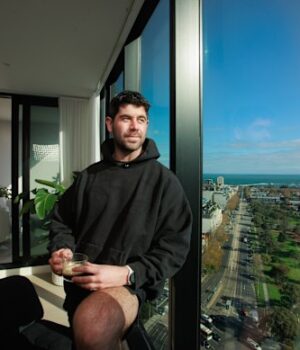
Travis Fein’s St Kilda Junction apartment has one of the most seductive views of Melbourne that money can buy.
On an upper floor in one of St Kilda’s tallest towers, his unit’s floor-to-ceiling windows give an uninterrupted view of the patchwork of open spaces around Albert Park Lake, Middle Park’s multimillion-dollar cottages far below and the curved shoreline of Port Phillip Bay beyond.
But Fein didn’t buy the view; he leased it.
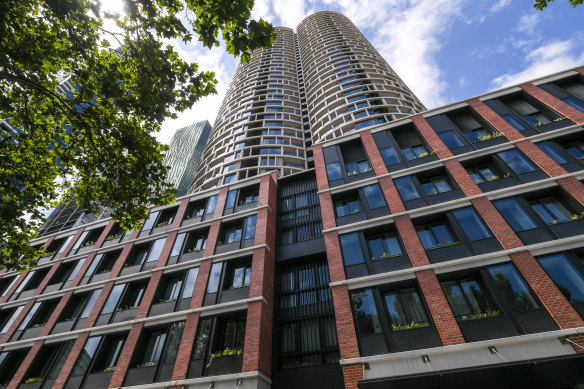
The 28-year-old property investor and social media identity sold his apartment and moved into a two-bedroom pad in Beach House, a 297-unit build-to-rent development that towers over St Kilda’s northern gateway.
Fein pays $1275 a week for his luxe apartment, virtually double St Kilda’s $650 median price for a two-bedroom unit.
“But for context on that – because that’s a big number – it’s a beautiful apartment,” he says. “I have Albert Park views, beach views, city views, so it’s one of the top-tier apartments.”
Built by Melbourne developer Gurner Group for $300 million, Beach House bills itself as a place to “live like a millionaire, mortgage free”.
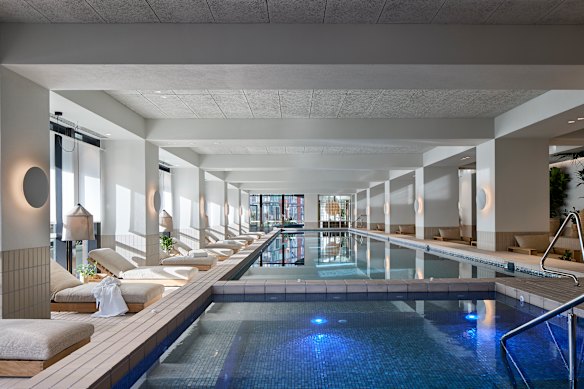
Its amenities would not be out of place on a cruise ship: a heated pool lined with banana lounges, dimly lit billiards room, 10-pin bowling alley, cinema, plush private bar with city views, day spa, pet spa.
The opulent complex is part of Melbourne’s first wave of build-to-rent developments, inner-city buildings marketed at lifestyle-conscious renters happy to pay over the odds for a central pad with perks.
“To be able to just use a sauna, ice bath and the whole wellness area and then go home to sleep, you’d need to spend $30,000 to $40,000 to have that at home privately,” Fein says. “You’re not paying for a normal rental. You’re paying for a nice lifestyle, which would cost a shit-ton of money otherwise.”
Footloose, financially flush and renting because he wants to, Fein could be a poster child for Melbourne’s burgeoning build-to-rent housing market, which has burst out of the ground and into the city’s skyline with a promise to make renting simultaneously more glamorous and more secure.
Governments desperate for solutions to the housing crisis have laid out the welcome mat for some of Australia’s biggest builders, including Lendlease, Mirvac, Grocon and Salta, along with operators from the US, Japan and Singapore.
But some experts say the influx of high-priced housing is doing nothing to ease Melbourne’s rental affordability crisis.
An analysis by The Age of 12 months of rental data from hundreds of listings at 14 completed build-to-rent developments bears out this criticism: they are 20 to 70 per cent more expensive on average than other nearby rental homes.
Meanwhile, some tenants interviewed for this story have said the experience does not live up to the glamorous sales pitch, or justify the high-end rents.
Build-to-rent isn’t mainstream housing. It’s pitched at a select cohort with money to spare.
But the model is muscling in on Melbourne’s struggling apartment sector so rapidly that some property analysts predict it will soon grow to be a major player in the rental market.
One set of numbers, calculated by property advisory firm Charter Keck Cramer, captures the seismic shift under way.
In 2021, an estimated 14,000 new apartments were built in Melbourne. Not one was a build-to-rent unit.
In the 12 months to July 2026, an estimated 8200 new apartments were built in Melbourne. More than half of them, 4400, were build-to-rent.
It’s the first time the incipient housing model has overtaken the delivery of conventional (or build-to-sell) apartments in Melbourne, or any other Australian city.
Build-to-rent towers have sprung up around Docklands, South Melbourne and Southbank, near train stations and tram lines in Kensington and Brunswick, and along the city’s hippest high streets in Fitzroy and Collingwood.
Several thousand more are in the pipeline, funded by a mix of domestic and foreign institutional capital that is swooping in to take advantage of federal and state tax breaks and friendly planning laws aimed at buoying investment in build-to-rent (BTR) housing.
Projects that had previously stalled are being revived and repurposed as build-to-rent: Southbank’s STHBNK, conceived and sold off-the-plan as Australia’s tallest apartment building, were altered last month to a smaller build-to-rent tower.
Plans for a 39-storey CBD office tower on Lonsdale Street were also dumped in August in favour of build-to-rent. Multiple BTR high-rises have just been approved around Arden underground station.
It’s a remarkable rise for a sector that barely existed in Australia five years ago.
But housing analysts warn the boom is a symptom of a dysfunctional housing market in which the annual number of new apartments being built in Melbourne has shrunk to lows last seen in the global financial crisis, while the city absorbs well over 100,000 new residents each year.
“I remember the good old days in 2016 and 2017, when we did 19,000 [new apartments a year]; that’s really the level that we should be building to bring Melbourne back into balance,” Charter Keck Cramer national executive director Richard Temlett says.
“People still need a place to live, and a lot more of them are just being forced to rent.”
The rise of the lifelong renter
“We drive to a house in Preston
We see police arresting
A man with his hand in a bag
How’s that for first impressions?
This place seems depressing
It’s a California bungalow in a cul-de-sac.”
Melbourne singer-songwriter Courtney Barnett’s 2015 tune Depreston was a forlorn indie anthem for a generation who believed ever-escalating property prices – up more than 400 per cent in Melbourne since 2000 – had denied them the Australian dream.
Renting has historically been a transitional form of housing for most Australians, Dr Tom Alves, acting managing director of the Australian Housing and Urban Research Institute, says. But in the 21st century, a growing cohort of lifelong renters has emerged.
This is particularly so among younger adults. In two generations, Australians aged 25 to 34 have changed from mostly home owners to mostly renters. Ownership rates have also fallen below 50 per cent among low-income Australians aged over 45.
“There obviously always were a bunch of people who were renting for their whole lives, but that was a small group, whereas now it’s become fairly mainstream and not necessarily by choice,” Alves says.
Australia’s steadily declining home ownership rate has “prepared the ground” for the recent boom in BTR housing, Alves says. As home ownership falls out of reach for more people, it offers those on good incomes an opportunity to lease a style of housing they could not afford to buy.
The new wave of BTR accommodation, overwhelmingly leased at a premium, has also emerged at a time when rental affordability is the worst on record, according to federal government advisory body, the National Housing Supply and Affordability Council.
An analysis by The Age of 1223 listings in 14 operational BTR developments, between July 2025 and June 2026, found that median rental rates in those buildings are 20 per cent to 70 per cent more expensive than other apartments in the same suburb.
Beach House, in St Kilda, listed its units at 66 to 70 per cent above St Kilda’s median. Realm in Caulfield North is similarly high-priced, leasing some of its one-bedroom apartments for more than double the suburb’s $455 weekly median.
Even Local, an operator that has sought to differentiate itself as a rare provider of affordable build-to-rent accommodation, listed units in Kensington at 37 to 48 per cent above median for the suburb.
Only one development, Spotswood’s Union Quarter, offered rental accommodation in line with the suburb’s median.
“What’s this doing in terms of affordability? I think very little is the answer. If anything,” Alves says.
Victoria’s Planning Minister Sonya Kilkenny visited Preston in late April to officially launch the maiden Melbourne apartment building for BTR brand, WeAreLiving.
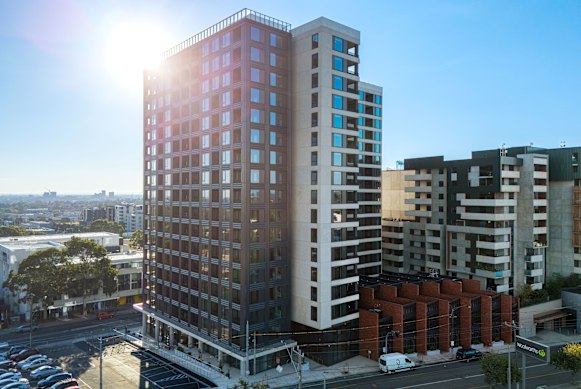
Standing on a 16th-storey rooftop BBQ area with a view of the CBD skyline behind her, Kilkenny gushed about the building to an audience of property and superannuation stakeholders being served finger sandwiches, Portuguese tarts and developer-branded cans of carbonated water.
“What a beautiful building it is. The bold red brick as you enter downstairs, I must say it’s one of my favourites,” Kilkenny told the crowd before helping to cut the ceremonial ribbon.
“This is exactly the type of development we want to see: great homes, well-built, secure, in fabulous locations, offering choice and diversity.”
Melbourne’s worsening housing affordability challenge “can only be met by boosting supply”, Kilkenny said, before listing the planning and tax changes she has steered through parliament to stimulate housing development.
“We’re also, of course, really proud to be the nation-leading build-to-rent capital, and we’re going to continue to support build-to-rent developments with 50 per cent reduction on land tax and, of course, the exemption from absentee surcharge.”
The absentee land tax surcharge is blamed by the property industry for driving foreign investors away from Melbourne’s apartment market. BTR buildings are exempt.
WeAreLiving ticks all the high-amenity boxes of Melbourne’s BTR boom. The building’s handsome red brick ground floor and basement levels include a gym, sauna, steam room and cold plunge pool, and a bookable dining room.
The building adds a splash of style to the cluster of grey high-rise apartment buildings that have been wedged into the narrow triangle of land between gentrifying High Street and the route 86 tram corridor on Plenty Road.
Rental units range from $545 a week for a studio apartment to $1390 for a three-bedroom townhouse, putting the development at the top of the range for Preston.
The building does not include any affordable housing.
This omission was a calculated decision. To do so would jeopardise the returns of the 1.2 million Aware Super members who have financed the project, one of its developers said.
“Our starting position here was a return for Aware and return for their members,” Barings Real Estate Head of Residential Warwick Dowler said. “So, from our perspective, that’s number one. To hit that minimum return hurdle here it had to be market rent.”
The project was financed with the assistance of a 50 per cent concession on land tax.
The government has established a four-month, accelerated approvals timeline for projects that include at least 10 per cent affordable housing. But Dowler said this inducement would do little to tackle the level of unmet need for lower-cost rental housing.
“Quite honestly … if [the government] want to see more affordable product, they need to look at subsidy programs,” he said.
Not chicken feed
Monday afternoon is Sasha Sheko’s rostered time to feed and water the four resident hens at 15 Thompson Street, a 197-room build-to-rent development run by Assemble in Kensington.
“I’m so inner-north I’m blanching kale stems to take to my chickens,” Sheko says.
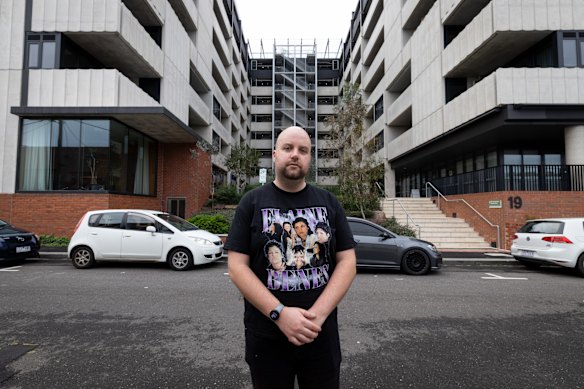
Sheko moved into a two-bedroom apartment in Thompson Street last year, saying a wistful goodbye to their old CBD apartment, where they paid a private landlord bargain-basement rent of $440 a week.
The new home is no bigger but is more modern and has communal amenities: including a common room where new friendships have been made, and a rooftop basketball court they almost never use. It costs $605 a week.
Sheko says it’s decent value for the area, although they have been so underwhelmed by the standard of maintenance that they expect to move out within a year.
“Just the whole Assemble model, ‘we’re ethical, we’re sustainable, blah blah blah’, I think it maybe raised my expectations in terms of what it would be like dealing with property management.
“I’m at the point where if I have any more issues I will ignore them and probably won’t be there in six months, which is a shame because the community is really lovely.”
Assemble is positioned at the affordable end of the build-to-rent market, with fewer amenities than most other BTR developers offer. It has also bought heavily into federal and state government schemes to deliver subsidised affordable housing.
Even so, Sheko’s weekly rent is more expensive than the $550 weekly median price for a two-bedder in Kensington.
University of Melbourne Professor of Property Piyush Tiwari has researched Melbourne’s first wave of BTR developments, and says the financial feasibility of the sector “hinges on the ability of units to be leased at higher than market rents”.
Communal amenities such as wellness rooms, swimming pools, gyms and cinemas have been included to attract tenants willing to pay the steeper rents necessary to make a profit.
“The original proposition was that BTR provides a higher end rental offering, including amenities, so the rents would be higher,” Tiwari says.
“Generally, the providers were expecting a rent to be 20 to 25 per cent above the market.”
Build-to-rent housing is mainstream in parts of Europe and in the US, where it accounts for roughly 4 per cent of the housing market, and caters more for lifelong renting families.
Tiwari says that if Australia follows these countries, mid-market build-to-rent housing will emerge. But two years after his research paper was published, most BTR buildings in Melbourne are even more expensive than the 20 to 25 per cent premium the first wave was financed on.
The Age calculated rental rates for Melbourne’s BTR developments using Homer, a property app that tracks the prices over time of all Australian properties on the market.
Homer chief executive Henry Pedersen had personal experience with Melbourne’s premium-priced BTR sector while looking for a rental home for his family of three in 2024.
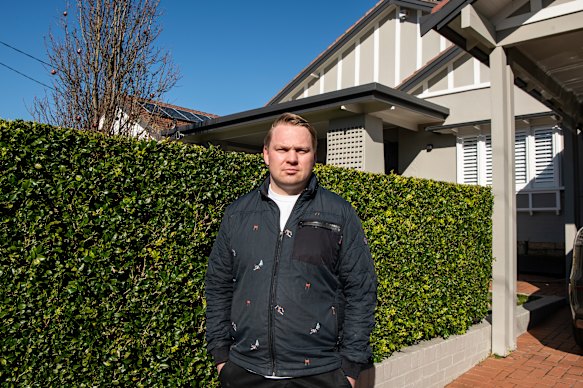
Pedersen and his wife considered leasing a three-bedroom apartment at Home in Richmond, but baulked when they found a modern four-bedroom townhouse in the same suburb for $250 a week less.
“The amenities of those things are really cool and that somewhat inflates the value, but at the same time I didn’t think it was worth that much of a difference in price personally; maybe if money was a bit looser,” Pedersen said.
He suspects many renters, aspiring to own a home one day, would make the same calculation.
“Paying 10 to 20 per cent more doesn’t help you save to enter the property market.”
Edward McAuliffe is director of BTR operations at Salta, which operates Fitzroy and Co, a boutique BTR in Fitzroy North, and has two large projects in development in Richmond and Docklands.
Median rental rates at Fitzroy and Co exceed the median rental in Fitzroy North by about 50 per cent, The Age and Homer’s analysis found.
McAuliffe agreed that most BTR housing in Melbourne is relatively expensive to rent, but said that was the only way to make the developments stack up financially.
“You know, we’re creating housing,” he said. “Yes, some of it’s at the premium end at the moment, but that’s a function of what you need to do to get a project to become viable, get the funding you need to build it and get it operating.”
‘It felt like a student campus’
Where younger renters have baulked at BTR, some operators have turned to international students to fill their new buildings, satisfying their financiers but undermining the premium rental experience.
The first few months living in Mirvac’s LIV Aston building in Docklands were pleasant for David Powlett. The apartment was comfortable, the neighbours were friendly and the address on the Yarra’s north bank was convenient.
The rent was high compared to other places he’d considered, but the single father and IT service designer needed a spacious and well-built apartment for himself and his two children, and was prepared to pay a premium for it.
“I was a bit fussy about cupboards that don’t open and noise levels and things like that, and the Mirvac apartment was actually very quiet, very comfortable, the build quality was very high,” he says of the three-bedroom unit he rented, initially for $1270 a week.
Powlett was one of the building’s first tenants.
“I was almost the only person on my floor,” he says. Even so, the small community of residents were socially lubricated by regular, catered gatherings thrown by management in one of the building’s common areas.
But six months in, the community in LIV Aston changed dramatically as scores of vacant units were filled with international students, seemingly within a matter of days.
“It really changed the whole atmosphere … I know quite a few people left because they felt the vibe had changed a bit too much. It just didn’t feel like premium accommodation, it felt like a student campus,” Powlett says.
Amenities such as the building’s cinema room, media room and dining spaces were booked out, sometimes for months.
“We didn’t use the amenities anywhere near as much as we thought we would … People just had them constantly booked, so it was just a nightmare to try and get in there,” Powlett says.
He stayed until the end of his 12-month lease, but left when the company sought to increase his rent by more than $300 a week.
On the other side of the CBD, in Mirvac’s LIV Munro building, Alaisdair Leith’s experience was almost the same: a luxurious lifestyle in a near empty building soured after the building rapidly filled up with overseas students.
Leith and his partner moved into a two-bedroom apartment facing Queen Victoria Market just three months after it had opened, paying $700 a week.
“The first six months there was incredible; no issues,” Leith says. “There was a really good blend of tenants; people in their 30s, retirees.”
But the building was clearly well below capacity until it was filled with international students, leading Leith to question the value in his premium accommodation.
“It was near impossible to book anything because they would book six months in advance. So it was like, well, I can’t use the amenities. So why am I paying this?”
They moved out earlier this year.
Melbourne University’s Tiwari says that international students are an easy market for BTR operators to tap.
But he says the fact they are doing so is also an indication that one of the key selling points for the BTR sector – the offer of long-term, multi-year leases instead of standard, 12-month leases – is attracting relatively few takers.
A Mirvac spokesperson said its BTR buildings attract different resident profiles depending on location, with some drawing in more students, others appealing to professionals, families, key workers or downsizers.
Mirvac is pursuing legal action against Victoria’s valuer-general in the planning tribunal, arguing that LIV Munro’s land value for tax purposes should be slashed by more than $32 million, due to “the deterioration in property market conditions and economic uncertainty over the past 12 months”.
But its 2026 annual report, published in August, presents a more bullish position about its build-to-rent growth strategy, telling investors that Australia’s housing crunch is fertile ground.
Low housing supply, historically low rental vacancy, increased migration and population growth, all support the company’s BTR expansion strategy, the report noted.
Charter Keck Cramer’s Temlett says the BTR boom is delivering desperately needed housing for Melbourne at a time when far too few conventional apartment developments are being built.
“We’ve got the fastest growing population other than WA, we’ve got a chronic shortage of rental stock, so that all points to the fact that rents will continue to rise.”
But in chasing the upper tiers of the market, Melbourne’s BTR boom has left the renters most in need of an affordable place to live out in the cold, Tiwari says.
“At the end of the day, millennials are budget conscious, and their experiences are very different. They are not necessarily looking for all those amenities, they’re looking for a decent home.”
Get a weekly wrap of views that will challenge, champion and inform your own. Sign up for our Opinion newsletter.