Source : the age
We’ve snorkelled into Tim Winton’s Ningaloo Nyinggulu documentary but someone has hit the fast-forward button.
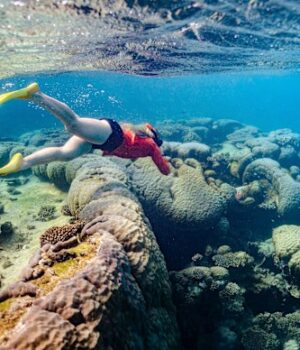
Fingers laced behind our backs, the natural slipstream pulls us along like a liquid conveyor belt. Caught in the drift, we float over coral gardens and alongside rivers of tropical fish, their neon colours flaring like falling stars.
One moment, a green turtle flashes into view; the next, a pouty-lipped grouper blows kisses in our wake. Overhead, the sun spins like a giant mirror ball, throwing shards of light across the reef.
Located in the Cape Range National Park, Turquoise Bay is ranked as one of Western Australia’s best beaches: bone-white sand, clear shallow water and a coral reef that begins just metres from the shore.
But a show this good comes with conditions – enter at the southern end, don’t fight the flow and make sure to exit before reaching the northern end of the sandbar. As a local told me, leave it too late and you’ll be sucked out to sea.
It’s my husband’s first visit to Ningaloo and I’m excited to show him one of my favourite snorkelling spots. I’m also relieved to see the reef looking so good.
In March 2026 Cyclone Narelle hit the Coral Coast, peaking at category 5 with 200 km/h winds, 250 millimetres of rain and a tidal surge that pushed water from the Exmouth Gulf more than 18 kilometres inland. Coming just days before the start of the season, the timing could not have been worse.
Despite extensive damage, four months on, the region is open and welcoming visitors.
The whale sharks and humpbacks have arrived on cue, the annual coral spawning was as spectacular as usual, and niche tours have sprung up in response to the lush conditions. The best part is the palpable feeling of optimism rippling through the small community.
For an overview we join Exmouth Adventure Co for a “Ningaloo in a day” safari, travelling from Exmouth to Charles Knife Canyon, through Cape Range National Park to Turquoise Bay and Yardie Creek.
At the midway point, as guide Ash Broinowski fits us with snorkelling gear, he explains that the ocean has numerous ways to self-heal after natural events.
“Listen carefully underwater and you’ll hear the crunch-crunch of parrot fish grazing on coral, removing algae and keeping the reef healthy,” he says.
I don’t hear or see the colourful clean-up crew but their handiwork leaves the water sparkling.
Turning from the reef to the ranges, the story of recovery is just as remarkable. Broinowski points out signs of new life everywhere, from a whistling kite sitting on eggs to mulla mulla plants, their purple pompoms nodding in the breeze.
The silver lining (or is that a green lining?) of receiving a year’s worth of rain in a few days is how vibrant everything is. “Last year we didn’t see the purple mulla mulla at all,” says Broinowski. “And now it’s already blooming in June.”
Further along, his eagle eyes spot the crimson blush of Sturt’s desert pea, the rare localised form that lacks the signature black eyes. “These indicator plants point to a bumper wildflower season ahead,” he says.
The next morning an eco-cruise with Yardie Creek Boat Tours takes us into gorge country. I stare up at sheer limestone walls banded with red, pink and cream – an ancient reef system frozen in stone. Rare, black-flanked rock wallabies hop about the craggy walls like furry acrobats, while the aerial roots of fig trees drape the canyon walls in long, tangled plaits.
“Since the cyclone cleared away the sandbar, Yardie Creek is once again open to the ocean, with its natural tidal flow restored,” says Jade Cantrell, our marine biologist guide. “We are seeing squid, dolphins, rays and turtles coming back into the mouth of the creek.”
This is the land and sea country of the Jinigudera, Baiyungu and Thalanyji people, who have maintained an unbroken connection to these lands for at least 32,000 years. Pushing deeper into the creek, Cantrell points out natural rock traps once used by the Baiyungu people to harvest fish from the sheltered waters.
As we drift she talks about the blind gudgeon, an eyeless fish that has lived in the region’s subterranean karst caves for millions of years. For her final trick she hands around a palm-sized megalodon tooth, another reminder that this arid landscape was once a tropical ocean ruled by giant predators.
On previous visits I’ve confined my time to the reef, but now I’m beginning to see why the Ningaloo Coast was listed as a World Heritage site for both its oceans and ranges.
Deeper again is Bullara Station, a 100,000-hectare working cattle station and outback stay, an hour or so south of Exmouth. “We received 380 millimetres of rain in six hours,” says owner and manager Edwina Shallcross, pointing to a marker where the floodwaters reached. “Never in 100 years has the property experienced such conditions.”
If it wasn’t for photographs showing staff kayaking across the floodwaters, I’d never have believed it. The woolshed bar is pumping with music and people (it’s happy half-hour when we arrive) and all of the accommodation options, from campsites to safari huts to bell tents, are close to capacity.
“A lot of our accommodation was lost or damaged,” says Shallcross, “but within five weeks, thanks to community support, we managed to rebuild, revamp and reopen. We are now bigger and better than ever.”
We stay in the historic Shearers Lodge, and though it comes with a communal kitchen, lounge and dining area, we’ve booked dinner at The Table. Here, husband-and-wife team of head chef Toby Fisher and pastry chef Maree Fisher serve farm-to-table dining (including the best rhubarb dessert of my life) inside a 110-year-old woolshed.
“We don’t have a pool, ocean front or artesian spa,” says Shallcross. “But we have created a community of travellers, a destination where people come to connect and slow down.”
On a walk of the property Shallcross explains that with the wetlands now full, waterbirds are returning in great numbers. “Nature has come in and given it all a big spring-clean,” she says. “Lake Eyre has had its moment, now it’s Exmouth’s turn.”
Back on the coast we spend our final afternoon at Vlamingh Head Lighthouse, where the full turquoise sweep of Ningaloo Reef is laid out against the red and green ridges of Cape Range.
In Winton’s words, “In the north of Western Australia, where the desert meets the sea, lies one of the last great wild regions on Earth.”
And right now it’s at its most spectacular.
THE DETAILS
FLY
Qantas flies to Perth with connections to Exmouth (Learmonth). See qantas.com
STAY
A Queen room in Bullara Station’s Shearers Lodge, $210 a night. Powered camp sites, $58 a night, from April to October. Ningaloo Lodge Exmouth has queen rooms for $270 a night. See bullarastation.com.au; ningaloolodge.com.au
TOURS
Ningaloo in a Day Safari with Exmouth Adventure Co costs $320 for an adult, $285 for a child, including transport, morning tea and lunch, snorkel equipment and national park entry fee. A one-hour eco-cruise with Yardie Creek Boat Tours costs $70 adult, $50 child. See exmouthadventureco.com.au; yardiecreektours.com.au
MORE
westernaustralia.com
The writer travelled as a guest of Tourism Western Australia.
 Kerry van der Jagt is a Sydney-based freelance writer with expertise in Australia’s Indigenous cultures, sustainable travel and wildlife conservation, and a descendant of the Awabakal people of the mid-north coast of NSW.