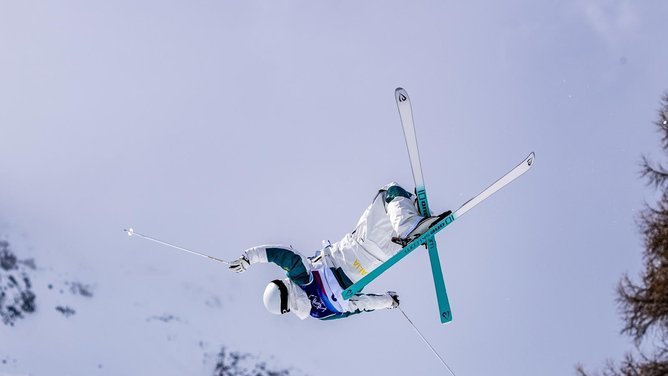
Source : Perth Now news
If Jackson Harvey has any childhood memories not directly tied to the depths of winter, you’ll be hard pressed to coax them out of him.
Raised in the mountains of Colorado by an American dad and an Aussie mum, the 23-year-old Olympic moguls skier grew up surrounded by great big piles of snow – a childhood experience he fears may soon become extinct, as global warming lashes Australia’s alpine communities.
“I remember there would always be this sense of anticipation when you knew you and your friends would be going out skiing the next day. They’d just be these endless days of skiing powder and just enjoying everybody’s company,” Harvey said.
“That’s what really sparked my love for the mountains and winter.”
Working alongside a coalition of scientists and winter athletes called Protect Our Winters (POW), Harvey has just spent a week in Canberra calling on politicians to support a national alpine resistance plan.
TikTok videos show Perisher ski resort covered in a measly amount of snow
He moved to Australia in 2023 to join the Olympic moguls skiing team, but as a teenager he spent the 2015 ski season in Jindabyne on exchange at the local Central School.
“One of my most vivid memories of that season was training on the famous Toppa’s Dream mogul course at Perisher Resort, which is this behemoth of a course. It’s known for its steep pitch, and it’s quite robust,” Harvey said.


“When I moved out to join the national team, we would train on the same course. For the last four years now, the main domestic moguls skiing event, which is held on Toppa’s Dream, has been shortened because of extreme weather circumstances like rain and high wind.
“The snow deteriorates so much that the jumps fall apart and the conditions become too unsafe and unsustainable to hold the event.”
The average temperature in the Australian Alps has risen by about 2C since the middle of the 20th century, and while that may not sound like much, the variation has caused a 30 per cent reduction in snow cover.
The changes are causing significant stress for local communities who have been forced to endure shortened snow seasons and, therefore, less profitability during key tourist influx periods.

Winter sports commentator and international freeskier Mia Rennie – “Miff” to her mates – was raised in Cabramurra on the western side of the Snowy Mountains, the town where local average temperatures are recorded each year.
She said. winters experienced by locals and tourists today are a far cry from the snow seasons of her childhood.
“During the winter, we used to regularly have to dig our door out of the snow, it was quite common. Now, when you tell kids that used to happen in Australia, it feels like a foreign story – they can’t relate to it,” she said.
“I used to ski at Selwyn Snow Resort when my parents were ski patrollers there, and the change has been so drastic. After the 2019 fires, they burned down and were forced to rebuild … but they can’t even hold ski seasons anymore.
“The lodge owners are really struggling this year to make the money. They’re losing customers, and it’s a lot quieter around town, especially Selwyn and Cabramurra.

“They just don’t get the snowfall they need … it’s a scary, daunting thing. I had my first turns there as a kid, and I know my kids won’t.”
Rennie said part of the reason she went to Canberra this week was to make sure everybody was “on the same page” about how dire the situation was.
“This isn’t something anybody can deny. The facts are there,” she said.
“People need to open their eyes and see that our winters have been shortening, snowfall is less and it’s decreasing every year. Nothing can be denied anymore.”

“Typically, a ski season has between three and five big snowfall events, but unfortunately as we’ve seen this season, some of those events are falling as rain, which is the natural enemy of snow,” he said.
“The future of drier and warmer conditions is really concerning.”
Dr Watkins said the flow-on effects could be even more devastating, citing issues around water flow and Indigenous heritage
“There’s a huge range of aspects well beyond just the environment and skiers. It’s not even just the communities on top of the mountain, it’s agriculture too,” he said.
“Around 29 per cent of the water that comes into the Murray Darling Basin comes from the high country.
“There’s First Nations aspects as well. This place has been part of their culture for tens of thousands of years. Ultimately, all of these things are at risk.”


According to Dr Watkins, there is a glaring need for a “co-ordinated mechanism” between state and federal governments to keep alpine communities thriving.
“At the moment, some pieces of the adaptation process are all over the place,” he said.
“There’s nothing really co-ordinating it together and there’s nothing at the moment really collecting all the voices.
“We’re asking the government to form a plan that doesn’t leave anybody behind.”
Social scientist Ruby Olsson believes a national alpine adaptation plan is the key to keeping Australia’s alpine regions safe.

“There is actually quite a lot of adaptation happening in the Alps, but it’s happening at a very disjointed, fragmented, individual level,” she said.
“There’s this missed opportunity to have something multi-jurisdictional, so across NSW, Victoria and the ACT. There’s also a role for private landowners to get involved, and on top of all of this we’re hoping the commonwealth can take on a co-ordinating role.”
Other defined areas of extreme environmental significance, like the Great Barrier Reef, are governed by plans similar to the one POW is advocating for.

Harvey said the best way to think about the situation was to assume we were “borrowing the environment from our children and grandchildren”.
“We want to leave it in a really good place for them, and that’s our responsibility. There’s a great deal of urgency here,” he said.
“My job in Canberra is not to ask for sympathy as an elite athlete but rather to advocate on behalf of future generations of athletes who deserve their fair shot at the gold medal.
“Everybody deserves to be able to experience the magic of the alpine region. That’s what we’re here for.”