
Source : INDIA TODAY NEWS
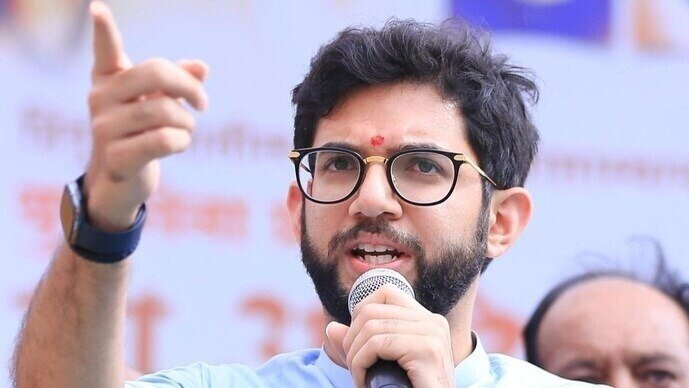
Shiv Sena (UBT) leader Aaditya Thackeray has described the recent wave of defections from his party as part of an elaborate plan allegedly orchestrated by Maharashtra Deputy Chief Minister Eknath Shinde to weaken Chief Minister Devendra Fadnavis.
He further alleged that Shinde is acting on instructions from senior BJP leadership at the Centre, with the objective of undermining Fadnavis’s prospects in national politics.
advertisement
The remarks come amid continuing political hostility between the Shiv Sena (UBT) and the Shinde-led faction, following the switch of six out of nine MPs from the Thackeray camp to the rival Sena group.
Speaking to Rajdeep Sardesai on India Today TV, Thackeray said the Shiv Sena (UBT) was “collateral damage” in what he described as a broader pattern of political engineering in Maharashtra and beyond, terming the recent defections as part of “Operation Devendra Fadnavis.”
‘FADNAVIS’S LAST ASSEMBLY SESSION AS CM’
Explaining what he meant by “Operation Devendra Fadnavis,” Thackeray alleged that several senior leaders who were once seen as potential national-level contenders had, over time, been systematically moved or “repositioned” within the party hierarchy.
He further claimed that Shinde’s actions were effectively serving interests within the BJP at the Centre, with the aim of ensuring that Fadnavis is no longer seen as a contender for the Prime Minister’s post.
He also suggested that Fadnavis could eventually be moved to the Union Cabinet, indicating that the current political arrangement in Maharashtra may not be permanent.
“Mark my words: this could be Devendra Fadnavis’s last Assembly session as Chief Minister,” he said, adding that Shinde is seeking to regain the Chief Minister’s post.
Thackeray cited the examples of Nitin Gadkari and Shivraj Singh Chouhan to support his argument.
“When Gadkari was about to become BJP president for the third time, controversies around Poorti and other issues surfaced. Shivraj Singh Chouhan, a widely accepted and popular Chief Minister of Madhya Pradesh, was subsequently moved from state leadership and brought into the Union Cabinet,” he said.
‘MONEY POWER INFLUENCING DEFECTIONS’
Responding to allegations that he has repeatedly claimed defections are driven by money without producing concrete proof, the Shiv Sena (UBT) leader insisted that evidence does exist.
“I do have evidence,” he said, referring to televised clips and widely circulated visuals.
He pointed to a video involving Rajesh Shirsagar allegedly asking a contractor for money, and another showing Sanjay Shirsat sitting beside bags of cash, both of which, he noted, were carried by multiple news channels.
Thackeray argued that these incidents point to a broader pattern in Maharashtra politics, where defections are often followed by sudden personal financial gains.
He alleged that several legislators who switched parties experienced a sharp rise in wealth shortly after joining the ruling side.
Some, he said, purchased luxury apartments in high-rise buildings, while others acquired expensive cars within months of their defection. “How does such sudden economic upliftment happen immediately after changing political sides?” he asked.
‘PROUD OF MY FAMILY LINEAGE’
When asked whether the Shiv Sena (UBT), like other regional parties including the TMC, suffers from a perception problem of being family-run organisations, something critics argue makes them more vulnerable to defections, Thackeray said he was “very proud” of his family legacy and insisted that political legitimacy ultimately comes from electoral acceptance.
The question referred to repeated criticism by the BJP that “parivarvaad” (dynastic politics) has driven leaders in smaller parties to quit in search of greater freedom and opportunities elsewhere.
“I’m very proud of my heritage, my legacy, my family,” he said, adding that leadership is ultimately validated at the ballot box. “If the people accept me, they will accept me. And for the last two elections, they have accepted me,” he said.
He argued that defections were not driven by dissatisfaction with family-led parties, but by other factors such as legal pressure and inducements. He alleged that “some leaders who switched sides were facing cases from agencies like the Enforcement Directorate, Income Tax Department, or CBI, while others were offered money.”
Thackeray also turned the criticism back on the BJP, claiming that dynastic politics is not limited to regional parties and that the BJP itself has a significant number of leaders from political families. He described this as a contradiction in the party’s public stance.
“That’s the baggage they’re carrying, and that’s where the hypocrisy speaks out very loud,” he said.
‘BJP IS BABAR JANATA PARTY’
The 36-year-old leader also strongly criticised the BJP over the controversy surrounding alleged irregularities in donations linked to the Ram Temple in Ayodhya, questioning the functioning of the temple trust.
Reiterating Shiv Sena’s historical association with the Ram Temple movement, he pointed to the party’s 2018 campaign and contributions made to the trust.
“In 2018, when the BJP had forgotten the Ram Temple, we had gone there and said, ‘Pehle Mandir, phir Sarkar.’ That’s when the BJP remembered. The Ram Temple was built thanks to the Supreme Court’s decision, not the BJP,” he said.
However, he alleged that recent controversies involving individuals appointed to the trust had raised serious concerns over transparency and integrity.
“Our faith has been shaken because allegations of scams involving people appointed by the BJP to the Temple Trust have surfaced,” he said.
He also referred to the BJP as the “Babar Janata Party,” drawing a comparison between the ruling party at the Centre and the founder of the Mughal Empire.
Extending his criticism beyond Ayodhya, Thackeray also referred to alleged irregularities in other religious centres, including claims related to land dealings in Ujjain involving Madhya Pradesh Chief Minister Mohan Yadav.
“They are plundering like the Mughals. So then what is the difference between the BJP and the Mughals?” he argued.
– Ends
SOURCE :- TIMES OF INDIA