

Source : the age
Milton Dick has spent the past four years refereeing one of Australia’s rowdiest workplaces. But the Speaker of the House of Representatives has set himself a mission that stretches far beyond keeping order in question time.
His focus is on a campaign to improve civics education, arguing Australians need a better understanding of the institutions that underpin democracy as trust is tested by misinformation, social media and growing global instability.
“As the Speaker, I need to protect democracy – whatever happens in the chamber, but also outside the chamber as well,” the 54-year-old says. “We have a duty of care to fight for it.”
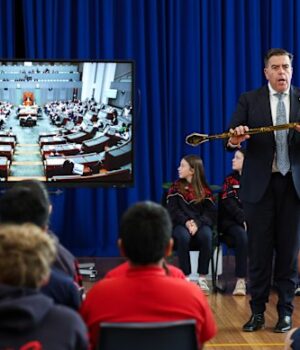
The Labor MP for Oxley, a seat previously held by former governor-general Bill Hayden and One Nation leader Pauline Hanson, has made school visits a defining feature of his speakership, travelling to classrooms across the country – from remote Indigenous communities to tiny schools with two students and island communities off Tasmania. This term, he wants to visit all 150 federal electorates.
His drive comes as democracies around the world grapple with declining public trust, political polarisation and online misinformation. Australia remains one of the world’s strongest democracies, Dick says, but that should never be taken for granted.
The Economist Intelligence Unit’s Democracy Index ranks Australia among the world’s strongest democracies, but Dick says those achievements cannot be assumed. Globally, only 31 countries are classified as liberal democracies, with three-quarters of the world’s population now living under authoritarian rule.
Dick wants nationally consistent civics education in years 6 and 10, arguing every student should leave school with a basic understanding of how governments are formed, how courts operate, how elections are run and why independent institutions matter.
The call comes as national testing shows Australian students’ understanding of democracy is deteriorating. The Australian Curriculum, Assessment and Reporting Authority found civics and citizenship results had fallen to their lowest levels in two decades, with just 28 per cent of year 10 students meeting the national proficiency standard in 2024, down from 38 per cent in 2019.
“I’m not talking about politics,” Dick says. “I’m talking about teaching democracy … it’s the meat and potatoes. More than ever, with the rise of social media and the impacts we’re seeing around the world, we’ve got to protect what we’ve got here and fight for it.”
Last month, Governor-General Sam Mostyn joined Dick for his 200th school visit since he became Speaker, at her old school in Canberra, Curtin Primary.
One of the more light-hearted moments comes when Dick asks students, as he does everywhere, to vote on whether pineapple belongs on pizza. The mock ballot sparks lively debate while introducing children to voting and parliamentary procedure.
Mostyn politely abstained, observing the political neutrality of her office.
The classroom visits have convinced Dick younger Australians are more engaged than they are often given credit for. Once discussions turn to who makes laws, why people vote and how governments are formed, students quickly become active participants.
“They get it,” he says. “I ask them who thinks they could be a member of parliament or do my job as Speaker. Only a handful put their hands up. I tell them that’s okay because I didn’t put my hand up either when my local member asked me that question at primary school.”
Dick insists the program is deliberately bipartisan, regularly inviting government, opposition and crossbench MPs into classrooms, so students see democracy rather than party politics.
The mission reflects his belief that public service begins with understanding civic responsibility.
Dick traces that commitment to his parents, Allan, a World War II naval veteran, butcher and taxi driver, and Joan, a nurse and midwife, who instilled a strong sense of service and respect for others. His brother, Cameron, was deputy premier of Queensland under Annastacia Palaszczuk.
“I’ve worked out my why,” Dick says. “My why is to hopefully do my bit to promote democracy and support civics.”
The Speaker is also expanding parliament’s outreach beyond schools. Every federal MP will receive a ceremonial mace to use when visiting classrooms, while a new National Youth Parliament will bring young Australians to Canberra to experience the legislative process first-hand.
To mark the 125th anniversary of the Australian flag, Dick has taken one flown above Parliament House on a national road trip, using it to teach students about Australia’s history and democratic traditions.
He says many are surprised to learn the flag was chosen through a public competition. Dick hopes descendants of the winning designers – including Perth artist Annie Dorrington and 14-year-old Melbourne schoolboy Ivor Evans – will be tracked down to attend anniversary commemorations in September.
“Their names have been banished from our history books,” he says. “I think it’s I think it’s high-time that we recognised those young people.”
Australia, he argues, has much to be proud of, from compulsory voting and an independent electoral system to a democratic tradition that extended political rights earlier than many comparable nations.
And his message is simple: democracy survives not only through the laws that protect it, but through generations who understand why it matters.
Cut through the noise of federal politics with news, views and expert analysis. Subscribers can sign up to our weekly Inside Politics newsletter.
 Rob Harris is the national correspondent for The Sydney Morning Herald and The Age based in Canberra. He is a former Europe correspondent.Connect via email.