

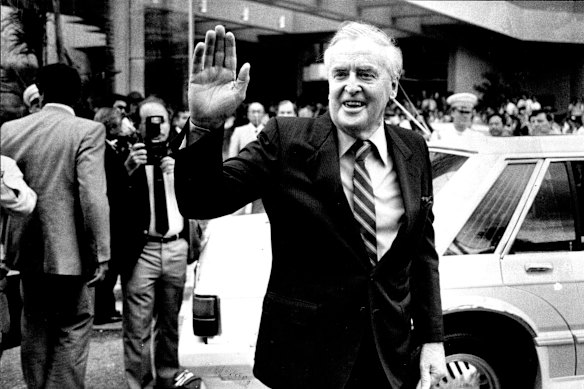
source : the age
Joh Bjelke-Petersen was visiting Disneyland in California in May 1987 when he was forced to face reality, something that was alien to his style.
His bid to become prime minister of Australia was a dead Donald Duck.
True story.
Back in Australia, the actual prime minister, Bob Hawke, had just called – on May 27 – a double-dissolution election for July 11.
It was four months earlier than expected, the first federal winter election, catching Bjelke-Petersen and his excitable boosters with their pants around their ankles.
Despite being premier of Queensland for 19 years and declaring he was ready to lead Australia, Bjelke-Petersen hadn’t managed to get to the point of nominating for a seat in the federal parliament. Now it was too late.
Even he had to understand that the ride to the prime ministership was a lot steeper than to Disney’s Space Mountain when you couldn’t even wangle yourself a seat in the House of Representatives.
And so came to an end the silliest political campaign in Australian history.
It’s all very well to chuckle about it now.
Back then, however, a lot of prominent Australians who should have known better took Bjelke-Petersen seriously, and so did up to a quarter of ordinary voters, according to polls of the time.
On January 31, 1987, the old charlatan launched his Joh for PM campaign at a “grassroots” rally in Wagga Wagga.
“I’m starting a bushfire today and it will go all over Australia,” he announced, standing on the back of a truck. For good measure, he threatened that anyone from his own side who didn’t support him would find their seats contested.
There is a compelling, if slightly askew, sense of deja vu in revisiting these old events, and even the style of their players, from the viewpoint of 2026.
Bjelke-Petersen famously flew around in his own plane, piloted by his very faithful confidante Beryl Young.
Australia’s currently ascendant Queensland-based populist, Pauline Hanson, has a brand new plane, everyone knows, gifted by her new patron Gina Rinehart, piloted by her close adviser and veteran of numerous thrilling political adventures, James Ashby.
Bjelke-Petersen’s stated aim was to save Australia from Hawke’s socialists, who had spent the previous year in budgetary pain and disarray.
Now Hanson wants to “Fire the Liar”, referring to PM Anthony Albanese, who is, among other things, mired in a cost-of-living crunch and a not very popular budget.
Back in 1986-87, inflation was running at almost 9 per cent, and the current account deficit had reached a record 6 per cent of GDP, prompting treasurer Paul Keating to issue his deathless warning that Australia risked becoming a “banana republic”. No matter that most people had no idea what either a current account deficit or a banana republic actually were: the electorate was out of love with Labor.
In late 1986, the party’s worried campaign committee’s market research had discovered “seething anger and resentment” in the voting public about the government’s economic management.
John Howard’s Coalition was thought to have a strong chance of unseating Hawke’s government.
But within weeks of Bjelke-Petersen announcing he was galloping to the fray, the Coalition led by Howard and the Nationals’ Ian Sinclair – who Bjelke-Petersen described as “losers” – was in flames.
Somehow, Joh for PM (later Joh for Canberra) briefly gained the support of about 20-25 per cent of Australians, according to various polls.
Among those smitten by Joh were Lang Hancock (Gina Rinehart’s late dad) and a flurry of spivvy Gold Coast developers known as “the white-shoe brigade”. Conservative historian Geoffrey Blainey wrote approvingly that “Joh is one of the quiet giants in our political history” who had the capacity “to launch an effective raid on the federal capital”.
Former Treasury secretary John Stone, writing under the headline “Why I am working for Sir Joh”, welcomed “the general thrust” of Joh’s policies.
These included a 25 per cent flat tax, a wholesale reduction of government’s role in Australians’ lives and the suppression of unions.
Even the ostensibly moderate Liberal Andrew Peacock was reported to have craftily offered his support behind the scenes to the 75-year-old Joh, in the hope it would assist him in replacing Howard as party leader.
As the weeks went by and the Joh campaign became weirder, I attended a rowdy meeting of usually sensible farmers and National Party members addressed by Sinclair in the town of Wangaratta.
Sinclair, a resilient politician of Country Party heritage who had served in the Menzies, Gorton, McMahon and Fraser Coalition governments, was greeted by a barrage of booing as he tried to argue it would be crazy to accede to Bjelke-Petersen’s demand that the Nationals should split from the Liberals.
Unable to get a hearing, Sinclair left the stage and, out of view of the mob, wept in frustration.
The tough Sinclair’s emotional distress was a shocking thing to see (I was backstage), but it spoke of the irrational nature of a populist campaign in full angry flight.
It wasn’t long before the Nationals split from the Liberals.
Joh’s campaign fizzled out by mid-year, but the damage was done … to his own side of politics.
Hawke won the election handsomely. The Liberals and Nationals were humiliated.
The year after Joh’s bushfire, Howard tried desperately to save himself by launching a policy he called, good lord, One Nation.
Howard’s One Nation rejected multiculturalism, and after visiting Margaret Thatcher in Britain in mid-1988, he began dog-whistling about curbing specific migrant intakes, by which everyone understood he meant Asians.
In 1989, both Howard and Sinclair were replaced. Peacock took the Liberal leadership and someone called Charles Blunt defeated Sinclair.
Labor retained government until 1996.
Forty years later, another right-wing populist bushfire is underway, and the Liberals and Nationals are burning fast.
Pauline Hanson’s One Nation isn’t a neat parallel for Joh for Canberra, of course.
Unlike Bjelke-Petersen, Hanson has her own party quite separate from the Coalition.
Still, she has become so swept away by her sudden popularity in the polls – largely driven by her oldest whinge, about Australia being swamped by foreigners, melding into the new anti-immigration phenomenon capturing the nativist Right across the world – that she is openly musing about being ready to become Australia’s prime minister.
There is, of course, no federal election due for another two years.
Plenty of time to visit Disneyland.
Cut through the noise of federal politics with news, views and expert analysis. Subscribers can sign up to our weekly Inside Politics newsletter.
 Tony Wright is an associate editor and special writer for The Age and The Sydney Morning Herald.Connect via email.


