source : the age
At Pitt Street Dental Centre, you can have your coffee and get your teeth whitened too. It’s a weekday afternoon at the clinic in Sydney’s CBD and I’m gulping a latte, trying not to think about how my coffee habit will discolour my chompers over time. The website of the clinic – “a five-star longevity dental spa” – features photos of celebrities with the pearly-white teeth that seem to be expected of people in the public eye. Yet everyday punters are among customers, too; the clinic performs about 500 whitenings a year.
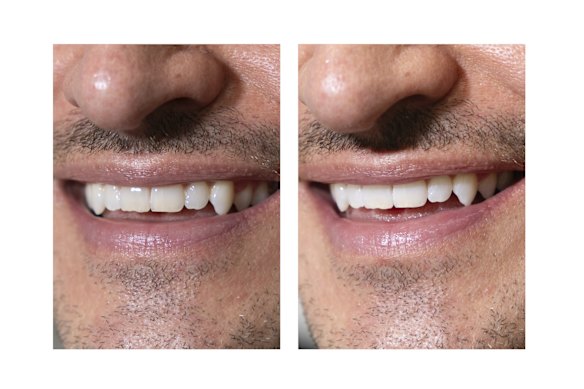
One of its clients has kindly agreed to show us his teeth-whitening in action. When Jean Carre, the co-founder of the Franck Provost hairdressing network in Australia, last whitened his teeth 15 years ago, they became sensitive, and the brightness didn’t last once he went back to coffee and red wine. This time, Carre says, “It’s for me to take care of them properly.”
Many others like Carre want teeth that are not just straight, but sparkling white. The proportion of adults who do some form of tooth whitening, including using home products such as toothpaste, has grown from 14 per cent in 2017 to 28 per cent, according to the Australian Dental Association’s 2024 consumer survey. Performing the cosmetic procedure is a big part of dental hygienist Charmaine Maher’s job, particularly at this time of year. “Spring time, people want to renew,” she says. “Most people are really happy with it. It does give a really good instant result.”
The global tooth-whitening industry turns over about $12.5 billion a year: methods range from strips, chewing gums, mouthwashes and gels to DIY kits equipped with LED lights, to “in-chair” bleaching by dentists and whitening salons. It’s not without risks, including “zingers” – sudden, sharp pain as the bleach penetrates the tooth – and gingival irritation (inflamed gums).
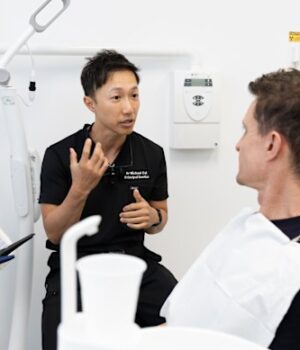
Dr Michael Cai, principal dentist and owner of the Pitt Street clinic, has had a front-row seat to the surge in teeth whitening, particularly among 20-somethings. “Especially during the COVID period, where everybody’s on Zoom, they can see themselves talking in meetings, right?” says Cai. “People start taking notice of their appearance, especially their smile, and notice teeth that are yellow. They look aged, and so people want to do something about that.” Big life events, such as getting married, are also a trigger.
But how does teeth whitening actually work? What’s the difference between doing it at home or having a dentist do it for you? And what, if anything, can go wrong?
How does teeth whitening work?
Tooth enamel is made up mostly of minerals, and is famously the hardest part of the human body – yet it’s porous, with microscopic crevices that can harbour the dark pigments in tannin-packed substances such as coffee, tea and red wine. Other causes of discoloration: genetics, medication, injury, poor oral hygiene and various medical conditions, including some that affect the liver or the kidneys and which can cause wild-coloured teeth – purples, oranges, greens and blues – in young children. Meanwhile, enamel thins with age and doesn’t grow back, exposing the underlying layer of dentin, which is living tissue made up of microscopic tubules linked to nerves, and which has a yellowy hue.
It’s not surprising that, eventually, our teeth might fail the “tissue test”, as seen in a marketing campaign for whitening strips by Procter & Gamble that compares the colour of teeth with a white tissue.
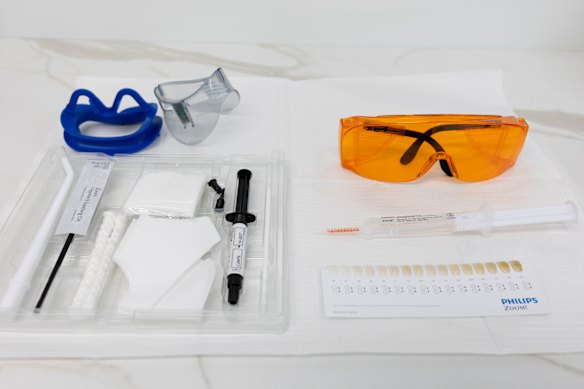
Back at the clinic, Jean Carre accepts the offer of paracetamol and ibuprofen ahead of the procedure to lessen any pain (more on which later), then he lies back in the chair while Charmaine Maher assesses his tooth shade. To non-professional eyes, Carre’s teeth look light and bright already, but this is subtle territory and Maher hopes to lighten them further by four shades, to B1.
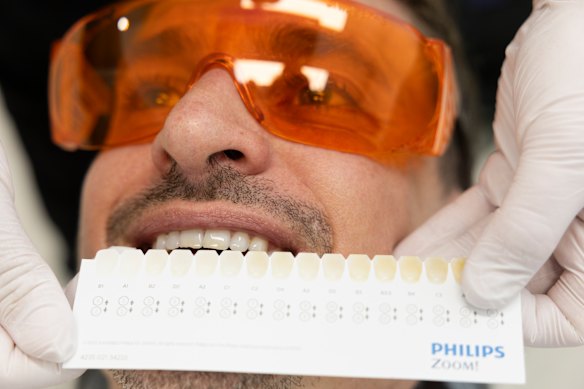
Tooth colour is not a one-size-fits-all thing. One popular “shade guide” used by dentists aiming for a natural result has 16 off-the-shelf hues: As (reddish-brown), Bs (reddish-yellow), Cs (grey) and Ds (reddish-grey). “In my universe, it’s actually unlimited,” says Cai, who makes teeth for people who lose theirs, based on the colour of the tooth next door. “Genetically, everyone has a variety of different colour teeth, so some teeth will whiten up better than others. And people who are older will have more dentine than enamel. Dentine is more opaque, so it absorbs all the light, so the teeth naturally look darker.”
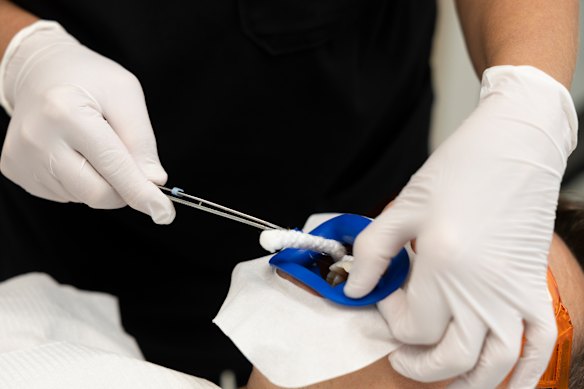
Next, Maher places a lip retractor in Carre’s mouth to stop the lips, cheeks and tongue from coming into contact with the whitening gel. “We’re dealing with a really strong peroxide,” she says. She inserts cotton rolls and gauze inside his mouth, too, to protect the skin and keep the area dry, and applies a protective liquid to Carre’s gums.
“Whitening changes the chemistry of the pigments inside the tooth, rather than simply polishing away surface stains.”
Then, the active ingredient: a hydrogen peroxide gel dabbed on Carre’s 20 most visible teeth (10 top, 10 bottom). Hydrogen peroxide breaks down into oxygen and water and releases free radicals that bombard stains both on and inside the teeth, a process caused oxidation, causing them to whiten. In chemistry talk, large organic molecules that absorb light, making the tooth look yellow or dark, are converted into smaller molecules that don’t absorb light. Cai says: “Hydrogen peroxide passes through enamel and dentine and oxidises coloured compounds inside the teeth, making them appear whiter. Whitening changes the chemistry of the pigments inside the tooth, rather than simply polishing away surface stains.”
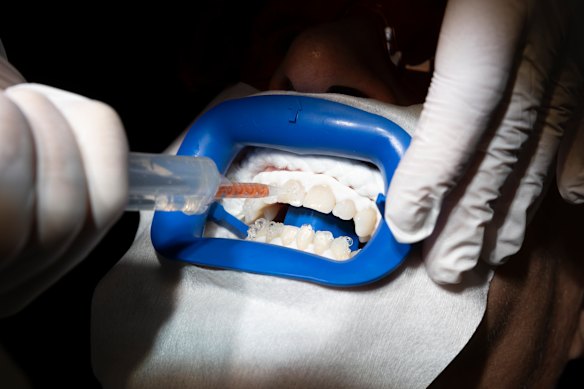
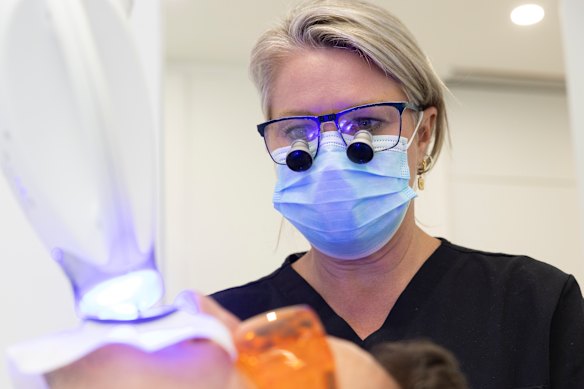
Maher turns a blue LED light on Carre’s mouth, part of the step-by-step protocol from the company that makes the whitening kits, although it’s the peroxide doing the actual work. From the comfort of his dental chair, Carre stares up at the ceiling and listens to piped pop music. He has a bell to ring if he feels any pain.
How does it feel so far, we ask?
Thumbs up.
With the 15 minutes over, Maher returns to wipe off the gel. Round one done; three to go.
In teeth whitening, concentrations of hydrogen peroxide vary, from very low single digits for off-the-counter products used at home, to about 35 per cent for products at dental clinics (25 per cent was used on Carre). The higher the concentration, the more the tooth lightens, and the greater the risk of adverse effects.
Under Australian law, only registered dental practitioners can use or supply high-concentration products, which means more than 6 per cent hydrogen peroxide or over 18 per cent carbamide peroxide, which is a mix of hydrogen peroxide and urea. The competition regulator last decade recalled several tooth-whitening products that contained unsafe concentrations of peroxide, which can burn the patient’s gums.
Another alternative to hydrogen peroxide is PAP, or – wait for it – phthalimidoperoxycaproic acid. PAP bleaches well, doesn’t burn the gums or cause zingers, and it’s quicker to use because the gums don’t need to be protected, says dental expert Laurence Walsh, an emeritus professor at the University of Queensland. But it’s a difficult ingredient to formulate and to work with chemically, he says, and it’s not widely available beyond a handful of high-end clinics.
What’s the difference between ‘in chair’ and DIY?
The most thorough way to whiten your teeth is “in chair” with a product administered by a dentist. Prices range from hundreds of dollars to more than $1000. The Pitt Street clinic charges between $500 and $700, and as part of the package, patients take home a whitening kit for maintenance, which contains trays (teeth-shaped moulds) and gels.
Then there’s whitening performed by technicians in salons and kiosks or by mobile services that are hired out for, say, parties, bridal groups, even corporate wellness programs. Often advertised as transforming smiles and rebuilding confidence, non-dental whitening is cheaper than that offered by a dentist, and fans say it’s convenient and effective.
“The tooth is alive, essentially. So it has a nerve. We want to just be aware of what products we’re putting in the mouth.”
However, the Australian Dental Association argues only dentists and trained dental professionals such as hygienists – not technicians – should be allowed to whiten teeth because technicians do not do a thorough analysis of the mouth beforehand. “The tooth is alive, essentially,” notes Sydney dentist Dr Monica Farrelly. “So it has a nerve. We want to just be aware of what products we’re putting in the mouth, what can possibly cause a tooth to change.” In-chair whitening is also not recommended for people under 18, pregnant or lactating women, or patients being treated for certain illnesses or disorders.
Before whitening, dentists first look for issues such as cracks in the enamel, crowns, bridges, implants, tooth-coloured fillings (which won’t change colour with bleaching), cavities and recessed gums, where the gum tissue that surrounds the tooth wears away or recedes, a condition that develops with over-enthusiastic brushing and age. (“We would never put the gel [hydrogen peroxide] on recession because recession is dentine that’s exposed, it doesn’t have the enamel, and we’re aiming for the enamel,” says Maher.) Farrelly, who is also a health promoter with the Australian Dental Association, says some people are ill-suited for whitening at all: those with abscesses, infections, draining sinuses and untreated gum disease.
“The second thing is, we take all the external stain off by professional cleaning, what we call a prophylaxis,” says Walsh. “Unless you do that, you can’t see the real shade of the tooth underneath. And secondly, those stains on the tooth act as a physical and chemical barrier to a bleaching agent that you apply, and saliva is also a barrier to the way that bleaching agents work. So, by altering those things, we can make sure that we get the best result. Whereas at home, if you just buy a product online and then stick it on top of your teeth, it’s going on top of both saliva, but also external stains.”
After getting rid of external stains, dentists make an assessment. “Is it going to be in the chair? Is it going to be at home? We have a whole range of options, instead of going, ‘Stick on these strips or gels’,” says Walsh. It can take hours, or several visits, to get the desired result safely. “The more difficult the case, the darker the teeth, the older the person, the more likely it is that you might need several treatments.”
Walsh says dentists will give cheaper at-home home products to patients who are happy to wear custom-fitted trays (which typically range from $300 to $700). They can also recommend a whitening product that has carbamide peroxide and releases slowly, to avoid creating teeth sensitivity or soft tissue irritancy. “The literature and our research shows that about 93 per cent of people will get a pleasing result from either in-office or take-home-type bleaching products when they’re selected appropriately, and they’ve got realistic expectations,” Walsh says. “So it’s very predictable, provided you’ve sorted out the natural teeth from the fillings, etc.”
Common at-home whitening products are mouthwashes, whitening strips, whitening trays bought over the counter and pens.
Then there’s the do-it-yourself approach. Oral care products, which once meant “toothbrushes” (and advertising campaigns featuring a shirtless dentist who couldn’t reveal his face), now stretch to electric toothbrushes complete with jet washing, liquid flossing and mouthwash dispensing, at $800 a pop. Whitening toothpaste does everything from removing surface stains (known as “mechanical removal”) with polishing ingredients such as silica, to bleaching with low levels of peroxide, and brightening the tooth with “enamel-safe” Vitamin C. The market has been contested: in 2020, the Australian arm of Procter & Gamble, which makes Oral-B products, took rival Colgate to court for advertising that its whitening toothpaste could remove 10 years of yellow stains. In the end, they settled out of court and the lawsuit was dropped.
Other common at-home whitening products are mouthwashes, whitening strips (thin strips coated with peroxide stuck on the upper and lower sets of teeth, which are convenient but which can cause sensitivity), whitening trays bought over the counter (not fitted to your own teeth) and pens with non-peroxide dyes that say they give an effect like whitening.
What can go wrong with teeth whitening?
A 2018 review of home-based whitening products by academics in Malaysia, India and Turkey found the most common adverse effects were tooth sensitivity and “oral irritation”, albeit mild and transient. A US study into whitening supervised by dentists both at home and at dental clinics found it is “safe and effective”, when the manufacturer’s instructions are followed, although there are risks.
Zingers, electric-like shooting pains, can hit when the whitening chemicals irritate nerves in the tooth pulp, even when teeth are otherwise healthy, and they eventually subside. They were described in one chat room we saw as “another level of pain”. (Dental hygienist Charmaine Maher says only two of her patients, who were brothers, have asked to stop a whitening because of discomfort.) Any other lingering sensitivity usually settles within a few days but if it persists for weeks or months, a dentist should investigate.
Dentist Monica Farrelly says professionally supervised teeth whitening is safe for most people, but it depends; on the state of the person’s teeth and gums, who is doing the procedure, and how. Poorly fitted trays can allow whitening gel to come into contact with the gums, causing irritation or burns. “If we’re whitening areas of decay or cavities, that can have harmful effects.”
“We know that older people bleach slower, bigger teeth bleach slower. Yellow teeth bleach slower. Grey teeth bleach much, much, much slower.”
We asked Michael Cai if he had ever treated people whose teeth had been damaged at non-dental clinics. “I’ve had cases from the beauty salons with burnt gums or severe sensitivity,” he says. “I’ve also had a case where they went to a beauty salon to do the whitening, and he’s got a front tooth which is an implant, so everything else went whiter, but the front stayed yellow, so it actually looks worse.” Whitening does not work on veneers, crowns or fillings. “This is why a careful examination before treatment is so important.”
Beyond the physical risks, some people excessively whiten their teeth because of psychological distress. The Dental Board of Australia requires clinicians to assess patients who might have body dysmorphic disorder. “In whitening, that might be someone who says, ‘I’ve had 10 treatments in the last year. I’ve been using this stuff at home every night. I don’t think it’s working. I want it to be whiter than [the] whiter that it is’,” says Walsh. “There are people who have OCD [obsessive compulsive disorder] that’s focused on their teeth. I’ve certainly seen and treated such patients.”
To rein in over-promising on teeth whitening, the regulator Australian Health Practitioner Regulation Agency in 2025 issued cosmetic procedure guidelines that spell out that dental practitioners must be motivated by a patient’s care and wellbeing rather than profit. Teeth-whitening advertising must not “glamourise” the cosmetic procedure, minimise its complexity, overstate its results or imply outcomes that are unrealistic. “So when someone says, ‘We promise we can bleach you three shades lighter’,” says Walsh, “it’s stupid because you don’t know if this person has got a mouthful of veneers or plastic composite fillings, and those can’t be bleached.
“Even with tooth bleaching, which seems simple, we know that older people bleach slower, bigger teeth bleach slower. Yellow teeth bleach slower. Grey teeth bleach much, much, much slower,” he says. “So even if you have two people whose teeth seem to be about the same size and shade, when you apply the same amount of bleach on their teeth, one person bleaches fast; the other person might take weeks to get the same result.”
How do you maintain white teeth?
It is possible, to some extent, to head off discolouration in the first place. Cai stresses that flossing and brushing twice a day and a dental check-up every six months – when dentists clean your teeth – will help keep stains at bay. For those who don’t care to quit cherries and curries packed with, say, bright orange turmeric, oral products can help. The major toothpaste brands are fine, says Cai, just don’t buy toothpaste from TikTok, or use anything faddish such as charcoal toothpaste, lemon juice or baking soda, as they can make your enamel more porous. “You will actually need to do more whitening, so it becomes a vicious cycle,” he says.
Walsh recommends toothpaste with an active stain-dispersing technology. “The normal agent is one called sodium hexametophosphate, which is in some of the Oral-B toothpastes. It binds the teeth more strongly than the external stain. And just used by itself, it will reduce the external stains typically by between 30 and 35 per cent,” he says. Some very weak mouth rinses also help, while some people use DIY products such as whitening adhesive strips between professional cleans (but, again, beware sensitivity and overuse).
In the days after a whitening by a dentist, patients are asked to eat “white” food (no tomato sauce, for example), to rinse with water after eating, to use a straw to drink liquids that are acidic, hot or cold (which reduces both staining and sensitivity) and to use desensitising toothpaste.
As the white starts to fade over time, whitening can be done indefinitely, as long as your teeth and gums are assessed by a professional. “It’s definitely not a one-and-done procedure,” says Farrelly. “People may go periods of years where they don’t do any whitening and then they start the process again.”
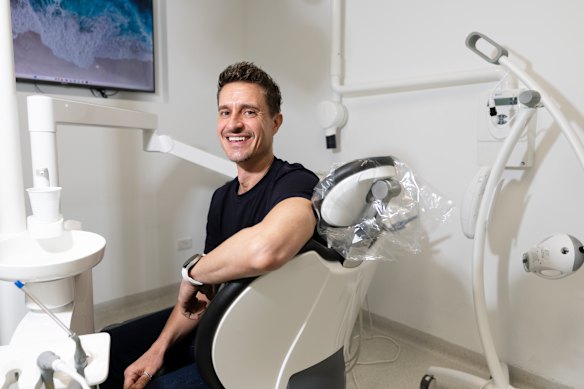
At the clinic, Jean Carre is all smiles after his fourth and final round. He tells us he thought it would be more painful than it actually was. “There was hardly any sensitivity towards the end, it was bearable.” As for the result: “I think it’s good, it still looks natural. It still looks like my teeth – just whiter. ”