source : the age
To submit a letter to The Age, email letters@theage.com.au. Please include your home address and telephone number. No attachments, please include your letter in the body of the email. See here for our rules and tips on getting your letter published.
Just because the Coalition is suggesting an order of preferences doesn’t mean a voter has to follow that suggestion. A voter can allocate the required numbers on the ballot sheet in any way they choose. We are not all just sheep who have to follow what others want us to do, following any party’s or any candidate’s leaflet handed out at a polling booth. We are individuals with individual choices, values and opinions. Please put a lot of thought into how you will vote and allocate your preferences according to your principles, not that of a party machine. Many independent candidates’ leaflets only ask voters to allocate the No.1 to them recognising voters’ ability and intelligence to think for themselves in regard to preferences.
Jenny Callaghan, Hawthorn
Labor, time to go into the wilderness
Unlike your correspondents (Letters, 12/11), I am not overly concerned by Jess Wilson’s decision to preference One Nation ahead of the Greens and Labor. Opinion polls indicate that the Coalition will almost certainly be in a position to form government with a comfortable majority in the Legislative Assembly. In this circumstance, One Nation will only have a potentially significant role to play in the Legislative Council. However, even in that house the new government will be able to negotiate with other parties as well as One Nation in order to pass its legislation. As for me, I won’t be deliberately preferencing One Nation ahead of Labor when I follow the Liberals’ how-to-vote card. Rather I will be sending a message to the Labor Party that it needs to spend some time in the political wilderness in order to examine why it lost its way so badly.
Ivan Glynn, Vermont
The choice is all ours, and enjoy the sausage
The Liberal Party in Victoria making the decision to preference One Nation has drawn many responses to The Age letters pages. How many voters take and follow party how-to-vote cards? Here’s a thought: if you want to vote for the Liberal Party first, you can still place One Nation last on your ballot paper. You are allowed to think for yourself. Even better, last Saturday in New Zealand’s election, that nation voted free of campaigners, how-to-vote cards and roadside signage at polling places. It’s the law. New Zealanders can vote without interference or annoyance. It seems that they have to do their homework before arriving to vote. Wouldn’t it be wonderful if we could say the same in Australia? Not only do we have the right to vote, we more importantly have the right to think for ourselves. Don’t let a party, any party, determine how you place your preferences. Do your homework. Say politely, ″no thank you″, when offered a how-to-vote pamphlet at a polling booth. Just enjoy your democracy sausage.
Gryff Jamieson-Ballard, Castlemaine
System imperfect, but it’s preferable
First-past-the-post elections are hardly the panacea your correspondent (Letters, 12/11) wishes for. Take the seat of Hawthorn with seven candidates standing. In today’s crowded contests, the most popular candidate might earn 30 per cent of the vote with the other 70 per cent going to the other six candidates. A first-past-the-post system would elect an MP that 70 per cent did not prefer. Our preference system considers the wishes of the majority, however imperfectly, in a way that first past the post cannot do.
John Gwyther, Coongulla
It comes down to competency and policy
The Victorian government does not deserve another term. Both the Coalition and One Nation have shown themselves incompetent at the simplest task of picking candidates. So independents or greens at least stand for something – the environment and the planet or a more civilised and thoughtful political discourse. Take your pick, but don’t vote for anyone who does not deserve it through competence and policy.
Greg Cooper, Mount Martha
THE FORUM
Tax gas dodgers
Every electric vehicle on the road reduces our reliance on imported fuel, and every home battery helps shave the evening peaks that drive up wholesale power prices. Both help ease the cost of living. So why is the Albanese government considering cutting support for these clean, efficient technologies (“Green energy perks face budget axe in bid to curb inflation”, 12/11)? A better option sits in plain sight: a levy on gas exports. The Australia Institute estimates a 25 per cent levy would raise about $17 billion a year, and argues it would steer more gas into the local market, easing gas and electricity prices. Don’t tax the households doing the right thing; tax the gas giants who are dodging their share.
Isabelle Henry, Ascot Vale
Hung parliament wish
My wish for the Victorian election is a hung parliament with independents holding the balance of power in the Legislative Council (Letters 12/11).
That would help rein in Labor’s profligate spending and the Liberal/One Nation propensity to slash funding to health, education, climate change mitigation and community services, plus keep a lid on the culture wars.
Jane Ross, San Remo
Labor’s fallen standards
An often quoted cliche is: the standard you walk past is the standard you accept.
When applied to politics, the standards the Labor Party has at best, accepted, and at worst facilitated, are not able to be ignored. Regardless of all other voting permutations, the Labor Party needs to be placed last in the coming state election.
Mike Pantzopoulos, Ashburton
Wilson’s conundrum
Jess Wilson has decided to preference One Nation ahead of Labor and the Greens unless in specific electorates a One Nation candidate holds or expresses extreme views. What a dilemma for her if a One Nation candidate, although highly unlikely, was in favour of keeping the Treaty in place.
Mark Hulls, Sandringham
Doomed outcome
The only things that preference deals produce are uncomfortable bedfellows and unworkable governments (“Liberals to put Labor, Greens last”, 11/11). There’s no point in doing deals to facilitate electoral success if you then cannot enact and deliver policies as promised. Any government dependent on short-term preference deals is doomed to long-term frustration and failure.
Jenifer Nicholls, Windsor
What follows protest?
Well said to your correspondent (Letters, 12/11). Lodging a ″protest vote″ just for the sake of protesting, without any consideration for the long-term implications, would be a bit like shooting yourself in the foot by way of protest. You are probably going to be worse off either way. There are no magic bullets in either context.
Helen Moss, Croydon
Qantas, it’s over
Dee Madigan (Comment, 12/11) hit the nail well and truly on the head.
I have always tried to fly with Qantas as I believed it to be the best airline. I, too, was excited when Alan Joyce left the company and Qantas appointed Vanessa Hudson to lead it.
Now, after having continued to support them, those days are coming to an end. I am currently going through a small and, some would say, petty dispute with Qantas over quite a lot of frequent flyer points following an international flight. So much for loyalty after choosing them for 50years. Maybe it’s time to walk away from this relationship.
Wendy Daniels, Hawthorn
Mental health failings
I commend Dr Mark Langley (Letters, 11/11) on reminding us of the government’s failure to look after the mental health of our community following the closure of the state mental and psychiatric hospitals and their associated outpatient facilities.
I had an extensive career in our mental hospitals including a brief position as acting Psychiatric Superintendent at Ararat Mental Hospital including J Ward, which was termed Victoria’s Ward for the Criminal Insane. I also helped run the outpatient psychiatric services at Prince Henry’s Hospital which preceded the Monash Medical Centre. In all of these, the public had free and immediate access to public psychiatric services. We turned nobody away. As I commented in my submission to the Royal Commission into Mental Health although there were evils in the mental hospitals including institutionalisation and a lack of agency among inmates, when we closed the system we abandoned the mentally ill. As I put it, we threw out the baby with the bath water.
Successive governments never implemented alternatives for public psychiatric care. Also, in the modern world the balance between individual and community rights has become distorted so that it is so difficult to compel those with a lack of insight to have effective treatment and rehabilitation.
The consequence of this has been a contribution to violence and lawlessness. The shortage of public psychiatric beds including beds in forensic psychiatry and the unwillingness to lock up violent offenders during the long wait before trial is endangering our community.
Dr Norman Rose, Kilmore
Failure of funding
Your correspondent (Letters, 11/11) is wrong in suggesting ″deinstitutionalisation has failed”. Research in the 1970s clearly demonstrated improved therapeutic outcomes for long-term psychiatric patients could be achieved in the community. However, the success of deinstitutionalisation was also shown to be dependent on the establishment of high-quality community mental health services that provided assertive and ongoing social interventions and support, and targeted therapeutic interventions.
Those of us who were proponents of deinstitutionalisation in the 1980s stressed to government that a failure to adequately fund community-based treatment would result in a failing system and poor care for those with chronic illness. Unfortunately, we then had the Kennett era.
Effectively, government took the money from the sale of psychiatric hospitals and put it into general revenue, while establishing a threadbare system of community treatment. It’s not deinstitutionalisation that has failed, rather for decades governments have failed to adequately fund appropriate treatment and supports. The irony is that the same 1970s research also showed that community-based treatment was cost effective, so long as it was adequately funded and maintained.
Dr Peter Cook, Essendon
Numbers with Wilson
While it is true that 40 per cent of Australians voted Yes in the Voice referendum, as your correspondent correctly says (Letters, 11/11), it is equally true that 60 per cent voted No. In Victoria, the No vote was slightly lower but still a significant 54 per cent against. From the day she was appointed Liberal leader Jess Wilson has made it clear she would “tear up” the Treaty. If she does win government, as seems likely, a majority of Victorians will have given her an undeniable mandate to repeal legislation that, thanks to the overwhelming No vote in 2023, should never have been brought before parliament in the first place.
Greg Hardy, Upper Ferntree Gully
Policies at odds
Definition of hypocrisy: The Liberals expel a candidate for making disparaging remarks about Indigenous people, yet they want to disparage First Nations people by expelling the Treaty.
Linda Lewis, Watsonia
How to reshape Labor
As Shaun Carney argues (Comment, 12/11) the shine has left the PM. But what to do? Anthony Albanese has been at the game of politics for most of his life. Is he going to change his political character now? Is he even capable of doing so?
In the UK, a sinking Labor government has had its fortunes reversed by the installation of Andy Burnham as PM. Not much essentially has changed in terms of policy, but there’s now a sense of a government with strong leadership, a clear direction, and a great communicator in the top job. Australia’s fundamentals are so much better than the UK’s, and yet we have a government that is floundering, led by someone who seems embarrassed to talk up his own government’s achievements – notably, making housing affordable for the first time in decades. There’s plenty more to do to fix 20 years of policy neglect and widening inequality, but there’s the basis of a good story to tell here. Labor is terrified of leadership change, for good reason. While polling shows a significant drop in support for Labor, more alarming is the tangible slide in the government’s credibility, which, once lost, is virtually impossible to recapture. Time for a switch à la Burnham?
Greg Gardiner, Brunswick
Wrong priorities
Illustrator Megan Herbert nailed it with her cartoon (12/11). However, it could have had the word “perchance” before “ready by late 2030s”. Wouldn’t it be good, if instead of giving $368 billion to the US on a vague promise of useless hardware, we invested the money in education, health and sustainability?
John Laurie, Riddells Creek
Myer was the apex
Your correspondent is correct (Letters, 11/11). Invoking the glorious past of David Jones is false nostalgia in Melbourne. When I was first in Melbourne in 1979 there was no DJs and Myer represented the pinnacle of retail experience. The food hall was dazzling.
Helmut Simon, Thomson
The halcyon days
David Jones is an interloper. In colourful mosaic and tiled signage, the name Buckley and Nunn Limited remains on the DJs’ Bourke Street building, a reminder of the halcyon days when about a dozen department stores operated in the CBD.
Jim McLeod, Sale
AND ANOTHER THING
Politics
Anthony Albanese says, ″Australia is a proud leader on climate change.″ What utter hypocrisy.
Reg Murray, Glen Iris
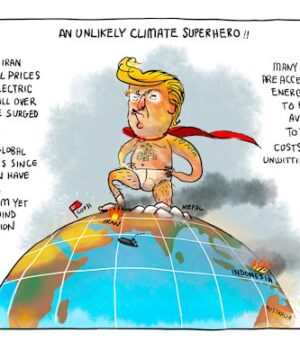
An exciting new cartoon coming soon ″Donald The Lame Duck and his Daffy mates″. Stay tuned.
Ian Holton, Yarraville
If ″first past the post″ is not an option, then voters have to do our own research, and vote for the candidates we prefer.
Wendy Brennan, Bendigo
I’ll see your pothole promise and raise it one million. How childish. We need politicians with vision to improve society and the environment.
Ralph Frank, Malvern East
“You shall be judged by the company you keep.” So the Liberals have put One Nation ahead of Labor.
Rod Cripps, Parkdale
Frightening to realise people will vote for this combination. Time to stop. Reflect. And why scrap Victoria’s Treaty with First Nations people?
Virginia Krumins, Albert Park
Furthermore
Re: “Aged care homes guarded”, (11/11). Old age is inconvenient enough, without driveby shootings.
Lawrie Bradly, Surrey Hills
A rising number of Qantas workers definitely don’t call Australia home.
Luigi Soccio, Daylesford
Qantas the flying kangaroo that escaped overseas.
Doug Springall, Yarragon
Megan Herbert (11/11) reveals a huge absurdity – believing that outmoded technologies can overcome a cyberattack on our defences.
Kay Moulton, Surrey Hills
It’s wrong that small voting centres are being closed. At least offer free transport to another centre.
John Walsh, Watsonia
Finally
Usman Khawaja should have named his book True Grit.
Paul Custance, Highett