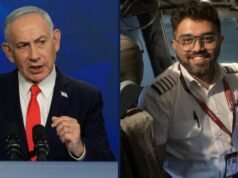
Source : INDIA TODAY NEWS
A flydubai flight from Dubai to Tel Aviv was thrown into chaos when a violent struggle broke out between the captain and co-pilot inside the cockpit. Israeli officials said the co-pilot stabbed the captain before the Boeing 737 MAX 8 went into a sudden dive. The co-pilot, whom an Israeli official identified as an Omani national, tried to take control of the aircraft.
advertisement
According to an Israeli passenger who helped subdue the attacker, the stabbed captain managed to open the cockpit door before collapsing. The passenger told Israeli Prime Minister Benjamin Netanyahu that this allowed them to enter the cockpit and restrain the attacker. A second set of pilots travelling on the flight then took over the controls. The aircraft was eventually stabilised and landed safely at Tabuk Airport in Saudi Arabia. The flight, flydubai FZ1073, was carrying more than 170 Israelis from Dubai to Tel Aviv. Flight-tracking data showed the aircraft plunged nearly 14,000 feet in less than 30 seconds.
Israeli officials said a potentially catastrophic crash had been averted. Hours later, some sources and Israeli media outlets identified the stabbed captain as Smit Machchhar. He was described as an Indian national from Gujarat who had previously worked for SpiceJet.
Here’s a blow-by-blow breakdown of what happened aboard the flydubai flight:
-
The trouble began inside the cockpit when passengers heard shouting and a physical struggle. Yasmin Abukasis, whose daughter Miryam Shira Ohayon was on the flight, told AFP: “She said one pilot tried to kill the other pilot with a knife. They heard shouting.” She said another passenger went to the cockpit, “saw a lot of blood” and called for help before passengers moved in and caught the attacker. An Israeli passenger separately told The Jerusalem Post that one pilot stabbed the other and tried to force him out.
-
The cockpit struggle was followed by a dramatic drop in altitude. According to Flightradar24 data cited by Reuters, the aircraft descended nearly 14,000 feet in less than 30 seconds before the first emergency signal was sent. The Boeing 737 MAX 8 was eventually brought under control and landed safely at Tabuk Airport in northern Saudi Arabia.
-
The plane suddenly began losing altitude, prompting several Israelis seated near the front to rush towards the cockpit and confront the attacker, according to a passenger who spoke to The Jerusalem Post. They eventually removed him from the cockpit. Two other pilots travelling at the back initially appeared to be in shock, the passenger said, prompting him to shout at them to take control of the aircraft.
-
Israeli officials told Reuters that the co-pilot stabbed the captain before passengers and cabin crew intervened. An Israeli official identified him as an Omani national. Investigators are examining how he was cleared to operate a flight to Israel and whether he held dual citizenship. Israeli sources quoted by Channel 12 also said he had worked for flydubai for less than a year.
-
Israeli media initially described the captain as being of “Indian origin”. Channel 12 used that description, while Ynet News identified him as an “Indian national”. Hours later, some sources and media outlets identified him as Captain Smit Machchhar, an aviator from Gujarat with more than a decade of flying experience who previously worked with SpiceJet.
-
The captain and co-pilot were being treated at a hospital in Tabuk after the aircraft landed. An Israeli passenger told The Jerusalem Post that the stabbed captain was in critical condition and said an Israeli dentist travelling on the flight treated him. A purported video carried by Israeli media claimed one pilot was seriously injured while the other suffered less severe injuries.
-
The passengers safely landed in Saudi Arabia after the flydubai aircraft was diverted to Tabuk. They spent around eight hours there before departing for Israel on a replacement flydubai aircraft, which later landed at Ben Gurion International Airport, according to flight-tracking data. The episode marked a rare arrival of Israelis in Saudi Arabia, which has no diplomatic relations with Israel. Two security sources told The Times of Israel that Israel had asked Saudi Arabia to allow Israeli aircraft to bring the passengers home, but the request was rejected.
-
One of the passengers who helped subdue the attacker, identified as Yaniv, later recounted the ordeal to Prime Minister Benjamin Netanyahu. He said he and another man forced their way into the cockpit and found the wounded pilot near the door. “When I went in, I saw the terrorist on the controls, between the two seats. There were no pilots in the seats,” Yaniv said. “I grabbed the terrorist, put him in a hold, and first of all pulled him outside.” He later returned to the cockpit, grabbed the controls and pulled them back as the aircraft tilted sharply. “The plane started leveling out a little more, and then the pilot told me he was taking over from there,” he said.
-
Asked by Netanyahu what the attacker was doing, Yaniv replied: “He was trying to destroy the controls in order to disable the plane.” Netanyahu said passengers and a crew member entered the cockpit after the aircraft “entered a tailspin and began to dive” and found the co-pilot “trying to sabotage the plane’s systems”. “They saved many lives. They prevented a heavy disaster,” Netanyahu said. An Israeli official separately told N12 that the co-pilot “tried to do 9/11 — either hijack the plane to the ground or crash it.”
-
Describing the incident as a “highly severe security incident”, Benjamin Netanyahu said the Omani national identified as the co-pilot was arrested after the plane landed and would be interrogated by Saudi authorities, while Israel’s Transport Ministry said it would launch a joint investigation with the defence establishment. Netanyahu said “all passengers are out of harm’s way” and ordered tighter security on Israeli and non-Israeli carriers flying into Israel, prompting Israel to review and ramp up security procedures for pilots flying into the country.
– Ends
SOURCE :- TIMES OF INDIA