Source : INDIA TODAY NEWS
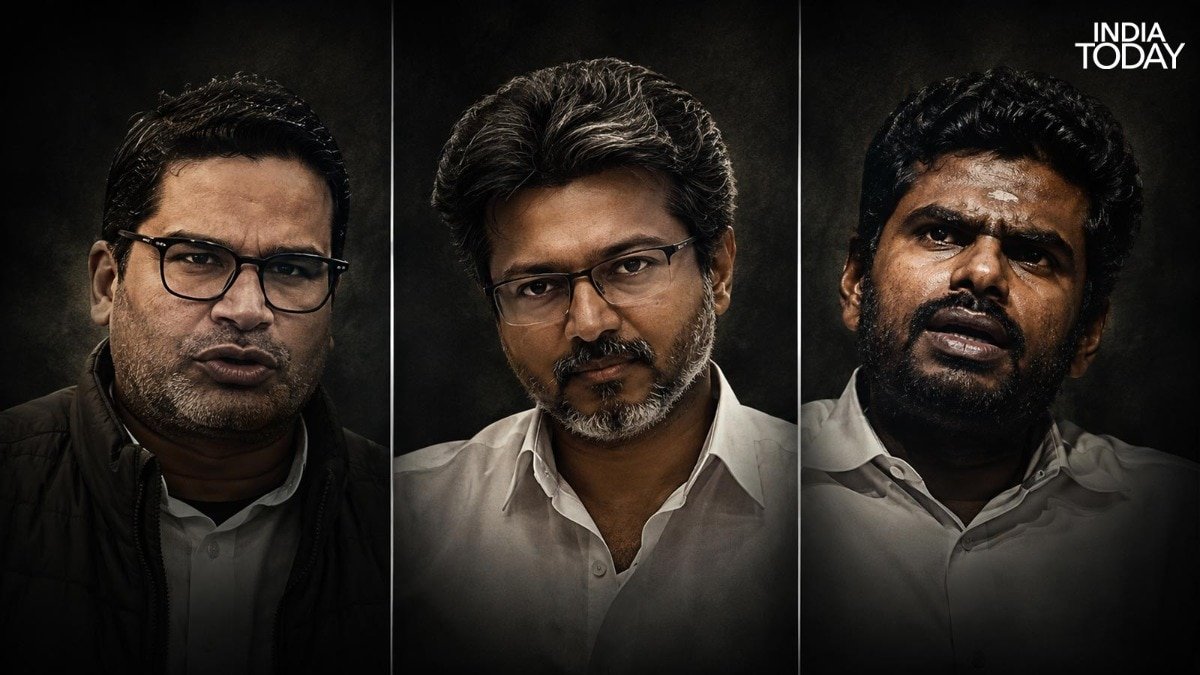
For decades, Indian politics has followed a pattern. It has been all about building a caste coalition, consolidating a religious voter bloc, cultivating a family legacy, and then fighting elections through an organisation that may have existed for quite some time. But a new political template or start-up-like mode is beginning to take shape in the political spectrum of the world’s largest democracy. The early signs of it are being seen in three different figures. Tamil Nadu Chief Minister C Joseph Vijay, political strategist-turned-politician Prashant Kishor and former BJP Tamil Nadu chief K Annamalai.
advertisement
These three are not ideological triplets, nor do they have the same political resources. Yet each is attempting, in his own way, to build politics from scratch rather than operate within an established political juggernaut. The hint of this pivot has come with Prashant Kishor, or PK as he is popularly known, winning Bihar’s Bankipur Assembly seat by-election on August 3.
PK was a political consultant before he dived into politics with the idea of transforming his home state of Bihar. He is a leader whose party had drawn a blank in its first Assembly election and returned to defeat the Bharatiya Janata Party (BJP) in one of the strongholds it had dominated for 30 long years.
It is PK’s victory that has pushed everyone to think about whether Indian politics is entering another generational transition? Will the next generation of political leaders look more like startup founders than traditional politicians?
Indian politics has never remained static. Every generation has brought a new organising principle. The Congress’s one-party dominance system was challenged by the rise of regional parties in 1967. Mandal in 1990 transformed the political importance of caste. The Ram Janmabhoomi movement’s peak year, 1992, reshaped the role of religion in electoral politics. Economic liberalisation changed aspirations, television changed political communication, and social media’s dominance since 2014 allowed politicians to speak directly to voters without depending entirely on traditional media or party structures.
The emerging model might be different again. It is politics built around a leader’s personal brand, direct citizen engagement, youth networks, data, technology, issue-based mobilisation and a promise to disrupt an existing political order.
Tamil Nadu‘s CM Vijay has already demonstrated how quickly such a political startup can scale. PK appears to have found electoral validation after a difficult beginning. Annamalai, meanwhile, has walked away from an established political organisation to build a new one almost from the ground up with a different working structure.
One is the unicorn. One is the startup trying to find its market. One is still building the company. But together, they offer a glimpse of what Indian politics could look like in the next generation.
PRASHANT KISHOR: FROM SELLING STRATEGIES TO BECOMING THE PRODUCT
Prashant Kishor’s transition into politics was perhaps the most unusual of the three. For years, PK operated from behind the political scenes, as the strategist who helped leaders understand voters, shape messages and build winning campaigns. He worked with some of the country’s most powerful political outfits and its leaders, across India’s political landscape from north to south and east to west, before deciding that he would no longer merely design political victories for others.
In 2022, he began the Jan Suraaj campaign in Bihar with a roughly 3,000-km padyatra (foot march). It was a strikingly old-fashioned method for a politician whose reputation was built on data, technology and modern campaign management. PK travelled through villages and towns, meeting people and attempting to understand the problems of Bihar at the grassroots level.
Jan Suraaj eventually transformed from a movement into the Jan Suraaj Party (JSP) in 2024. The pitch was equally unconventional. Instead of placing caste arithmetic at the centre, Kishor spoke about education, employment, migration, healthcare, pensions, agriculture, women’s economic empowerment and governance. He argued that Bihar’s political stagnation was partly the consequence of a political system that had spent decades fighting over power without adequately addressing why young people were forced to leave the state in search of work.
PK’s party was built differently. He gave tickets to academicians, intellectuals, retired bureaucrats and legal experts to contest the Assembly election, while also ensuring proportional representation for backward classes, women, transgender and the youth.
But the first electoral test of PK and his JSP was brutal. The party contested 238 of the 243 Assembly seats in the 2025 Bihar election and failed to win even one. The party secured only around 3% of the vote. PK himself had chosen not to contest. For a conventional politician, such a result could have been the end of the project.
But PK continued to insist that Jan Suraaj was not designed around a single election. He had attempted to build a political organisation, not merely a campaign.
Then came Bankipur’s bypoll. Kishor’s victory there does not automatically transform JSP into a major political force in Bihar. A bypoll is not an Assembly poll, and one constituency cannot erase the structural advantages enjoyed by established parties. But politically, the symbolism is difficult to ignore. The strategist who spent years helping others win elections has now demonstrated that his own political vehicle can win one.
What makes Bankipur more than a constituency story is that it suggests a new political organisation can survive its first major failure, rebuild and return with electoral credibility. And that is precisely how startups work.
Start-ups go to the market with their business model, fail, return to the drawing board, and pivot quickly for a comeback.
THALAPATHY VIJAY: THE UNICORN OF THE START-UP POLITICS OF INDIA
If PK represents a political startup searching for scale, Vijay represents the unicorn, which is an exceptionally rare political enterprise that achieved extraordinary growth in a short period.
C Joseph Vijay entered politics in 2024 by launching his party, Tamilaga Vettri Kazhagam (TVK). The actor-turned-politician already possessed a massive public following that most political leaders spend years trying to acquire. But converting film popularity into political power is not as easy as converting fans into voters.
Tamil Nadu has one of India’s most sophisticated political ecosystems. The two Dravidian giants, Dravida Munnetra Kazhagam (DMK) and the All India Anna Dravida Munnetra Kazhagam (AIADMK), have spent decades developing dominance in the state. The land of the Tamils has rarely been kind to outsiders attempting to break that duopoly of the DMK and the AIADMK.
Vijay nevertheless tried to create a new political brand. His politics did not completely revolve around caste nor Periyar. When the TVK chief spoke about social justice, it was largely framed through equality and welfare rather than caste mobilisation. He positioned TVK against communal politics and attempted to attract young voters.
Vijay’s manifesto focused heavily on everyday concerns like women’s welfare, employment, education, healthcare, farmers, pensions, free electricity, drinking water and social security.
But the real achievement of TVK was the speed. Traditional parties take years to establish themselves, whereas Vijay’s party not only built itself from scratch but also formed the government within two years of its birth.
In the 2026 Tamil Nadu Assembly election, TVK emerged as the single largest party with 108 seats in the 234-member Assembly. With support from Congress and other regional partners, Vijay was sworn in as Tamil Nadu CM, ending the 60-year dominance of the Dravidian heavyweights.
That is why the startup analogy fits him better than almost any recent political entrant. Vijay created a new brand, entered a market dominated by established players, converted an existing community into a political base and then captured power. But the unicorn story comes with its own warning.
A political startup can scale rapidly because of the founder’s brand. Governing, however, requires institutions. A fan base can fill a rally, but it cannot by itself run a government. The real test for Vijay will therefore be whether TVK can transform the extraordinary popularity of its founder into a durable political institution. If it can, the Vijay experiment could become one of the most consequential examples of political entrepreneurship in contemporary India.
ANNAMALAI: THE FOUNDER WHO LEFT THE ESTABLISHED COMPANY
K Annamalai represents a different kind of political entrepreneur when compared to PK and Vijay. He did not spend years crafting elections from outside the political system like PK, nor did he enter politics with a film star’s fan base like Vijay. The IPS officer-turned-politician entered conventional politics in 2020.
Annamalai spent around six years with the BJP and was the party’s Tamil Nadu president. He experienced the machinery of a national political organisation from the inside. He attempted to bring his own style to the party, but reached the point where he believed the existing structure could not accommodate the kind of politics he wanted to pursue.
So he quit the established party like some start-up founders who quit established companies to work on their passion. Annamalai is very much like Tony Fadell and Martha Stewart, who left their safe harbours to pursue their dreams.
On June 5, 2026, Annamalai launched We The Leaders, a political movement that he says will become a political party slowly. Unlike a conventional politician launching a new party before an election, Annamalai has chosen to build the organisation first and contest later, with the 2031 Tamil Nadu Assembly election as the larger objective.
That makes his experiment perhaps the most literal political startup of the three. There is no immediate election to fight, and Annamalai’s movement is emphasising rather on membership, civic engagement, leadership training and building an organisational structure.
We The Leaders has spoken about term limits, age limits and rotation of leadership for elected representatives. Annamalai has described himself as the movement’s “Chief Servant”, rather than building the organisation around the conventional idea of a supreme leader. His movement also seeks to position itself against caste and religion-based politics, asking citizens to approach political participation as citizens first.
In this sense, Annamalai is not merely trying to create another party. He is trying to redesign the organisational structure of one. But unlike Vijay and PK, Annamalai does not yet have an electoral victory to demonstrate that the model works. That is precisely what makes his experiment interesting and uncertain at the same time.
THREE FOUNDERS FOR THE POLITICS OF NEXT GEN?
PK, Vijay and Annamalai have different traits as politicians. PK has experience designing political strategy. Vijay has an enormous fan base. Annamalai has administrative and political experience.
Their political environments are different too. PK’s fray is Bihar’s deeply involved caste and alliance structures. Vijay’s battlefield is Tamil Nadu’s established Dravidian political order. And Annamalai’s is to create political space outside the structures he once operated within.
But there is a common thread running through all three. They are attempting to manufacture a political constituency rather than inherit one. That is a significant departure from the conventional Indian political model. That is startup politics of India.
But this does not mean caste and religion are suddenly irrelevant in the country’s politics. They remain powerful forces in Indian elections. Nor does it mean traditional parties are disappearing. Established parties have local leaders, grassroots workers, resources and social relationships built for decades, which is something startups cannot manufacture overnight.
Yet the startup analogy captures a genuine shift in political behaviour. The recent student agitations and emerging political developments across the country offer a hint of a broader change.
Indian politics has evolved with every generation that found a new way to organise voters. On the ground sense is that the next generation might see politics beyond caste, religion and division. The political market is looking like it is changing. The question is no longer whether politics can be built differently. Bankipur, Vijay and Annamalai suggest that it could. The question now is whether this new model can scale.
– Ends
SOURCE :- TIMES OF INDIA