Source : INDIA TODAY NEWS
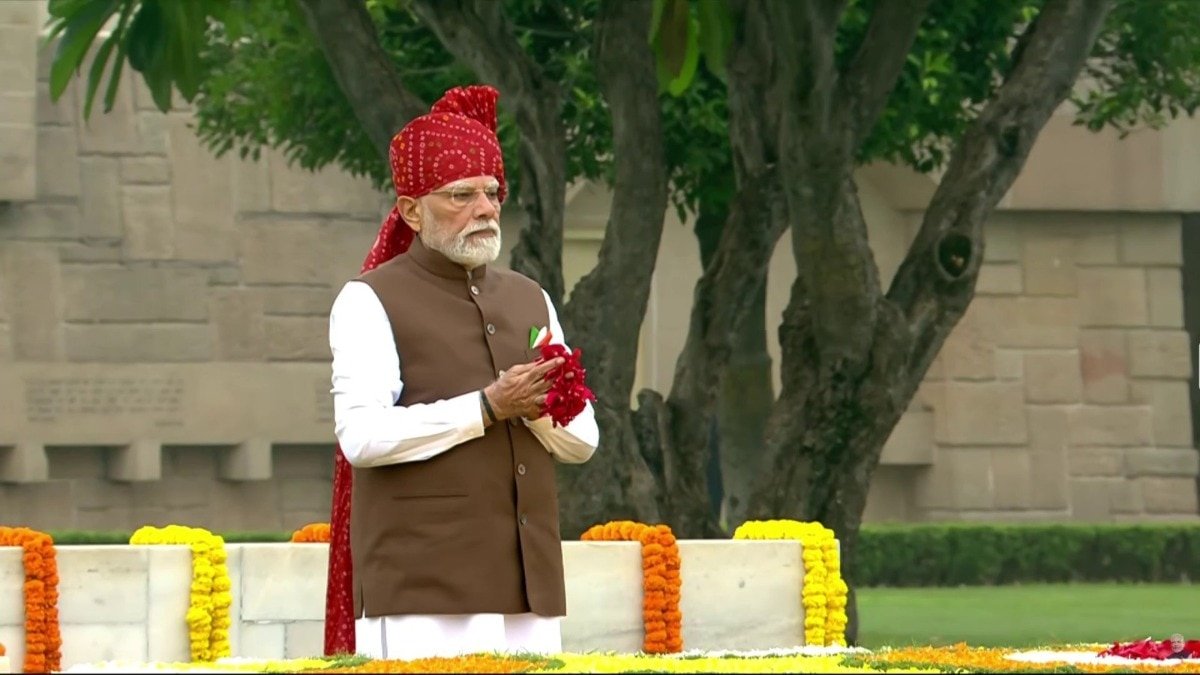
Prime Minister Narendra Modi kept up a familiar Independence Day tradition on Saturday, turning up for the 80th Independence Day celebrations in a striking bright maroon safa (turban) dotted with yellow and white Bandhani patterns.
The maroon turban, paired with a crisp white kurta-pyjama and brown Nehru jacket, marked the continuation of PM Modi’s Independence Day tradition of wearing distinctive turbans.
advertisement
Go back to his first Red Fort speech in 2014 and there he was in a bright red Jodhpuri bandhej, complete with a green tail. A year later came yellow and multicoloured criss-cross patterns. There have since been pinks, reds, saffrons, bandhani and leheriya, and even a turban carrying the colours of the national flag.
A look at all 12 together shows there is a pattern.
Many of the turbans draw heavily from Rajasthan and the wider textile traditions of western India. The colours are usually bright. The tails are often long. Saffron, red and yellow keep returning.
Political analyst Sajjan Kumar says this is unlikely to be accidental.
“When it comes to a political leader in the public sphere, everything is deliberate. PM Modi is very conscious of the messaging that he does,” Kumar told India Today Digital.
There is also something interesting about what PM Modi does not wear at the Red Fort, Kumar points out.
PM Modi has worn Sikh-style turbans on other occasions, but his Independence Day choices have generally stayed away from styles with an explicit religious identity. They also don’t resemble the more functional turbans associated with farmers in Haryana and other parts of northern India.
Instead, Kumar sees them as closer to the elaborate ceremonial styles historically associated with Rajasthan and Gujarat.
“It does not signify religiosity or peasantry. It signifies something which is closer to the traditional royalty style of turban or safa,” he said.
So how has the Independence Day turban changed over PM Modi’s years at the Red Fort? And what was India talking about after each of those speeches?
2025: ORANGE TAKES OVER
Orange dominated PM Modi’s Independence Day look last year.
He wore an orange turban in the traditional safa or pagri style, with a white kurta, matching orange jacket and a stole in the colours of the national flag.
The speech had a very different backdrop.
It came months after the Pahalgam terror attack and the resulting Operation Sindoor, which figured prominently in PM Modi’s address. He praised the armed forces and said India would no longer tolerate nuclear blackmail.
Self-reliance was the other big thread. From defence equipment to semiconductors, PM Modi argued for reducing India’s dependence on other countries and also announced plans for next-generation GST reforms.
2024: A SPLASH OF LEHERIYA
The year before, it was a Rajasthani leheriya that stood out.
PM Modi’s turban featured the distinctive wave-like tie-dye pattern in orange, yellow and green, paired with a white kurta and blue jacket.
Leheriya gets its name from lehar, or wave, and is among Rajasthan’s most recognisable textile traditions. It was also another example of the western Indian influence that runs through PM Modi’s Independence Day wardrobe.
His speech made news for another reason.
PM Modi used the Red Fort to make a pitch for what he called a “secular civil code”, arguing that India needed to move away from religion-based civil codes. He also pushed “One Nation, One Election”, spoke about crimes against women and returned to his larger Viksit Bharat 2047 pitch.
2023: BANDHANI BEFORE AN ELECTION YEAR
A multicoloured Rajasthani bandhani-print turban was PM Modi’s choice in 2023. Yellow, green and red ran through the headgear.
He paired it with an off-white kurta-churidar and black V-neck jacket.
Bandhani, the centuries-old tie-dye craft associated particularly with Gujarat and Rajasthan, was familiar territory for PM Modi. The political setting, though, was important. The 2024 Lok Sabha election was less than a year away.
PM Modi repeatedly addressed India’s 140 crore people as his “parivarjan”, or family members, and spoke about India’s demographic strength, democracy and diversity.
Then came a line that immediately acquired political significance: PM Modi said he would be back at the Red Fort the following year to present the country’s achievements.
2022: WHEN THE TURBAN BECAME THE TRICOLOUR
If there was one year when the message of the turban was impossible to miss, it was 2022.
India was celebrating 75 years of Independence. The Har Ghar Tiranga campaign was underway. And PM Modi arrived in a turban carrying the colours of the national flag.
The headgear featured white and green stripes against saffron and was paired with a white kurta-pyjama and light blue sleeveless jacket.
The symbolism extended to the speech.
PM Modi laid out his “Panch Pran”, or five pledges, for the next 25 years: make India a developed nation, shed the colonial mindset, take pride in India’s heritage, strengthen unity, and fulfil one’s duties as a citizen.
Kumar sees 2022 as one of the clearer examples of how clothing and political messaging can come together in PM Modi’s public appearances.
2021: SAFFRON, RED AND A LONG PINK TAIL
It was difficult to miss the tail in 2021.
PM Modi wore a saffron turban with red patterns that ended in a long splash of pink over his shoulder. A blue jacket over a white kurta-churidar completed the look.
India, meanwhile, had just emerged from the devastating second wave of Covid.
PM Modi looked beyond the immediate crisis and spoke about the 25-year journey to 2047, calling it India’s “Amrit Kaal”. He also announced the PM Gati Shakti national master plan and expanded his familiar political slogan to “Sabka Saath, Sabka Vikas, Sabka Vishwas and Sabka Prayaas”.
2020: A TURBAN IN THE TIME OF COVID
There was no escaping the pandemic in 2020, not even in the Prime Minister’s Independence Day attire.
PM Modi wore a saffron-and-cream turban with a long trail, but it was the white scarf with a saffron border that captured something about that extraordinary August 15. PM Modi used it to cover his mouth and nose as India battled the first year of Covid-19.
PM Modi’s speech centred on Atmanirbhar Bharat. He also called for greater self-reliance, pushed “vocal for local” and announced the National Digital Health Mission.
2019: YELLOW AT THE RED FORT
PM Modi’s first Independence Day appearance after his emphatic 2019 election victory came in a bright yellow safa with hints of green and red and a long tail.
But what he wore was quickly overshadowed by what he spoke about.
Just 10 days earlier, the Centre had effectively scrapped Jammu and Kashmir’s special status under Article 370.
PM Modi used the Red Fort address to defend the decision, pitching it as “One Nation, One Constitution”. He also announced the creation of the post of Chief of Defence Staff and the Jal Jeevan Mission.
2018: SAFFRON BEFORE THE BATTLE FOR 2019
Saffron was the dominant colour in 2018.
PM Modi wore a saffron turban carrying red patterns, continuing two colours that would return repeatedly in his Independence Day appearances.
There was an election less than a year away, and much of the speech sounded like a report card of his first term.
PM Modi listed the government’s achievements in electrification, sanitation, welfare and infrastructure. He announced the September launch of Ayushman Bharat and also promised that an Indian would travel to space aboard an Indian spacecraft by 2022.
2017: RED, YELLOW AND A ‘NEW INDIA’
Red and yellow came together in 2017, with golden criss-cross lines running through PM Modi’s turban.
His message from the Red Fort was about what India could look like five years later.
PM Modi pitched a “New India” by 2022, when the country would celebrate 75 years of Independence. Invoking the five years between the Quit India movement in 1942 and Independence in 1947, he called for another five-year national effort against poverty, corruption, terrorism, communalism and casteism.
2016: PINK & YELLOW; BALOCHISTAN STEALS THE SHOW
PM Modi’s pink-and-yellow tie-dye turban was among the brighter headgears of his early years as Prime Minister.
Yet few remember the 2016 address for the turban.
One word dominated the headlines: Balochistan.
From the Red Fort, PM Modi referred to Balochistan, Gilgit and Pakistan-occupied Kashmir, saying people there had thanked him for raising their concerns.
It was an unusual intervention into Pakistan’s faultlines from an Indian Prime Minister’s Independence Day address and came at a time when relations between the neighbours were deteriorating.
PM Modi also spoke about moving from “Swarajya” to “Suraj”, or good governance, and summed up his approach as “Reform, Perform and Transform”.
2015: YELLOW TURBAN WITH A VERY LONG TAIL
If 2014 established the turban tradition, 2015 made it difficult to ignore.
PM Modi chose a predominantly yellow turban criss-crossed with multicoloured lines. Its most striking feature was its exceptionally long tail.
The speech produced a slogan that would soon become a government programme: “Start-Up India, Stand-Up India.”
PM Modi called on banks to encourage entrepreneurship, particularly among Dalits, Adivasis and women. He also spoke about corruption, rural electrification and One Rank One Pension, saying his government had accepted the demand “in principle”.
2014: IT BEGAN WITH A RED BANDHEJ
The tradition started on PM Modi’s first Independence Day as Prime Minister.
He arrived at the Red Fort in a bright red Jodhpuri bandhej turban, its long green tail providing a sharp contrast to his white half-sleeved kurta.
The choice also established a visual template that would return in different forms over the next decade: bright colour, traditional textile, western Indian influence and a prominent tail.
The speech itself offered an early glimpse of the PM Modi government’s priorities.
He called himself the country’s “Pradhan Sevak” rather than “Pradhan Mantri”, announced the Jan Dhan initiative, and invited manufacturers around the world to “Make in India”.
SO, IS THERE A MESSAGE IN THE TURBAN?
Twelve years of Independence Day photographs show plenty of experimentation. There is red and yellow, pink and green, bandhani and leheriya, saffron and the Tricolour.
But Kumar argues that there is a common thread running through them.
“If you see, while it’s a mosaic of India, the colours represent India’s spirit and aesthetics. But it also has a binding code, wherein saffron has dominated,” he said.
That fits into what Kumar describes as PM Modi’s tendency to layer his political communication. A cultural symbol can also carry geographical, ideological and political meanings.
It is tempting, then, to search every turban for an electoral signal. Kumar cautions against going that far.
“Election is always one of the factors, but that is not the sole factor,” he said. Linking every design to an approaching election, he added, would be an “overstatement.”
What is harder to dismiss is the consistency.
Bright colours have remained. Western Indian influences have remained. So have the flowing ceremonial styles. And every August 15, a new turban inevitably becomes part of the imagery coming out of the Red Fort.
From the red Jodhpuri bandhej in 2014 to the orange safa in 2025 and the bright red safa in 2026, PM Modi has never repeated the exact look. But the tradition itself has endured.
– Ends
SOURCE :- TIMES OF INDIA