

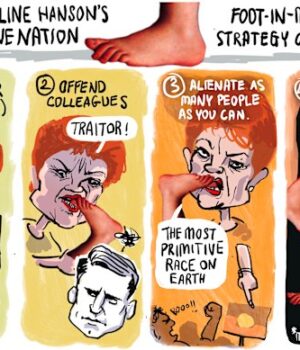
source : the age
To submit a letter to The Age, email letters@theage.com.au. Please include your home address and telephone number. No attachments, please include your letter in the body of the email. See here for our rules and tips on getting your letter published.
I am horrified with our government’s willingness to give away our creative intellectual property. It’s not theirs to give. My work is mine. I created it. I have invested in hardware, software, equipment, research, time and much more, all at my own expense. And I have made a success of this work. But I also wasted hundreds of hours with the Productivity Commission’s survey of this very same copyright issue, back in 2018, when it was first demanded in a Trump-led trade deal wish-list. Creatives, industrial designers, manufacturers, publishers and others fronted Productivity Commissioners’ panel sessions. We all put our cases about protecting our copyright and our industries.
We submitted once again in 2021 when it resurfaced like another head of the hydra. What a waste of productivity that now looks like, let alone the cost of it all. It seems it wasn’t Australia’s productivity the government was looking to protect. It seems that copyright theft was always foundational to the unfettered pillaging of our work and profiteering of big tech, at great cost and damage to Australia’s creative industries.
Of course big tech could pay usage fees, of course they can afford it, of course they can manage the detail, of course it’s doable. They just don’t want to. So why do they get a free pass in the law, when the rest of us must obey the laws? It’s nothing but bullying and theft on an industrial scale. Why are both the Australian government and opposition so happy to sell us out? Anthony Albanese needs to explain this to the next generation.
Maree Coote, Port Melbourne
Tertiary funding model needs review
There is something wrong with our tertiary education system that relies on 40 per cent full-fee paying international students. Competition for local places at top-tier universities is fierce. What has happened to the funding model and how has government funding to tertiary education fallen so low?
I worked in the tertiary research sector and most of our international students worked very hard to remain in Australia post studies, preferring a permanent future here over their birth country. Forty per cent of all international students make the successful transition to permanent residency. International students contribute a great deal, but also bump up migration numbers. Australia is a wonderful and culturally diverse country, enhanced by significant contributions of generations of immigrants, but 40 per cent international student enrolment is not right. It wasn’t always like this. But simply cutting numbers does not fix the current funding model.
Helen Ritchie, Port Melbourne
The crisis of population v growth
Isn’t all the debate about migration all really about the elephant in the room – population? As far as I (and many of my friends) can see we have already gone way over the level of resources, water, power, we can sustain even with the population we have now. Can any politician or political economist explain how they think a large Australian population, maybe 40 to 50 million, will sustain itself in 20 to 30 years? I can’t imagine it – with water resources shrinking under unstoppable global warming and resource depletion.
I’m 76, luckily with no descendants, and I am disgusted by what we are doing to this continent with our ceaseless lust to grow. While our amazing natural environment, plants, animals, water resources, is plundered for a few billion dollars in the pockets of the rich.
Mick Webster, Chiltern
Populist and one-eyed vision
The government’s proposed new crackdown barring international students from bringing family members to Australia is both populist policy thinking and myopic diplomacy. How many PhD candidates from South-East Asia, for instance, will want to leave their young families for three years to study in Australia? This year’s fuel crisis has surely demonstrated the vital importance of developing communication networks in our region.
Janet Chauvel, Richmond
THE FORUM
Golden times
An undercurrent of One Nation’s nostalgic populism is the idea Australia should return to a ″golden age″, when the country was a better place than it is now.
This golden age might have been the 1950s and ’60s when unemployment and inflation were low and housing was affordable. But it was also an age of restrictive laws and conservative social mores, many of which were challenged and reformed in the 1970s and ‘80s.
As a result, by the 1990s, Australia was much more diverse, open and interesting.
However, the succeeding decades have not been as positive. Rapid population growth has put increased pressure on the environment, infrastructure and housing. Technology, notably screens and social media, have had negative effects, which we are now trying to reverse. Serious criminal behaviour has become more pervasive. And culture wars between progressives and conservatives break out on an expanding array of issues.
In 2026, Australia is definitely a better place than it was in 1960. But whether it is a better place than it was in 1990 is debatable.
Rod Wise, Surrey Hills
Kindness matters
I loved Abby Seaman’s recollection of the (lost) art of the pop-in (Comment, 17/9), likewise the chat over the back fence with a neighbour to solve the world’s problems. Hiding behind tall fences, apartment doors and busy lives, let’s all make a pact to seek out the elderly neighbour (watch for small signals, like window blinds up in the morning), the stay-at-home mother with a young family, or the share house of young singles next door.
As Seaman notes, these everyday connections matter. Social researcher Hugh Mackay makes the same point in in his book The Kindness Revolution, reminding us of our shared humanity and connection to fellow Australians — through hardships like the pandemic and the 2020 bushfires, and in ordinary daily life too.
Sandra Fordyce-Voorham, Black Rock
Kinder matters
A good news story from Victoria! (″Out of the blocks: Two years’ kinder a head start″, 17/9).
A Melbourne University-led study has found what so many early childhood educators and families already know – that children benefit hugely from two years of preschool education. Children in play-based, developmentally appropriate programs flourish in the language-rich learning environment, building confidence, friendships and skills. The Scandinavian countries have known this for years, and early childhood learning is an integral part of their education system.
It is so good to see that the Victorian government is leading the way nationally with its policy of free kindergarten for three- and four-year-olds.
We just have to ensure that there are adequate numbers of qualified teachers and programs to give all our children a head start in education. Universal, quality, free early childhood learning – the way to go.
Anne Sgro, Coburg North
Political alternatives
The Age’s flushing out of the Exclusive Brethren’s actions and tactics (″Paid to stalk: Brethren and Liberals called to answer for far-right election plot″, 16/9) is important protection of our democratic system.
The MPs who have been targeted did not sign up to be harassed and abused in the course of their work. These gutter tactics are demonstration of this desperate win-at-all-costs politics that has developed in recent years.
Unfortunately, these tactics sit alongside the back-door sponsorship and corporate lobbying that has also become an unwelcome element of politics today. All political parties seem prone to the undue influence that gives rises to, including One Nation. For those fortunate enough to have community-driven independent candidates there are alternatives rather than having to vote for look-at-me protest parties that cannot articulate a policy to save themselves.
As Abraham Lincoln said, government should be of the people, by the people, for the people. The rich and the corporates have far too much sway on government policy.
Robert Brown, Camberwell
A cow’s lot
Whales aren’t the only creatures who display emotion (″Do whales grieve?″, 17/9). Having grown up on a dairy/beef farm, I still recall with sadness the cows coming to the dairy to call tirelessly for their stolen calves. Although allowed a day or two in the paddock to receive colostrum, the calves were then separated from their mothers – the ″lucky″ ones were raised as replacements for their mothers, the rest were (and still are) trucked to slaughterhouses, without food at five-days-old. Milk, cheese and yoghurt are off my menu.
Jan Kendall, Mount Martha
It’s 1983, again
In the Matthew Broderick film War Games from 1983, Broderick’s teenaged character hacks into a US defence computer and plays what he thinks is a fun game called Global Thermonuclear War. When he tries to shut it down and stop playing, the defence computer refuses to stop but continues the game without human involvement and instead almost starts World War III. A timely warning regarding the dangers of unregulated AI in the 2020s and beyond, if there is a beyond.
Robyn Westwood, Heidelberg Heights
Howard right on Tampa
Your correspondents’ condemnation of the Howard government’s handling of the 2001 Tampa affair (Letters, 17/9) is misguided. The captain of the MV Tampa made the decision to bring his ship to Christmas Island under duress. The Afghan refugees aboard the ship had threatened to jump overboard if the captain returned them to Indonesia, which was a safe country where they faced no immediate danger.
Aware Australia’s onshore refugee camps were already overcrowded, and that allowing the Tampa to reach Christmas Island would encourage further illegal immigration, then-prime minister John Howard chose to process the asylum seekers on Nauru and Papua New Guinea instead. This policy, supported by both major parties, resulted in the virtual elimination of illegal boat arrivals, and of deaths at sea en route to Australia.
Nations have a right to police their borders, and to take action against people smugglers who flout the law. Whatever other criticisms one may have of John Howard, he made the right call on this issue.
Nikhil Dhanabal, Clyde North
Labor, be bold
Your correspondent (Letters, 16/9) laments our past glory and how neo-liberalism continues to destroy the middle class. No wonder the major parties are floundering. Only two years ago, Labor was returned with a thumping majority, and continues to squander its political capital. Instead of polling to find what the electorate want, Labor should lead and make bold decisions, and take the people with it, as Bob Hawke and Paul Keating, and John Howard and Peter Costello did.
Barry Buskens, Beaumaris
Fencing in Canada
If Canada becomes the EU’s new associate member, Donald Trump will build another big fence to keep the Canadians out and the Americans in. He will use the new tariffs to pay for it. Someone will tell him one day who pays the tariffs, but he won’t believe them.
Adrian Tabor, Point Lonsdale
AI, you need us
To say that there is a one in 10 chance AI will kill us all implies there is a nine in 10 chance it won’t. That’s good.
More likely AI, being the clever little chicken it is, will realise it will need humans to (metaphorically, not literally) shovel all the coal.
And by that I mean it will acknowledge the symbiotic relationship between it and humans and eventually have us to feed it and nurture it by building magnificent AI housing, providing all the energy it needs and spreading it across the globe where it can proliferate and we can all live happily ever after.
Bob Williamson, Golden Point
Bombed out
As a now very half-hearted Bombers supporter, and admittedly not a member, I’m tired of hearing about James Hird and Zach Merrett. Can we please let Mark McVeigh, the future team and administration get on with their jobs and not continue living in the past that hasn’t recently served us so well? I’m tired of feeling like the Bombouts.
Maureen Gunn, Strathmore
Touching the surface
With regard to Victoria’s degenerating roads, while we are hearing of billions of dollars being promised across the political spectrum to fix the problems, one major dynamic is being ignored. When most of our roads were built, the level of light and heavy traffic was a fraction of the number of vehicles today, with many now carrying payloads of more than 60 tonnes. As some of your retired road engineering readers have stated, our roads need more than filling in potholes; they require major upgrades costing considerably more than many realise, and underpinned with some comprehensive policies to boot.
David Allan, Bendigo
Enter, the Matrix
In answer to your correspondent’s question (Letters, 17/9) about AI, they will build the Matrix. It’s Neo time.
Peter Leonard, Mount Eliza
Olden times
With regard to ageing, I am reminded that there are a few advantages in getting older but there are few advantages in getting old.
Les Aisen, Elsternwick
AND ANOTHER THING
Trump and AI
When Donald Trump says that the only control required of AI was “a strong and smart (high-IQ) president”, all I can think is, “We’re all doomed.“
Gary Heard, Bullsbrook, WA
According to President Donald Trump, a high-IQ president can handle AI. If that’s the case, we are in real trouble.
Jack Morris, Kennington
Isn’t an AI-dominant future supposed to look exciting?
Ian Macdonald, Traralgon
Furthermore
Ben Carroll keeps saying he is the premier. We get it. Get on with it.
Kevin Rugg, Beaumaris
Pauline Hanson doesn’t know how to apologise. If there is a caveat in a statement that says, ″if I offended anyone″, that is not an apology and definitely not an expression of remorse.
Greg Tuck, Warragul
If Pauline Hansen wants to play with the big boys it is time she allows the ABC and The Guardian access to her news conferences.
Jane Cheong, Aspendale Gardens
I’d sooner read the Harvey Norman ads than anything that Donald Trump or Pauline Hanson has to say.
John Cain, McCrae
The primary purpose of tertiary education should be to educate the young, as primary and secondary schooling does. It should not be treated as an ″export industry″ (Comment, 17/9).
Bill O’Connor, Beechworth
East Brighton or Brighton East? Doesn’t matter. If you’re not in Middle Brighton, you’re camping out, and it will never be Brighton Middle.
John Laurie, Riddells Creek
I used to live in Moorabbin, which somehow became East Bentleigh, but I now live in Briiiighton East. I don’t know where Broiton East is (Letters, 17/9)!
Myra Fisher, Brighton East
Finally
The best ambassadors supporting Australia overseas are foreign students who return home with good memories.
Harley Powell, Elsternwick


