

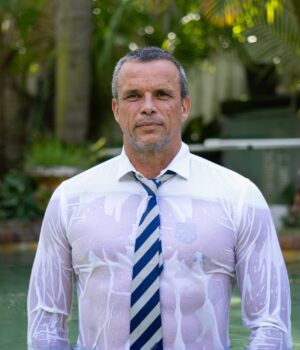
Source : ABC NEWS
Silver.
It is one of the world’s heaviest metals.
And for 25 years it weighed Australian Olympian Scott Miller down. Drugs and bad decisions destroyed his life until a dramatic arrest and incarceration saved it.
When Miller went to the Atlanta Olympics in 1996 as a 21-year-old, the weight of a nation was on his ample shoulders.
He would win silver, beaten for gold in controversial circumstances by Russian Denis Pankratov, who swam more than a third of the race underwater, to break the only individual men’s world record in a final at the meet.
Shattered, Miller threw the silver medal in the bin, only to have it retrieved by his mother, Jenny.
The Australian saw the silver as “failure” and it triggered a spiral that would last decades, culminating in what is one of the biggest falls from grace in Australian sporting history.
Loading…
Miller went from Olympian and 90s heart-throb as Cleo magazine’s Bachelor of the Year to convicted drug supplier.
Miller himself acknowledges the monumental level of his dive from the dais.
“It’s up there,” Miller told the ABC News Documentary Deep End.
It was after Atlanta that he first began to use drugs.
“I struggled to regain form after the ’96 Olympics because I started to experiment with recreational drugs,”
Miller said.
“It gave a taste of that sort of lifestyle.
“I don’t know what the straw that broke me was but there was a lot of shit going on there.
“[It was] one thing after the other after 96.”

Scott Miller screams after finishing second in the men’s 100m butterfly final at the Atlanta Olympics to Russian Denis Pankratov. (Allsport: Al Bello via Getty Images)
It included parties, an ill-conceived marriage, injury, addiction, pimping, bankruptcy, drug dealing and finally more than three years in maximum security prison. But it was prison that saved him.
The party boy and the fashion icon
After the ’96 Games Miller was wildly popular.
Handsome and armed with a cheeky grin he was considered the pin-up boy of the pool.
Scott Miller in 1994 just before he would truly grab the nation’s attention. (Supplied)
Fame was thrust upon him and so were the pitfalls that came with it.
Miller was trying to live two lives. That of the party boy and the swimmer — it would lead to a positive test for marijuana and a short ban.
“1997-98 I was trying to do both,” Miller said.
“Money gets thrown at you and things change quickly.
“You go to things and you don’t know why you’re going to them … you’re doing it for someone else.”
It was a time his best friend, Olympic gold medallist Chris Fydler remembers well.
Chris Fydler (centre) celebrates gold with Ashley Callus (left) and Michael Klim (right) in the famous “smash ’em like guitars” race at the Sydney 2000 Games. (Darren England/ALLSPORT)
“Following the 96 Olympics [Miller] was a superstar in Australia and not just in the sporting world,” Fydler said.
“He was on every talk show. He was wearing silk shirts, he was partying with models, he was ambassador for various brands and having a general kind of good time.
“You couldn’t walk down the street without someone recognising him.
“If you went to a nightclub, he wouldn’t be waiting in queues.”
Training had also no longer become the primary objective.
He was named Cleo Bachelor of the Year in 1997 and had met his soon to be wife, fashion editor Charlotte Dawson, the future host of Australia’s Next Top Model.
Charlotte Dawson was synonymous with fashion in Australia. (Don Arnold: Getty Images)
The relationship thrust him further into the spotlight and something that was very 1990s … glossy magazines.
New Idea, Women’s Day, Cleo … Miller and Dawson were everywhere.
It was a whirlwind romance and Dawson — someone Miller saw as a “strong woman” — proposed to him.
Miller though said he wasn’t in it for all the right reasons.
Broadcaster Alan Jones had become somewhat of a mentor and Miller and Fydler were living in a Newtown warehouse Jones owned so they could be near to their training base at Sydney University.
Miller says Jones had become somewhat controlling and even pushed for a change of manager to Harry M Miller, something Scott says cost him money.
Dawson helped him break that cycle.
“Charlotte didn’t take any shit from him,” Miller said.
“She really would put a foot down and he didn’t like it. And I liked the fact that he didn’t like it.
“It made her more attractive to me.
Miller liked it when Charlotte Dawson stood up to Alan Jones. (AAP: Mick Tsikas)
“She wouldn’t let him control me, whereas [prior] I felt he had this control over me somehow.
“For whatever reason, I just saw it as a way to fix the situation that was becoming uncomfortable.”
The pair would get married in 1999, but things quickly deteriorated.
‘Nothing was getting in my way’
Dawson had met a party boy who swam a bit, but with Sydney 2000 closing in Miller switched back to full-time athlete mode, determined to right the wrong of Atlanta.
“When the focus shifted and I wasn’t the handbag. When I wasn’t keen to go to the opening of an envelope … she didn’t know how to handle it,” Miller said.
“I was training and going to bed early. Disciplined, selfish — f***ing nothing was getting in my way.
“She didn’t understand how I could become a completely different person … and thought I was having affairs and ringing my coach seeing where I was.”
The marriage crumbled but Miller was swimming some of his fastest times yet and was confident of another crack at Olympic gold.
Scott Miller and Charlotte Dawson at an event a few years after their marriage ended. (Patrick Riviere/Getty Images)
Then disaster struck.
A broken foot he suffered while walking down stairs in thongs, hampered his preparation for the Olympic trials.
Australia had three of the five best butterfly swimmers in the world in Miller, Michael Klim and Geoff Huegill, but unable to execute a butterfly kick until race day Miller failed to finish in the top two and make the team.
Abandoned by the AIS?
If 1996 was hard and the beginning of a dalliance with drugs — this was the start of a deluge.
A framed photo of the 1994 AIS Swimming Team. Scott Miller is in the back row, third from the right. (ABC News: Jack Fisher)
The injuries were truly piling up. A snapped Achilles in 2003 and then in 2004 on the way to trials Miller’s broad shoulders could no longer carry the load.
By February 2004 he could not get his arm past horizontal and retired at 28, feeling like the AIS and swimming authorities had abandoned him.
“There was no transition, no help from the swimming industry,” Miller said.
“I felt abandoned and completely alone. I had no formal education, no prospects and no plan B.”
Fydler says that at that time the AIS was not always turning out well-rounded humans.
“The Institute of Sport in the late 80s and early 90s … lost its way as far as developing good young humans,”
Fydler said.
“They got really good at developing athletes, the science was really solid, the coaching was really, really good but … the focus on education or focus on what you’re going to do after swimming just disappears.
Scott Miller after winning one of his two gold medals at the 1995 Pan Pacific Swimming Championships. (ABC News: Jack Fisher)
“He [Scott] was not forced to go to school and so the education piece just kind of fell away.”
The Australian Sports Commission (ASC) acknowledged former practices undertaken at the AIS were harmful, with its board making an apology in 2021 and establishing a Restorative Program for athletes.
“We know athlete wellbeing is central to performance and the commitment to Win Well doesn’t stop at retirement,” an ASC spokesperson told the ABC.
“Through our high performance arm, the Australian Institute of Sport (AIS), we continue to invest in practical support for athletes before, during and after transition from high performance sport.”
‘Filthy on the world’
Once that support fell away after swimming, Miller remembers struggling with his mental health.
“Idle time is dangerous for an athlete that is kind of depressed because his body gave up,” Miller told the ABC.
“I was filthy on the world.
“I went straight to the dark side. I didn’t hesitate.
“You go into destructive mode, you just want to hammer yourself [and] you don’t want to feel anything.
“What started out as using cocaine or ecstasy when I went out to party quickly became a daily smorgasbord of methamphetamine, heroin, cocaine for that instant mood enhancer.
“My circle of friends changed from fellow Olympic athletes and high achievers to drug addicts and drug dealers.”
Scott Miller and Chris Fydler have remained firm friends since their teenage years. (Supplied)
Nicole Miller remembers that Scott and struggles to reconcile it with the brother she knew prior and knows now.
“He was gone,” she said.
“His eyes. He was emotionless. I felt like I just lost him.“
The destructive period reached a crescendo in 2006 when Miller called his father from a hotel room during a methamphetamine-fuelled binge.
When his father arrived, Miller swallowed a bottle of pills and was taken to hospital.
“This was an absolute cry for help,” Miller recalled.
But it wasn’t long before he found trouble again.
In 2009 he avoided prison over a drug-related charge but legal bills had to be paid and Miller had to save his parents’ house.
Miller is candid when he speaks about the ups and downs of his life. (ABC News: Jack Fisher)
Enter the world of prostitution.
For three years, Miller helped run an escort agency of several women.
“I might’ve saved the house, but the lifestyle I was leading and the environment I chose nearly killed me in the process,”
he said.
“Drugs and escorting go hand-in-hand — in the end it was just too much.”
Candles, cars and crystal meth
That return to the world of drugs eventually led to his first time incarcerated, when he spent a couple of weeks in Sydney’s Silverwater jail for possession.
In 2014, ex-wife Dawson took her own life, something he feels he understands better now than then.
“I feel that she got in that dark place and there was no one there,” Miller said.
“She had a good soul. She was a good person. I feel her presence often.“
Charlotte Dawson in 2013. Miller remembers her fondly. (Getty Images/Lisa Maree Williams)
By this time Miller was truly in a spiral and in 2021 was caught in a sting.
He was in law enforcement’s sights — and his group’s plan to transport methamphetamine in candles to regional NSW was tracked every step of the way to a drop-off point in Yass.
All four men would be arrested. Miller was the most high-profile.
The AFP had tracked Miller and his accomplices using the ANOM app.
When he was arrested shirtless in his Rozelle home, an officer chastised him.
Scott Miller after being arrested in 2021. (Supplied: NSw Police)
“From Olympic swimmer to drug dealer, haven’t you fallen far?” Miller recalled the officer saying.
He whispered “alleged drug dealer” in retort.
The eventual sentence was more than five years in jail for playing a “central role” in a drug supply operation.
Lifesaving sentence
Miller says that post arrest, in the police vehicle clarity finally hit him.
“February 16th, 2021 is the day that I truly believe saved my life,” Miller told the ABC News Documentary Deep End.
Miller was incarcerated at the maximum security facility at Kempsey, NSW. (Suppled: BESIXWatpac)
“I was sitting in the back (of the wagon) and watching the trees go by, the first thing I thought was, I’m not going to see my loved ones for at least 10 years.
“Then I just had this wave of relief. It wasn’t fear, it was relief that just f***ing came through my veins, every part of me.“
Miller landed in Kempsey’s maximum security prison, something he still sees as a tough call but one that saved him.
Like many in prison, Miller was faced with a choice. Clean up or continue down an illicit path.
He chose the former, training whenever he could and adopting a regimented regime.
It was not always smooth though.
Attacked by a cellmate in his first month, Miller was hauntingly honest about the violent incident.
“I was kind of dead inside. I didn’t really care to be honest,”
he said.
Despite Scott being embarrassed whenever friends and family saw him in prison greens, his sister Nicole says jail was the best thing for him.
Nicole Miller says her brother went through a period where he was no longer present. (Deep End: The Scott Miller Story)
“When I went and saw him, he looked amazing,” she said.
“I just saw how well he was doing in there, going to the gym and getting himself back. I saw the boy in 1996 that was getting up on the blocks.”
Redemption
Meeting with Miller now in a leafy northern beaches suburb it is clear he is different to the drug-dealing version of himself.
Scott Miller has moved home to take care of his parents, especially his mother Jenny. (ABC News: Jack Fisher)
He is dedicated to two things. Family and delivering an anti-drugs message.
He has returned here to look after his parents.
His mother Jenny needs care and Scott is her registered carer.
“If I am not here there is no-one to feed her,” Miller said.
Scott is also determined to repay her for all the 4am starts at the local pool when he was a child.
Family has become a priority for Miller since he left prison. (Deep End: The Scott Miller Story)
He smiles when he speaks of that time.
“She didn’t complain, didn’t whinge … she used to take a doona and a pillow, sleep in the back seat and wait for me to finish and I would go back [home] in the doona and pillow,” he said.
“That was the routine.”
In the home with Miller as he refurbishes it, it is obvious to see how much he is trying to repay a debt of gratitude.
He has cleaned not only himself up but the pool. The gardens are next.
Miller has cleaned himself up, the backyard pool and is now turning his attention to the garden at the family home. (ABC News: Jack Fisher)
He is finally ready to be a father to his teenage son Jack. And while that relationship is coming along nicely he is also delivering a message to other young Australians about the pitfalls of drugs, while working for Alcohol and Drug Awareness Australia.
“There’s a lot of shame there when you’re sitting in the cell and you’re starting to think about all the people [that] get hurt,” Miller said.
“There’s a lot of ripple effect for other users and their families and the communities that you damage doing what I did.”
He has spoken to apprentices but is soon to speak with professional footballers.
He hopes his message can resonate with a group of young men who may be suddenly exposed to fast cash and a potentially fast life. Many who may have come from regional areas specifically impacted by methamphetamine use.
“Speaking to athletes … I think it will resonate more with them,” he said.
And what about Australia? A nation that thinks it knows who he is but might not recognise this softly-spoken 51-year old.
“If they believe what they read and they see, they probably hate me,”
Miller said.
“I can’t apologise any more than what I have. It doesn’t make it right but all I am trying to do is balance it up.”
Anchor aweigh
Forgiveness from society is one thing, forgiving himself is another for Miller.
Australia’s 4x100m medley relay team after winning bronze at the 1996 Atlanta Olympics. From left to right: Phil Rogers, Scott Miller, Steven Dewick and Michael Klim. (Allsport: David Cannon via Getty Images)
It’s been 30 years since Pankratov swam a style that Fydler still describes as legal but “not necessarily ethical” to pip Miller for gold.
Nicole Miller recalls seeing a “devastated” Scott after that race in the Aussie bar in Atlanta.
“It was complete disappointment. He was in shock,” she said.
Miller told the ABC he tried to swim underwater like Pankratov but he was always faster on top of the water.
He still questions whether world swimming’s governing body, FINA, did their job, given they banned Pankratov’s style after the Atlanta Games.
But what of the silver medal?
The silver medal Scott Miller won at the 1996 Atlanta Olympics. (ABC News: Paul Johnson)
Miller still thinks about that race, the result, the aftermath.
When you’re in prison as he was, there’s a lot of time for that.
“It still bloody hurts,” Miller said.
“It’s the wrong colour. You don’t go there for silver.”
But now it resides along with his bronze medal from the same Games for the 4x100m medley relay — in pride of place, on display.
“I am proud of it,” Miller said.
“It’s like the anchor has been released.“
Scott Miller and his medals from the 1996 Olympics. (Deep End: The Scott Miller Story)
Watch Deep End: The Scott Miller Story, on Monday June 22 and 29 from 8pm on ABC TV and ABC iview.