source : the age
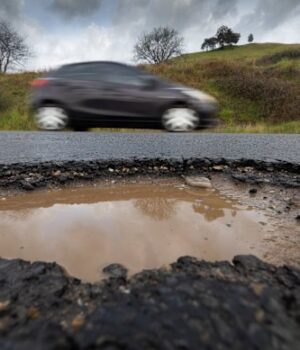
On Sunday, The Age published the chronicle of reporter Benjamin Preiss, with photographs by Jason South, of his road trip north from Melbourne that had one aim in mind: to count the number of potholes encountered. This was not a journey of self-imposed dangers on the highways and byways of Victoria, but to bear witness to the state of our roads.
Last month dozens of motorists were stranded on the Princes Highway after their cars’ tyres were damaged from a series of potholes. It is but one of many incidents on our roads and highways. There are hundreds of thousands of potholes in this state. The inbox for The Age’s letters to the editor regularly receives correspondence from readers on road conditions. None of them are complimentary.
It is to be applauded then that both the Labor government and the opposition are turning their focus on tackling the problem. The Coalition says it will spend $5 billion over four years to eliminate a million potholes. Opposition Leader Jess Wilson announced the spend during a tour of lower house electorates in July, and had been highlighting the issue in social media posts for months.
On Monday, Premier Ben Carroll announced a $354 million increase to road funding and will delay some level-crossing removals to finance the removal of 500,000 potholes. The government will also establish a website where Victorians can log pothole sightings. The premier has announced a pilot program to use minimum-security inmates on road maintenance such as mowing grass, controlling weeds, removing graffiti and picking up roadside rubbish. This would free up road crews for pothole repairs.
The numbers proffered by the parties are a sign of the rising stakes at play as the election nears. In the May budget, Labor committed $1 billion for road maintenance; this would repair 200,000 potholes. However, state budget papers show that the government’s target to patch 74,000 square metres of regional roads this financial year is down from 95,000 square metres the year before, and a fraction of the 566,000 square metres completed in 2024-25. This wasn’t a reduction, the government says, but a shift towards resurfacing and rehabilitation works. The Sunday Age reported that data gathered by citizen reporting platform Snap Send Solve shows that reports of potholes and damaged roads rose more than 46 per cent to 37,482 in the year to August 16.
The Victorian Farmers Federation also launched a campaign urging regional drivers to document potholes they encounter. Federation president Ryan Milgate said in July such reports would show the scale of the decaying roads, which were “the worst they have ever been. Many are literally falling apart and some are straight-up death traps.”
Milgate’s comments, when taken with those by Melbourne University pavement geotechnics expert Mahdi Disfani and Deakin University transport engineering professor Ashim Debnath, paint a picture of a pressing need. Disfani said that when several potholes formed, large patches of road needed repair – it was not just about filling in the hole. Debnath saw a pothole in terms of cancerous growths. “If we don’t treat it early, it will just keep increasing in size.”
That Victoria has the worst potholes in the country, as observed by chief executive of the National Transport Research Organisation Michael Caltabiano on the ABC, goes beyond playing catch-up in repatching. The building and design and materials used in road construction need to be reassessed.
Debnath’s definition, in its likening to a growth, can be extrapolated into voter sentiment. Motorists are voters. A pothole can be seen of itself and as symbolic of a growing sentiment that Labor has failed to tackle issues that directly affect people. Resolution is a marker of government competence. While it is gratifying to see Carroll moving on the issue, it is also a sign of significant financial pressures that it has had to scrap part of one initiative, the removal of level crossings – a signature policy of Daniel Andrews’ government – to pay for another.
It is a lesson that should not need teaching that government, fundamentally, is to serve the people and get the basics right. It is to listen to what the people are saying are priorities for them.
One doesn’t need to be a roads scholar to work that out.
Get a weekly wrap of views that will challenge, champion and inform your own. Sign up for our Opinion newsletter.
 The Age’s View – Since The Age was first published in 1854, the editorial team has believed it important to express a considered view on the issues of the day for readers, always putting the public interest first.