Source : the age
Australia’s largest listed data centre developer has warned investors that power supply delays, likely caused by community opposition, will hit the development of its flagship West Footscray facility.
Data centre giant NextDC sought a trading halt in its ASX-listed shares on Monday telling investors it needed to assess the impact of the delay in getting power to its M3 data centre in West Footscray.
The company did not give a reason for the delay but analysts tipped it was likely the result of a fierce community blockade in Melbourne’s inner-west last month that brought a multi-million-dollar power pole expansion by electricity distributor Jemena to a standstill.
Citigroup analyst Siraj Ahmed said in a briefing to investors that the trading halt likely related to electricity distributor Jemena’s pause on that project.
NextDC’s market admission is the clearest evidence yet that Victoria’s rapid push to attract power-hungry artificial intelligence infrastructure has run directly into grid constraints and suburban resistance.
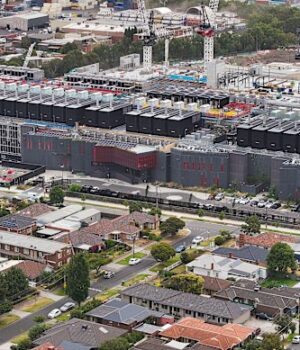
The M3 facility in West Footscray is designed to eventually span 10 hectares across an industrial pocket directly adjacent to residential homes.
The data centre already takes up five hectares and is undergoing a $750 million expansion.
But feeding the site required network operator Jemena to replace standard wooden electricity poles with 15-metre-high concrete structures carrying 66,000 volts down residential streets in West Footscray and neighbouring Yarraville.
Neither Jemena nor NextDC has confirmed the rollout was directly linked to the power pole pause.
That rollout ground to a halt in Yarraville last month following direct action by local residents, who blockaded contractor trucks with parked cars, ignored door-knocks, and filled excavation pits to stop the high-voltage lines reaching the NextDC site.
Jemena bowed to the pressure and has since paused work in Yarraville to allow for consultation, leaving the high-capacity power route unfinished. Many of the West Footscray power poles designed to carry the far higher voltage had already been installed.
In its letter to the ASX, signed by NextDC company secretary Michael Helmer, the company said its board had not yet met to consider the full implications of the power delay. The trading halt will remain in place until Wednesday or until a full announcement is made.
The moves could be a headache for the Carroll government heading into the November election as it seeks to balance investment attraction with increasing community opposition to data centres.
Former premier Jacinta Allan and her former economic development minister Danny Pearson had aggressively courted hyperscale data operators, using fast-tracked planning schemes to bypass municipal councils and grant approvals in as little as 28 days.
However, the rapid influx of data halls occurred without corresponding planning by the Victorian state for the massive transmission upgrades required to power them.
And, like in the US, community opposition to the mega-computer halls has risen.
Data centres consume about 2 per cent of national grid power, but the Australian Energy Market Operator projects that share could rise to 9 per cent by 2035 as AI adoption accelerates.
Carroll last month brought in new rules on data centres to address growing community concerns. They required developers to supply their own renewable energy, use recycled water, and for data centres to be located at least 150 metres from homes.
For West Footscray residents living 15 metres from the facility’s northern boundary, the market freeze comes after years of noise, construction dust, and street excavations.
Resident Jacqui Glover, who has fought the expansion from her front porch, last month told a Senate inquiry into data centres that the facility next door to her had consistently prioritised corporate expansion over local liveability.
Read more on the Victorian election:
 Clay Lucas is an investigative reporter at The Age who has covered urban affairs, state and federal politics, industrial relations, transport, health and aged care. Email him at clucas@theage.com.au or claylucas@protonmail.com, or via Signal +61439828128.Connect via X, Facebook or email.