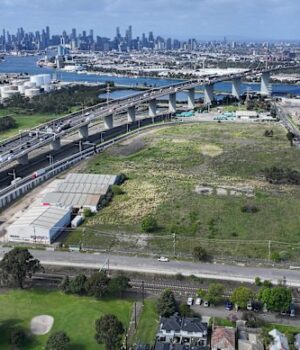
Source : the age
A $1.47 billion data centre proposed at the foot of the West Gate Bridge would draw more power than an entire regional city and has sparked local opposition, as the state government flagged new rules to rein in the booming sector.
Using the state government’s fast-track planning process, developer GreenSquare wants to build a data centre on the former Mobil fuel terminal in Spotswood. The project would take six years to build and, when finished, support 130 on-site jobs.
The move comes as Artificial Intelligence Minister Anthony Carbines addressed a major Melbourne tech conference, saying that changing public sentiment towards data centres meant developers needed to “engage communities early, keep them informed, and share the benefits”.
Spotswood residents are already campaigning against GreenSquare’s plan, mirroring conflicts worldwide as communities face the physical reality of rapid AI expansion, which is straining power grids and affecting residential neighbourhoods bordering industrial zones.
The planning application and architectural plans show GreenSquare wants to connect the 240-megawatt facility to the electrical grid via an underground connection to avoid the street-level battles over power poles that erupted in nearby Yarraville last week.
The application bypasses local council approval under Victoria’s fast-tracked Development Facilitation Program and will be decided by Planning Minister Sonya Kilkenny. This is in contrast to GreenSquare’s recent experience in Western Australia, where in May it withdrew a similar suburban Perth proposal from a council process in the face of fierce community opposition.
The Spotswood data centre would be built on a site that has stood vacant since dozens of tanks on the badly contaminated land were demolished in 2013. The 8-hectare parcel of land operated as a heavy chemical and fuel distribution terminal from 1927 to 2009.
The planned centre will feature ten data halls, with parts of the buildings reaching up to five storeys. The facility will use 240-megawatts of power at full capacity – roughly equivalent to 250,000 Victorian households, or a town slightly smaller than Geelong.
To safeguard the facility against power failure, GreenSquare will store about 4 million litres of fuel across 16 tanks to power its backup generators. The volume of fuel to be stored on-site will trigger mandatory dangerous goods referrals to the Environment Protection Authority and Fire Rescue Victoria.
Planning documents argue the site is ideal for a data centre because it is physically isolated from homes, as it is bounded by the Werribee railway line, a West Gate Freeway on-ramp, and a Visy Glass manufacturing plant.
GreenSquare chief executive Charles Penny said the site was well suited for the development because it was “a large, established industrial site with access to existing power infrastructure, major transport routes and telecommunications networks”.
He said its industrial legacy meant what could appropriately be built on the land was limited – “particularly more sensitive uses such as residential development”.
He said the data centre would “rehabilitate and reinvest in a former industrial site and transition it to modern digital infrastructure that supports Melbourne’s growing economy”.
“We recognise the site’s proximity to residential areas. That is why noise, traffic, air quality, water use and visual impacts have all been carefully assessed through the design and planning process,” Penny said.
Nearby residents say they have suffered enough already from other major projects. The western boundary of the site, while separated by a suburban rail line, is 60 metres from a kindergarten.
“Spotswood has already endured years of disruption from the West Gate Tunnel project,” said Laura Mar, part of No Data Centre in Spotswood, a residents group fighting against the project.
A petition they have launched has almost 2000 signatures.
“The last thing this community needs is a 240-megawatt industrial data centre being built just metres from homes,” she said.
Residents argue the project’s construction will increase traffic, disrupt badly contaminated soil and increase noise in the area. “Then once it’s built, they’ll leave Spotswood living with the noise and the long-term risk.”
A spokesman for Kilkenny said the data centre plan was under consideration and would be decided on its merits.
It comes as Carbines made his first major public appearance as Victoria’s new minister for artificial intelligence and the digital economy, after his appointment last month by Premier Ben Carroll.
Carbines told the Data Centre World conference at the Melbourne Convention and Exhibition Centre this week that the industry would need to pay for the water and energy infrastructure it required, rather than sharing the costs with households and businesses.
The shift in the government’s public posture from its previous strong enthusiasm reflects an escalating national political debate over how to manage hyperscale digital infrastructure.
Prime Minister Anthony Albanese and leaders in all states and territories except Queensland and the Northern Territory last month agreed that data centres be exclusively fuelled by new renewable energy sources.
To complement this work, the Carroll government is finalising a new set of rules and regulators for the sector, expected to be announced in coming weeks.
Carbines said the state also wanted data centres to prioritise recycled or non-potable water first, build in areas where they did not compete with homes and schools and to meet the same standards as other industrial developments in areas such as noise, emissions and environmental impact.
In his address, Carbines signalled that the era of uncoordinated expansion across suburban Melbourne – facilitated until recently by the state government – had ended.
“We welcome this industry,” he told the conference, but it was placing pressure on local infrastructure. “How governments respond to that pressure – whether we get ahead of it or get run over by it – is going to shape how this industry is regarded for a generation.”
Carbines acknowledged that public anxiety over data centre rollouts was escalating both locally and internationally.
He pointed to international precedents where rapid data centre expansion outpaced public planning systems, forcing governments in the Netherlands to restrict facilities to designated zones, Ireland to require dedicated power generation before grid connection, and Singapore to pause new capacity entirely.
“In the US, data centre infrastructure has become an issue in the midterm elections,” Carbines said.
Start the day with a summary of the day’s most important and interesting stories, analysis and insights. Sign up for our Morning Edition newsletter.
 Clay Lucas is an investigative reporter at The Age who has covered urban affairs, state and federal politics, industrial relations, transport, health and aged care. Email him at clucas@theage.com.au or claylucas@protonmail.com, or via Signal +61439828128.Connect via X, Facebook or email.