

Source : THE AGE NEWS
Designed in the space-age 1960s, the Concorde was a boundary-pushing supersonic aircraft.
By the time it launched in 1976, public frustration with pollution – including noise pollution – made Concorde’s sonic booms decidedly unpopular. The cost and the uproar over sonic booms limited Concorde’s utility to primarily flying over oceans – from New York to London, for example – and it became a niche product, until it was forever grounded in 2003.
It’s possible Qantas’ Project Sunrise could follow a similar trajectory, but in reverse – starting niche and then finding a broader market.
When announced in 2017, a 22-hour, single point-to-point flight seemed a novelty, solving a somewhat non-existent problem: the need to fly from Sydney to London without mucking around with stop-overs.
Then, the conflict in the Middle East erupted this year, whacking a hole in consumers’ travel patterns and the baseline expectations of airlines.
The Iran war appears to have ended, with a ceasefire signed this week.
But the uncertainty isn’t going away. It acts as a reminder of the growing complexity faced by commercial aviation.
For Qantas, the fate of Project Sunrise will rely on how well its management has read the market. The airline insists – with some evidence – that demand for non-stop Sydney to London travel exists more than ever.
Qantas-commissioned research shows consumer intent to book ultra-long-haul flights has risen from 58 per cent in February to 70 per cent in May. Among premium travellers, that figure now reaches 80 per cent, up 12 percentage points over the same period.
The airline’s technological advances – from the development of a 20,000-litre additional fuel tank and AI-powered flight planning technology, to the special “Wellness Zones” in the cabin and research on circadian rhythms to minimise jet lag – all contribute to this “moonshot” offering, as CFO Rob Marcolina describes it.
To be clear, putting people on 22-hour, point-to-point flights across the globe is not the same as launching a supersonic jetliner.
Concorde was an entirely new plane, which cost $3.3 billion in today’s dollars to develop and build.
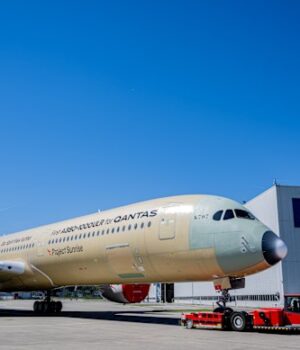
For all the fanfare, Project Sunrise is not a new kind of jet, but an adaptation of the existing A350-1000, of which over 700 are already in service.
Benoit de Saint-Exupery, executive vice president for sales of commercial aircraft at plane maker Airbus, admitted as much.
He told a panel in Toulouse this week that Project Sunrise “is just the extension of an existing platform [the existing A350 model plane], so it’s not a big development, it’s an incremental development.”
But that’s not to say it’s insignificant, especially in a time when plane manufacturers face a backlog of thousands of airframes.
De Saint-Exupery said that taking on the challenge to produce the mega-long-haul plane for Qantas helped keep Airbus’ “engineering muscle going”. And other airlines have already expressed interest in the specially made A350-1000ULR model, too.
Project Sunrise pushes the envelope on longer range and shorter flight time. It aims to resurrect the “better, stronger, faster flight” era of commercial aviation.
That alone, in a time of reusable rockets and satellite-enabled super-fast internet, is noteworthy.
Given how central long-haul travel is to Australians, and the actual technological evolution Sunrise represents, it’s no wonder the plane is such a matter of pride for the airline.
How well Qantas has read the market and the moment to launch its “moonshot” new travel offer will determine whether the mega-long-haul plane is a success or not.
The Market Recap newsletter is a wrap of the day’s trading. Get it each weekday afternoon.
 Chris Zappone is a senior reporter covering aviation and business. He is former digital foreign editor.Connect via X, Facebook or email.

