Source : THE AGE NEWS
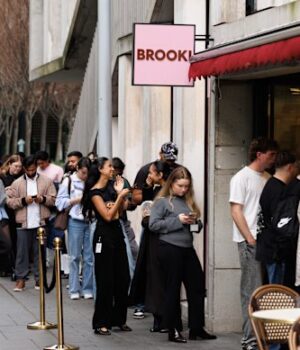
Queuing for cookies and frozen yoghurt, waiting for watches, standing for sandwiches and even lining up for lipstick has become a modern pastime.
Australian cities are spoiled with a smorgasbord of cuisine and shopping choices offering instant gratification, often online, but consumers are increasingly opting to spend free time waiting.
Instead of repelling us, queues are drawing us in. Tapping into evolutionary psychology, a growing body of evidence suggests queues boost revenue per customer and cut costs – all while acting as free marketing. That’s spurring businesses to actively cultivate lines out the door.
‘I go for the social aspect’
On a Thursday afternoon in Sydney’s Barangaroo, a 20-person queue stretched outside Brooki Bakehouse. The viral Brisbane-founded bakery recently launched there and in Melbourne, drawing constant lines.
The visual appeal of their gooey cookies, with stringy strands of melted chocolate that stretch between two halves of a freshly broken warm biscuit, make for engaging TikToks and Instagram reels.
That is exactly what drew in Mahibhana Mahinthan and Hannah Nemovi. The 21-year-old law students had four hours of classes that day, but used their sole hour of break to travel and queue for the snacks.
“We like sweet treats and going around Sydney trying them,” Mahinthan sad, planning to try the Nutella and Pistachio options and review them on Instagram.
The wait was no barrier; they meet friends almost weekly at frozen yoghurt chain Yo-Chi, which has a reputation for long lines across the country.
“[Yo-Chi] isn’t even that good, it’s more of a social thing for us, a way to catch up with friends,” Mahinthan said.
Nemovi agreed: “I don’t even like yoghurt, I go for the social aspect, you talk to your friends in the queue, then after, the whole experience”.
Their view of cult-food queues as a third space to hang out makes sense, said Geetanjali Saluja, a senior lecturer at the University of Technology Sydney researching consumer decision-making.
Gen Z avoids public drinking and nightclubs, Saluja said, partly fearing making a fool of themselves in such situations and online permanence. “They don’t want to be captured doing something embarrassing. Going out to eat frozen yoghurt is very different,” she said.
A non-alcohol-centric space “with a vibe” strongly appeals to Mahinthan. “[Younger people] need more hobbies outside of drinking,” she said.
The friends are far from alone in their willingness to queue. Many Australian businesses are infamous for lines. After The New York Times suggested Melbourne’s Lune could be the world’s best croissanterie in 2016, pre-dawn queues formed, following the brand as it expanded nationally.
Similar crowds recently swarmed gold bullion exchanges, Mecca’s Melbourne flagship opening, Swatch watch launches, and Pop Mart toy drops for Labubu dolls, echoing past eras of iPhone release days or concert ticket lines.
Gelato brand Messina is so synonymous with queues, even at its capacious headquarters in the inner west Sydney suburb of Marrickville, that it partnered with the Bondi Lines app to offer real-time tracking. Messina’s availability in supermarket tubs, which don’t draw crowds, speaks to the lure of the queue.
‘Evolutionary psychology’
Queuing is “part of what it means to be human,” according to Dr Paul Harrison, Chair of Consumer Behaviour at Deakin University.
“There’s safety in numbers,” he said, explaining that mimicking others reduces decision-making risks, a desire rooted in “evolutionary psychology”. Queues now replace newspaper reviews and word of mouth, Harrison said, adding they can signal quality and convince us to take a risk on a new restaurant or cafe.
Renata Freund, founder of behavioural science market research firm Honeycomb Strategy, said a queue creates hype. “We have this natural human tendency to want to follow the crowd,” Freund said.
“There’s so much stimulus being thrown at us [on social media], so when we notice a queue, whether it’s in person or in images online, it jumps out at us as real and valuable,” Freund said.
Scarcity from pop-ups or shops that stay open until sold out drives demand, Freund said, provided it doesn’t frustrate customers. Meanwhile, luxury brands like Louis Vuitton, Cartier, Gucci and Chanel use customer limits to guarantee lines.
Labor and marketing costs go down, revenue goes up
Enduring a queue can also allow people to enable acts of consumption that would otherwise be frowned upon as indulgences. After all, buying six cookies or $15 of ice cream for yourself isn’t something you’d brag about. “The ritual makes us feel seen,” Harrison said.
This translates to social media cachet. “They didn’t just eat a burger, they can talk about the journey of the queue, and weigh up if it was worth the wait,” said Saluja, the researcher.
Research also shows that the longer we spend in a queue, the more we tend to buy. We make a “join-or-balk” decision to stay or leave, and then rationalise our sunk waiting costs by spending more than we otherwise went in thinking we would, a 2021 Hong Kong Polytechnic University study concluded.
In addition to a higher average revenue per customer, cultivating queues allows a business to err on the side of rostering fewer staff and a perception of scarcity can justify higher prices.
This logic can be difficult for businesses to embrace. But Freund warned that empty shops are often misjudged as low-value rather than highly efficient.
Queues can sometimes backfire if products disappoint or understaffing is overly obvious, Saluja said.“I’d like to believe that companies are doing their best to meet demand, but they certainly don’t mind if there’s a bit of a queue,” she said.
Crucially, queues must occur before entry and selection, with long checkout lines at a supermarket, for example, fostering resentment and reducing impulse buys, a 2026 study found.
Back at Brooki, after 20 minutes of waiting, Mahinthan and Nemovi got their treats. The verdict? “The cookies were good but very sweet to say the least,” Mahinthan said. “Overall, we give it a good 7.5/10.”
The Business Briefing newsletter delivers major stories, exclusive coverage and expert opinion. Sign up to get it every weekday morning.
 Elias Visontay is a National Consumer Affairs Reporter at The Sydney Morning Herald and The Age.Connect via email.