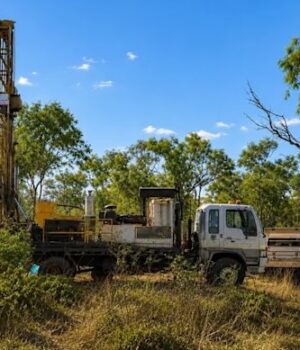
Source : THE AGE NEWS
Barkly Rare Earths has continued its impressive exploration success, hitting significant rare earths mineralisation in 13 of 16 additional holes at its flagship Barkly rare earths project in the Northern Territory.
The latest results from its 10,000-metre phase-one drilling campaign have pushed the boundaries of known mineralisation another eight kilometres into previously untested ground. Significant rare earths intercepts have now been recorded in 56 of the 60 holes assayed, spread across a whopping 23km and delivering an impressive strike rate of more than 93 per cent.
The drilling program is designed to test for extensions to the project’s existing 40 million-tonne inferred mineral resource grading 2100 parts per million (ppm) total rare earth oxides (TREO). The current inventory is split between the northern and southern deposits, leaving almost 15km of virtually untouched ground in between for the drill bit to explore. That sizeable gap helps explain Barkly’s lofty exploration target of between 200 million and one billion tonnes at a grade of between 1600ppm and 1900ppm TREO.
The results served up another swag of eye-catching TREO grades, reinforcing the project’s potential amid accelerating global investment in non-Chinese critical minerals supply chains.
‘This is an intercept rate over 90 per cent across the 60 phase-one holes reported so far, in holes up to 23 kilometres apart.’
Barkly Rare Earths managing director Craig Wright
The four highest-grade new assays from the latest batch all came from the project’s southern reaches, within and around its existing mineral resource.
The standout hole struck a 1.5-metre intercept grading 2171ppm TREO from a shallow 10.5m, including a cracking 0.5-metre section assaying 4550ppm TREO and 1678 magnet rare earth oxides (MREO) from 10.5m. Another notable hit included 2.5m running 1774ppm TREO from 20.5m, which contained a richer slice of 0.5m going a 2599ppm TREO and 845ppm MREO from 21m.
Further northwest, five of the first eight holes drilled 8km from previous intercepts also returned significant mineralisation, including the widest phase-one intercept to date of 5.5m at 1035ppm TREO and 343ppm MREO from just 22m downhole.
Barkly Rare Earths managing director Craig Wright said: “We have now intersected rare earth mineralisation in the northwest, outside the exploration target and six to eight kilometres from previously reported mineralised intercepts. In the south, all eight holes returned significant intercepts… It gives me real confidence in the scale of what we are drilling at Barkly, and we are tendering for a second rig so we can build out the resource faster.”
The company says drilling continues to confirm the deposit’s key characteristics; it appears laterally extensive, with the mineralised horizon now intersected across a massive 23 km. It is shallow and flat-lying, with hits between surface and 38m downhole and is rich in high-value magnet rare earth oxides (MREO), which make up a healthy 29 to 38 per cent of the TREO in the new intercepts. Management says this is consistent with the 34 per cent MREO ratio of the existing inferred mineral resource.
MREO’s include neodymium, praseodymium, terbium and dysprosium, some of the most sought-after of the 17 rare earth elements. They are essential for manufacturing high-strength permanent magnets used in electric vehicles and wind turbines.
Notably, uranium and thorium levels remain consistently low, between one and three ppm and five to 11 ppm, respectively. Low levels of these radioactive elements are a significant advantage, potentially simplifying processing and reducing costs.
The results come as Australia and its allies crank up the race to secure critical minerals supplies and loosen China’s grip on the global rare earths market.
The Federal Government recently trumpeted the start of construction at Arafura Rare Earths’ Nolans project, also in the Northern Territory, which has attracted A$1.2 billion in government backing and is tipped to eventually meet up to five per cent of global rare earths demand.
With Australia and the United States committing billions to building alternative supply chains, the geopolitical stars appear to be aligning for explorers such as Barkly.
To date, the company has drilled 89 holes for 2168 metres, including 6 re-drills. Samples from a further 26 holes are at or being prepared for the lab, including two re-drills of assayed holes. The company is also progressing with concentration and extraction testwork, with a mineral resource update targeted for the fourth quarter of this year. Barkly is also tendering for a second drill rig to speed up the campaign.
With a hit rate that would make a West Perth miner blush and a mineralised footprint that now stretches over 23km, Barkly is systematically building a case for a project of serious scale. As Australia and its allies plough billions into securing non-Chinese rare earths supply, the company’s timing looks impeccable. And as a second drill rig rolls in, the market may not have long to wait to see how big this story could get.
Is your ASX-listed company doing something interesting? Contact: mattbirney@bullsnbears.com.au