SOURCE :- THE AGE NEWS
Warning: This story contains graphic content.
A lake formed by a landslide on the Nepal-China border started to overflow on Friday, putting at risk areas devastated by a flash flood two days ago and forcing a temporary halt to rescue efforts, authorities on both sides said.
Residents in Nepal’s Rasuwa district, on the border with China’s Tibet, were seen rushing up hillsides to escape any surge in the river level, according to a witness.
The risk of the lake bursting prompted all Chinese rescue personnel and vehicles to withdraw to stand by in a safe area, state broadcaster CCTV said on Friday. Authorities in Nepal had stopped rescue operations for the next 90 minutes, an army officer said.
The lake’s reservoir has topped 2.5 million cubic metres of water, up from the estimated 1.5 to 2 million cubic metres a Chinese eight-member engineering team dispatched to monitor the site recorded a day ago.
The setback came as Foreign Minister Penny Wong confirmed on Friday morning that at least 39 Australians were understood to be among those reported missing – up from 35 overnight.
“The extraordinary scale of this disaster and the remoteness of the affected region mean immense challenges lie ahead for the response and recovery,” Wong said in a joint statement with International Development Minister Anne Aly.
Wong told ABC radio it was an “an unfortunate possibility” that more Australians could be reported missing in the coming days as the true scale of the disaster became clear.
The Australian government will provide $5 million in humanitarian assistance, and Wong was preparing to speak to her Nepalese counterpart on Friday afternoon to discuss other ways Australia could support the recovery and rebuilding effort.
Prime Minister Anthony Albanese said in a post on social media: “Australia is sending crisis and humanitarian response specialists to help after the devastating Nepal-China floods. We’re also providing humanitarian assistance including food, emergency shelter and medical support.”
Greens senator David Shoebridge said the $5 million pledged by Australia would “not come close” to meeting the need for recovery and repair efforts.
“I think Australia needs to step up and really commit to helping rebuild. This is a country with minimal spare resources,” he said.
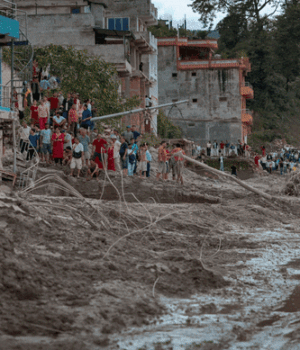
Fast-moving waters swept through villages, wiping out bridges, roads and entire settlements in a Nepalese valley near the border with China on Wednesday, killing at least 469 people, although that number could rise dramatically.
More than 1000 people are missing, including hundreds of foreign nationals from two dozen countries, including India, the United States, Britain and Canada.
But there was some good news on Friday, with
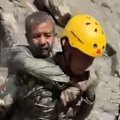
883 locals and labourers rescued in the Rasuwa mountainous district, including an “extremely dangerous and challenging” rescue mission that freed 350 people trapped in the tunnel of a hydropower plant.
“The troops are still gathering to safely evacuate more than 100 people trapped in the same tunnel,” the Nepalese Prime Minister’s Office said.
Footage released by the office showed a team of Nepalese soldiers crawling through thick mud up a steep passageway to enter the tunnel and save those trapped inside.
Tom Fletcher, the United Nations under-secretary-general for humanitarian affairs, said aid teams were experiencing major difficulties trying to reach the areas most affected by the floods due to the extent of damage to roads and bridges in the area.
“It’s a very, very challenging terrain for them to be navigating right now,” Fletcher told CNN. “We’re having to use air assets to reach them … The immediate priority is saving as many lives as we can.”
Footage released by the BBC showed a giant boulder being swept along by the flood, underlining the force of the torrent.
Fear of further flooding
Nepal and China both warned of the risks of further flooding in the Himalayas as debris from the initial glacier collapse formed a lake straddling their border.
Chinese authorities mobilised an eight-member engineering team to conduct aerial surveys and 3D modelling of the barrier lake, according to state broadcaster CCTV.
“Residents of the lower banks … passengers, rescuers engaged in rescue operations, and all concerned are requested to exercise special caution and stay in safe places away from the river banks and risky areas,” Nepal’s disaster authority said.
One of the engineers, Chen Hanxiao, said the general approach to reducing the lake’s threat was to excavate a drainage channel at a lower point of the dam, but the width and depth of that channel needed calculations based on how fast the water would flow and how quickly the lake would fill.
China on Thursday warned that 3 million cubic meters of water – the equivalent of about 1200 Olympic swimming pools – were expected to flow into the lake over the next three days, with peak flow expected around September 1.
Chinese President Xi Jinping dispatched his second-in-command to visit, Premier Li Qiang, to the devastated areas of Tibet, demonstrating the severity of the disaster, which may be the worst since an earthquake in 2015 killed about 9000 people.
Li inspected emergency rescue and relief operations, and visited first responders and displaced people in temporary shelters, according to the official Xinhua News Agency.
Assessments based on seismic and satellite data indicate the initial flood was triggered by the collapse of a glacier and underlying bedrock in the Himalayan region between Nepal and Tibet on Wednesday, causing a 5.2-magnitude seismic event that sent water, ice, rock and debris downstream.
Images and videos circulated online show the extent of the water’s force, with walls of grey water sweeping through villages and valleys, pulling down trees, pushing boulders and sweeping over masses of people attempting to flee.
The flood is a major test for Nepal’s fledgling government and its new leader, former rapper Balendra Shah, who rode to power on a wave of Gen Z enthusiasm. He will need to work closely with regional neighbours China and India. China has deployed at least 574 rescuers to the land crossing, and India says it was co-ordinating closely with Kathmandu on rescue and relief efforts.
The country’s tourism industry, which supports over 1 million jobs, will take a hit in a peak period, and will be anxious about the future given Nepal’s frequency of extreme weather events.
Which regions were hit?
The Bhote Koshi River flooded about 9am on Wednesday (1pm AEST), destroying several villages as well as roads and hydropower projects, officials said.
Warnings were issued in several districts urging people to stay away from the banks of the Bhote Koshi, Trishuli and Narayani rivers.
The flood triggered a mudslide that hit Gyirong Port, a major land crossing with neighbouring Tibet, cutting roads, communications, and power links to the area.
Rasuwa, the worst-affected area, witnessed a flash flood similar to those in August last year, when a glacial lake in neighbouring Tibet overflowed due to high temperatures in the mountain region. Nine people died, and critical infrastructure, including a bridge connecting the two countries, was damaged at the time.
Climate experts at the Kathmandu-based International Centre for Integrated Mountain Development said the Lhende Khola River, a tributary of the Bhote Koshi River, experienced its highest-recorded flood on Wednesday.
“The Lhende Khola has flooded twice in 14 months, this time triggered by an ice rock avalanche from a glacier on the Nepal side that blocked the river and released a sudden surge downstream,” said Saswata Sanyal, a disaster risk reduction specialist at the climate research group.
“In a warming Himalaya, early warning is the first line of adaptation.”
The Himalayan region, which spans Nepal and several neighbouring countries, including India, is especially vulnerable to heavy rains, floods and landslides because it is warming faster than much of the rest of the world due to human-caused climate change.
Research has shown that extreme weather events, including heatwaves, heavy rains and melting glaciers, have become more frequent in the region.
Members of the Kathmandu research group found this year that glaciers across the Hindu Kush Himalaya region are melting at an accelerating rate, with ice loss rates doubling since 2000 primarily due to rising global temperatures and climate change.
Australians in need of emergency consular assistance should contact the Department of Foreign Affairs and Trade’s 24-hour Consular Emergency Centre on 1300 555 135, or +61 2 6261 3305 (if calling from overseas).
With Reuters, AP, Bloomberg