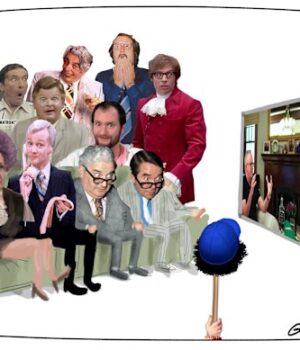
source : the age
To submit a letter to The Age, email letters@theage.com.au. Please include your home address and telephone number. No attachments, please include your letter in the body of the email. See here for our rules and tips on getting your letter published.
Waste education key
The state Liberals propose weekly rubbish bin collection. But what about when we run out of landfill sites? Instead of encouraging more rubbish, why not educate people on how to reduce waste? This would be a longer-term and more environmental solution.
Our family was inspired by a couple who went a year without putting their landfill bin out. We composted all our food scraps, tissues and paper towels in a worm farm and composting bays, which Imade from pallets . I covered them up with chook-wire to keep the rats and possums out. (Dog poo’s OK too, as long as you don’t put it on your veggies.) We bought a set of washable nappies, refilled containers with shampoo, laundry powder and honey from the local wholefoods store. And tried to buy products that had minimal or recyclable packaging. All the soft plastics, we bagged and took to Woolies.
After six months of not putting our bin out, a tatty old pillow tipped us over the edge. That was a couple of years ago. But now, thanks to Liberals leader Jess Wilson, we’re fired up to see if we can beat our PB.
Grant Morgan, Hurstbridge
Priorities amiss
Angus Taylor, Andrew Bragg and Tim Wilson have done no favours to ordinary Australians with their plans to gut the National Construction Code. Wilson says lower income earners should just “put on a jumper” in colder weather. They propose reducing regulation including energy efficiency. Wow. They (say they) will make housing cheaper and make owners (and renters) pay for it with increased energy use for the life of the building. They decry the cost of energy on the one hand but on the other hand they will make us all use more of it. If people should just get used to the weather, they could start by turning off the heating and cooling in Parliament House.
Chris Curnow, Skye
Outrageous spending
For the Bayside Council to propose spending $40,000 to forensically research how the endangered Growling Grass Frogs first arrived at the site of the Yalukit William Nature Reserve, in Brighton, is outrageous (″How did frogs get to Brighton? For council, it’s a $40,000 question″, 13/8). Our rates should be spent on protecting and preserving endangered species, including frogs, not a witch-hunt. The volunteers for the Yalukit William Nature Reserve Association, who care for this site, should be applauded and encouraged by the council, for their work.
Caroline Shepard, Brighton
Look to the birds
Growling Grass Frogs used to be common in the eastern suburbs of Melbourne, although their presence has no doubt been affected by the recent worldwide decline in frog populations due to a fungal disease
While it is comforting to learn that this frog species is once again thriving in a Brighton nature reserve, it is also laughable to learn that Bayside Council is considering spending $40,000 to dispel a claim that they were illegally transported from Melbourne’s west. If indeed the species has only recently arrived at the reserve it is more likely that the frog eggs were transported there by water birds, which is a common method of distribution.
John Lambrick, Malvern
Heat problems
They are shutting down nuclear sites in Europe because of the heatwaves causing lack of water. What say those who want them here in our climate?
Ross Hosking, Blackwood, SA
Power of policies
Sussan Ley says her bus trip through America was to try to find ″clarity″. She has talked about people whose lives were in transition and disarray, and people who are disconnected from politics and the ways of government, and those whose lives are characterised by a lifetime of being overlooked.
It is somewhat disingenuous to speak of people as being ″overlooked″ without acknowledging the structural conditions that leave people overlooked in the first place. Chronic, grinding poverty, insecure housing, inadequate access to health and social services, and persistent economic exclusion are not incidental to people’s disconnection from government.
These are not simply personal circumstances. Disconnection is shaped by policy choices, the distribution of resources and access to opportunity. If we are serious about understanding people who feel overlooked, we need to look beyond their disconnection and examine the structural conditions that produce it. Clarify is what governments must do: to make the connections between people’s lived experiences and the policies that shape them and allocating resources to address disadvantage rather than simply describing its consequences. Every government has a responsibility to improve the lives of its citizens, particularly those who do not have the income and resources necessary to live a decent and secure life.
Dr Helen Keleher, Professor (Adj) Monash University
The correct usage
Not to sound pedantic, but Nikki Barrowclough’s piece (“About time we got our heads around correct grammar”, 14/08) wasn’t about grammar at all. It was about usage. She has noticed the relentless rise in the popularity of around in place of alternative prepositions such as concerning or regarding. She has put her finger on a trend that she finds annoying, and many of us would agree with her. But none of her examples seem to be ungrammatical; they are just questions of usage or style.
By contrast, it would be very bad grammar to say “I’m sick of him hanging around I”, instead of “around me”. In English, prepositions are followed by nouns or pronouns in the objective or accusative case, like him or me.
Justin McDermott, West Brunswick
Sides of a coin
Your correspondent (Letters, 15/8) argues that private school funding alleviates strain on state schools, but how do we justify a system where 98 per cent of our private schools are funded above the School Resourcing Standard and 98 per cent of public schools below this standard?
Productivity Commission data shows that over the 2023-24 period non-government school spending per student grew 27.5 per cent versus 5 per cent for government schools. A UNICEF report has described the Australian education system as one of the most unequal in the developed world.
In the end, it is not about who pays for what, but about the sort ofsociety we want, and we are accepting a divided educational system that would not be tolerated by any other visionary country.
Bryan Long, Balwyn
A hipster the PM is not
Can we just move on from the PM’s stupid remark about melons? He was trying to be hip and failed miserably. Surely there must be more important things on the agenda.
Ian Anderson, Ascot Vale
Fruits of sadness
Ditch the influencers prime minister, we would rather not know their opinion – it only leads to melancholia.
Greg Curtin, Nunawading
Spoils of war
So now we need to buy a missile system to protect the AUKUS submarines we may never see. MAGA has become MARA – Make Americans Richer Again.
Pete Garfield, Echuca
Bin, and gone
Following his defeat in the Clacton byelection in the UK, I guess the Count is now, sadly, a bit of a has-bin.
Paul Sands, Sunbury
The real thing
The country sends all its loving to you, Johnny. Young Talent Time was such good fun. Smiley is a great anti-war song. You were the real thing. Tomorrow, we’ll miss you.
Ann Rennie, Surrey Hills