source : the age
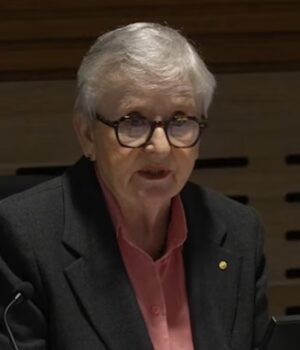
Professor Steven Prawer walked into his office at the University of Melbourne and found around 20 people waiting for him, most with their faces covered by keffiyehs. He had spent untroubled years running a physics research collaboration with the Hebrew University of Jerusalem. Other senior staff were involved in the collaboration, but Prawer, who wears a kippah, was the only one visibly Jewish.
He told the people in his office that they were trespassing and asked them to leave. They refused, and as he tried to reach a secure part of the building, two of them followed him and wedged a foot in the door to stop him closing it, chanting, “Prawer, Prawer, you can’t hide, you’re guilty of genocide.”
When he returned to his office later that day, a photograph of him had been vandalised and symbols associated with Hamas had been stuck to his walls.
Accounts like this are now part of the public record of this country, permanently, because a royal commission compelled them.
I made a submission to the Royal Commission on Antisemitism and Social Cohesion. My submission is principally about the malevolent power of the herd and the damage it wrought to a country’s society and democracy. I wrote my submission because I cannot countenance any minority group in this country having to send their children to school under armed guard. I would feel the same whatever group was in that situation.
Over recent weeks, the royal commission has attracted criticism. Some have expressed concern that certain witnesses have not been called to give evidence. Others have argued that some of the loudest antisemites and supporters of proscribed terrorist groups who have done so much damage to our country have not been made to answer publicly for what they have said and done. The disgraceful events at the Sydney Opera House on October 9, 2023, have not been fully examined. Those grievances are real and they must not be dismissed.
But taken on their own, they understate what the commission set out to achieve and what it has already achieved. Its single greatest feat has been to create an extraordinary truth-telling process. Truth-telling processes are incredibly important and cathartic. I have seen this with my own eyes, in the area of sexual abuse of children, through an organisation I chair.
In this commission, more than 20,000 submissions were made before a single public hearing began – the largest response of its kind in Australian history. Commissioner Virginia Bell, the highly respected former High Court judge, opened each hearing with the lived experience of Jewish and other Australians before institutions were questioned. Ordinary Australians, many of them frightened and previously without a platform, were heard with empathy, care and respect.
If the personal accounts established the human cost, the institutional evidence has been just as pointed. The vice-chancellors of ANU and the Universities of Sydney and Melbourne answered for their institutions. The University of Melbourne confirmed that the university had chosen not to name the students disciplined over the occupation of Professor Prawer’s office.
There is now no more complete public record of contemporary antisemitism, perhaps since World War II. Once evidence like this sits on the record, it becomes very hard to pretend it does not exist.
Some want the commission to do more than build a record. They want it to name every person, leader and institution that turned away while this hatred grew and to see them held to account. I understand that wish and the raw anger that sits behind it.
It is true that another commission may have been conducted in that way, allowing the performative evisceration of bad actors and institutional leaders who enabled them. However, and having regard to the terms of reference, this commission was never going to disembowel protagonists or terrify witnesses into submission.
Systemic and meaningful change requires real listening, education and empathy, of the kind being displayed by this commission. This commissioner seems to understand that history shows that punishment and retribution need to be balanced with education and understanding.
The commission has done an extraordinary job to date and should be trusted to finish its work in the best way Commissioner Bell thinks fit. Forensic criticisms of the commission at this stage can only give those resistant to change an opportunity to dismiss the commission as partisan.
The success of the commission should be judged by the degree of cultural and institutional change it effects, and by the recommendations that are made and implemented. A commission that delivers instant gratification but compounds fractures to social cohesion is ripe for politicisation and harms our chances of real change.
The report Commissioner Bell writes by December will have an impact, and so will what the government will assuredly have to do with it. But the evidence that got us there already exists and cannot be undone and Australians can see what antisemitism looks like. We, as a community, can no longer deny or ignore it and are duty-bound to confront it.
Only then can we be satisfied that we took the steps that needed to be taken to reveal, recognise and confront the abhorrent disease of antisemitism – a disease which is anathema to a country that is world-famous for giving everyone a fair go.
Philip Crutchfield is a Melbourne barrister