

Source : INDIA TODAY NEWS
There are films that ask you to admire their courage. And then there are films that silently ask an uncomfortable question: What happens when a democracy decides that some lives are no longer worth remembering? Satluj belongs to the latter category.
For years, the film itself became a story of censorship before audiences could even judge it as cinema. Denied a theatrical release in India and eventually arriving on streaming under a different title, the film carried the burden of controversy way before anyone had seen a single frame. But strip away the politics surrounding its release and what remains is something far more haunting – a deeply humane story about memory, accountability and one ordinary man who refused to let thousands disappear twice.
advertisement
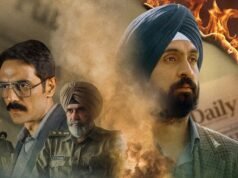
Satluj tells the story of human rights activist Jaswant Singh Khalra, played with remarkable restraint by Diljit Dosanjh. A bank manager by profession, Khalra began piecing together evidence of thousands of alleged illegal cremations carried out during Punjab‘s militancy years – the ’90s – after families started searching for loved ones who vanished without a trace. What starts as an attempt to answer a grieving mother’s question gradually turns into one of the most dangerous investigations imaginable, as municipal registers, cremation records and bureaucratic files expose a system that had learnt to erase people as efficiently as it erased evidence.
Director Honey Trehan does not make the mistake of turning Jaswant Singh Khalra into a larger-than-life hero. That would have been the easier film. Instead, he introduces us to a man whose greatest weapon isn’t rage or violence, but paperwork, registers, files, numbers, municipal records and cremation logs. In a time when guns dictated the narrative, he believed documents could speak louder. It isn’t about discovering a conspiracy. It is about discovering that every atrocity leaves behind a paper trail if someone is willing to look closely enough.
Which is exactly what makes Satluj so unsettling. The camera doesn’t linger on dead bodies for sensationalism, it does so to establish the loss of life. In one of the most haunting scenes, the film shows a family being killed, including a seven-month-pregnant woman. But we only see her body, never the act of killing – and that doesn’t take away from the horror.
The film recreates Punjab of the 1990s, making it look hauntingly dark, real and still. This isn’t a world built on loud speeches or chest-thumping nationalism. Fear hangs quietly in the air. Families wait for sons who never return. Mothers refuse to accept absence as truth. Entire neighbourhoods have learnt that asking questions can itself become a crime.
Trehan understands something many political films often forget. Violence isn’t frightening because we witness it, it is frightening because of what it leaves behind. The silence, the waiting, the uncertainty and the inability to mourn because nobody officially admits a death ever happened.
KU Mohanan’s cinematography reflects this emotional paralysis beautifully. Faces carry exhaustion before dialogues do. Empty roads feel threatening. Even daylight seems stripped of warmth. There are no visual flourishes trying to beautify suffering. The camera simply watches, allowing grief to accumulate until it becomes impossible to ignore.
The screenplay wisely avoids reducing the conflict to good versus evil. Instead, it asks a far more uncomfortable question: Can institutions built to protect citizens slowly begin protecting themselves instead? Once that shift happens, where does justice go?
The policemen here aren’t presented as cartoon villains. They have normal conversations. They laugh, eat, discuss promotions and personal milestones. Which is exactly what makes them terrifying. The machinery of violence isn’t always driven by monsters. Sometimes it is sustained by bureaucracy, ambition and the belief that the end justifies every possible means – a clear showcase by the film.
Suvinder Vicky delivers one of the film’s strongest performances as the senior police officer representing that machinery. He doesn’t scream or perform cruelty theatrically. He behaves like a man convinced history will never question his decisions. That confidence makes him far more dangerous than any loud antagonist.
Diljit Dosanjh, meanwhile, gives one of the finest performances of his career. He has often proved that beneath the star persona lies an actor capable of extraordinary restraint. Here, he understands that Khalra wasn’t trying to become a revolutionary. He was trying to remain human while the system around him steadily abandoned its humanity.
As a man who would simply fold his hands whenever threatened or given a warning, Diljit never relies on dialogue. His eyes constantly search rooms for answers that never arrive. His pauses communicate fatigue more effectively than speeches could. The performance refuses to seek applause. It seeks empathy.
Geetika Vidya Ohlyan brings heartbreaking dignity to the role of Paramjeet. Political films often reduce wives into symbolic sufferers waiting at home. Here, she becomes the emotional cost of activism. How do you support someone you know is morally right while fearing every day that righteousness may take them away forever? The film never verbalises this conflict, but it lives inside every scene she occupies.
Arjun Rampal’s arrival introduces an important balance. By including officers who still believe in constitutional values, the screenplay avoids making simplistic arguments about the Indian state as a whole. The problem, the film suggests, isn’t the existence of institutions but what happens when institutions stop questioning themselves.
The film’s greatest achievement is that it refuses easy political binaries. Is it anti-police? No. Is it anti-state? Not really.
If anything, it is deeply pro-Constitution. It repeatedly argues that the strength of a democracy isn’t measured by how efficiently it defeats enemies, but by whether it protects the rights of its own citizens while doing so. Which also makes us wonder why exactly it has been banned in the country, and now, even removed from ZEE5.
That makes Satluj feel surprisingly contemporary.
Replace Punjab in the 1990s with almost any place where national security becomes the ultimate justification for secrecy, and the questions remain disturbingly relevant. At what point does patriotism become an excuse to stop asking difficult questions? When does demanding accountability begin to look like betrayal? And who decides which dead deserve remembrance?
These questions give the film its lasting power.
Despite crossing the two-and-a-half-hour mark, the narrative rarely loses momentum because every discovery raises the stakes. What begins as an investigation slowly transforms into a survival thriller where truth itself becomes dangerous. Trehan also knows when to relieve the tension with brief moments of warmth and humour, preventing the film from becoming emotionally exhausting.
A few courtroom and investigative stretches could have benefited from tighter editing. Certain conversations repeat ideas the audience has already understood. A sharper second half would have made the emotional pay-off even more devastating. Yet these are minor complaints about a film carrying enormous emotional and political weight.
More importantly, Satluj reminds us of what cinema can still do. It can preserve memories that power wants erased. It can ask questions official records refuse to answer, and it can become an archive for people’s almost forgotten history.
Ironically, a film about preserving memory has itself struggled to remain visible. Perhaps that is the final tragedy surrounding Satluj. But good films have a strange way of surviving. They continue to exist in conversations, in uncomfortable questions and in collective memory long after platforms remove them.
Satluj deserves to be remembered for exactly that reason.
– Ends
SOURCE :- TIMES OF INDIA