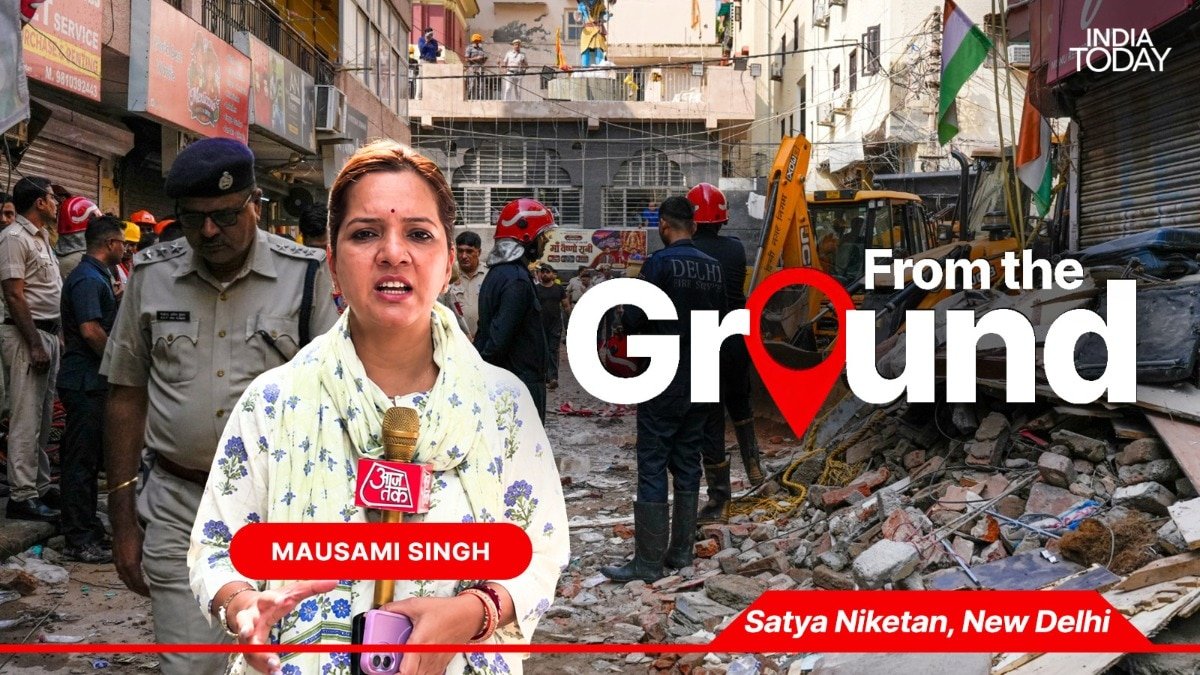
Source : INDIA TODAY NEWS
More than 24 hours after a five-storey building collapsed in Delhi’s Satya Niketan, killing seven people, rescue operations are still underway. I am at the site, where NDRF and Delhi Fire Service teams are removing heavy debris in the hope of finding survivors.
The lane is packed with students, residents, rescue workers and emergency vehicles. It is so narrow that even the movement of a single vehicle can block the passage, making an already difficult rescue operation even more challenging.
advertisement
But the collapsed building is not the only danger here.
I have walked through the dark and congested lanes of Satya Niketan and seen how closely the buildings stand. In some places, the gap between two balconies is barely the width of a hand. Electricity poles and tangled wires hang dangerously close to balconies, while air-conditioning units are installed almost everywhere.
It is a recipe for disaster.
TEN STEPS AWAY, ANOTHER BUILDING AT RISK
Just ten steps from the collapsed structure, I entered houses No. 111–112. Two buildings share a single staircase, and around 60–70 students live there.
I saw a broken and leaking roof, rooms without windows, a suffocating kitchen and cracks near the foundation of a pillar. The buildings have 18 electricity meters and six water meters — an indication of how many people are packed into this limited space.
Despite these conditions, the buildings remain occupied. Students reportedly pay Rs 25,000 for two rooms, while a single bed can cost as much as Rs 15,000.
The conditions raise questions over whether such buildings are being used as authorised PG accommodation and whether they comply with building permissions and safety norms.
A NIGHT OF FEAR FOR STUDENTS
Inside a girls’ PG located just a few steps from the collapsed building, I met Ritvika, a first-year Venkateswara College student from Bihar. Her name has been changed to protect her identity.
Ritvika told me that she and several other students could not sleep through the night. When they heard the building collapse, they were so frightened that they initially thought an earthquake had struck.
They watched ambulances, Delhi Police personnel and NDRF teams arrive as chaos spread through the locality. Several students stayed awake through the night, using their mobile phone flashlights.
The collapse site is surrounded by a medical store, stationery shops and a temple. Students say the area remains crowded throughout the day. Some had been at the same spot shortly before the building came down.
STUDENTS COME FORWARD TO HELP
As rescue teams continued working, students from Maitreyi College reached the site to help. They distributed water and biscuits among those present. Maitreyi College Students’ Union president Aditi Verma and student Palak Yadav were among those assisting at the site.
DANGER GOES FAR BEYOND ONE BUILDING
What I have seen inside Satya Niketan shows that this tragedy is not about one collapsed building alone.
Old structures have been converted into overcrowded PG accommodations here. Buildings stand almost wall-to-wall, lanes are too narrow for emergency vehicles, rooms lack ventilation and electrical wires hang dangerously close to balconies.
The Delhi High Court has now sought an audit of PG hostels and asked the MCD to ascertain whether such buildings were constructed with valid permissions and in accordance with building bylaws. The court has also called for more hostel facilities for students and stronger regulation of PG accommodations.
The collapse has raised urgent questions: How many buildings in Satya Niketan are structurally unsafe? Were notices issued against them, and were those notices enforced? Are these PGs authorised? And why are students still living in buildings that could become the site of another tragedy?
The rescue operation will eventually end, but the danger will remain unless every vulnerable building is inspected and those found unsafe are immediately evacuated.
– Ends
SOURCE :- TIMES OF INDIA