Source : ABC NEWS
When Dale Lewis recalls being at the Sydney Swans in the 1990s, it certainly was not all about big games and big crowds.
“We’re training, doing preseason out of the showgrounds next door [to the SCG] and one of the days, the Big Day Out was on at these showgrounds. We had to walk the oval, arms linked like we’re in a search party checking for needles and shit in the grass before we trained,” he says.
“The Swans weren’t popular. We were having crowds of 5,000 people. I jumped the fence one day to get the footy for a boundary umpire.
“I’ve got a great mate … his brother used to come, and he used to love it because he could sit anywhere, and he cracked the shits when we started getting good because he had to go buy a ticket and couldn’t get a decent seat and sit where he wanted to.”
It all changed in the mid 1990s, when the Swans went from the basement to the penthouse.
With three straight wooden spoons between 1992 and 1994, they went from winning one game in 1993 to four wins in 1994 and eight wins in 1995, then a surge to 16 wins and top of the ladder in ’96.
A finals win over Hawthorn put them in a home preliminary final against Essendon at a heaving SCG, 30 years ago today.
Swans utility Troy Luff had gotten his opportunity that season. Originally from Traralgon in Victoria, he grew up attached to a footy like most kids, then he and his family moved to Nelson Bay near Newcastle.
He was spotted while kicking goals for fun in the Hunter, but struggled to make a mark with the Swans under Ron Barassi.
Then new coach Rodney Eade changed everything as Luff became a permanent fixture in the side.

Troy Luff got his big opportunity for the Sydney Swans in 1996, and he rode the momentum to the prelim. (ABC News: Billy Cooper)
“It was more excitement rather than pressure,” Luff says.
“If we lose, we lose. We got this far, but everyone just went out there and enjoyed themselves, and the results came our way.”
Lewis agrees.
“None of us saw it coming, but by Christ it was addictive once you started to win, especially at home,” he says.
“Because I think that was the year we started. We ended up winning 22 or three in a row at the SCG as the run got going. You started to get a feeling about it.
“And once we’d beaten Hawthorn in that first qualifying [final], the expectation was why not?”
In 1992-93, the Swans lost 26 games in a row.
Lewis, who was drafted against his preferences in 1990 by Sydney, was out the week they broke the run against Melbourne, and ended up playing in 33 consecutive losses. He had tried to get out of Sydney in 1994, but ended up staying.
In 1995, there were a series of important arrivals, none bigger than the famous bookends, Paul Roos and Tony “Plugger” Lockett.
The former St Kilda superstar Lockett had won his third Coleman Medal (and first in Sydney) in 1996, booting 114 goals in the home-and-away season.
Former Fitzroy key position player Roos brought skill, leadership and experience.
Now they and the Swans were a win away from a grand final.
The game
It was fierce, frantic footy early doors. Not a heap of composure was shown, with lots of scrubby kicks under pressure, aiming for territory, not accuracy.
Early in the game, Essendon was looking for James Hird, who – along with Michael Voss of the Brisbane Bears – would win the Brownlow Medal two days later. Hird kicked long from 60, and Steven Alessio marked before converting from 20 out.
Soon after, Lewis marked, then tripped over Hird and was crunched in a tackle. Hird grabbed the ball and scored. Swans fans were livid, but Essendon led by two goals.
The Swans tried kicking to Lockett, but Essendon cleared – their movement was better, and Hird earned a free on 50. He went long, Justin Blumfield came down with it and ran around to kick Essendon’s third.
Sydney could not take a trick. Lewis grabbed the ball in the centre square and quickly went long again in Lockett’s direction; in the end, Jason Mooney kicked a point to make it 3.1 to 0.1.
Hird came off the ground with blood streaming from his left cheek after he and Andrew Dunkley contested a ball, the Swans defender roughing the Bombers star as he lay on the ground with Dunkley on top of him.
A Barry Young point extended the lead, then Gary O’Donnell took possession and went long to Che Cockatoo-Collins, who marked and drilled it from inside 50. Seven minutes left, Bombers by 25.
The Bombers were dominating clearances, and Damien Hardwick set up Mick Symons for a contested mark, but his kicking radar was off. The Swans’ forward forays were like chaos balls compared to the Dons.
Dale Lewis’s long-kicking, strong marking style made him an important player for the Swans against the Bombers. (Getty Images: Mandatory Credit: Allsport Australia/ALLSPORT)
Another series of points, then Wade Chapman marked a Stuart Maxfield kick near horizontal at half-forward. His kick came, and Lewis drifted in from the side for a great mark. He kicked it, and the Swans trailed by 19 at quarter time.
“Part of your job is to kick goals and everything else, but to take a big mark,” Lewis says.
“That was in front of the Ladies Stand too, I think. A mad, mad Swans house there. Always nice to do that.”
Luff says the Swans had built up confidence during the season.
“There was never an attitude of, ‘Oh geez, they’ve got three goals on us, we’re going to lose this.’ We were like, ‘No, no, we’ll get that back’.”
Tough night for Essendon’s Lloyd
On the Essendon side of things, forward Matthew Lloyd was playing a prelim in game 16 of his career, at just 18 years old.
Drafted at 16, thanks to a one-off change of the rules due to draft concessions for the new Fremantle side, Lloyd was highly touted.
He kicked three on debut against the Crows in 1995 before playing a couple of finals as a schoolboy.
In 1996 he kicked another seven against Adelaide, and then just before finals he booted three against the Swans at the MCG.
“I was playing local footy in 1993, Western Jets in ’94, and then suddenly I’m playing as a 17-year-old in ’95. So yeah, it all happened so fast, but I was very driven,” Lloyd says.
“[The focus] was all footy, footy, footy. I was 78 kilos, and I actually ended my career at 92 to 94 kilos.
“So I was out of my depth physically. I did kick three on debut, and I kicked three in the first [1995] final, so I had some good moments.”
Matthew Lloyd kicked three against the Swans in August 1996, but he struggled in the cauldron of an SCG prelim a month later. (Getty Images, file photo)
Fast-forward to the prelim in 1996; it was a different story.
“I just felt like the SCG, where I hadn’t played before, the crowd was on top of you, it was loud, and it was physical,” Lloyd says.
“I was a very nervous type. I had a big fear of failure. I wasn’t able to get my hands on the footy; it was more the atmosphere in that stadium and some big Sydney players too that I was playing on [that was intimidating].”
In the second quarter, Sydney was trying to hit back, and narrowed the gap through goals to skipper Paul Kelly and Daryn Cresswell. The lead was four points.
Lloyd was scrambling to make an impact. Nearly halfway through the quarter, a big Mark Harvey kick was bouncing towards the boundary at half-forward.
Mark Bayes and Hird were running one way, and Lloyd was racing out of forward 50. As Lloyd recalls, what happened next was “quite innocuous” as he tried to bump Bayes.
“You bump someone, and instead my elbow came back into my side. It took my breath away, and I felt winded. I played out the rest of the second quarter, but I felt like I was deteriorating health-wise,” he says.
A review of the video does not suggest there was a huge problem – Lloyd kept launching himself into packs, although if you were keeping your eye on him rather than the ball, he was taking longer to get up each time.
“It’s all a bit of a blur for me because I remember I couldn’t concentrate; I couldn’t really take in the half-time address [from Kevin Sheedy],” he says.
“I was losing colour in my face and body. I said to the club doctor, I’m not feeling very well, and they decided to have me start the third quarter and see how I was feeling after five minutes.
“I’m not sure how long I was in the third quarter where I eventually came off … but they knew to get me to hospital at that point.”
Lloyd went to emergency at a Kings Cross hospital.
“I just remember lying there still in my full Essendon kit of the football jumper, the shorts, socks, and boots I presume, and just pain, just in so much pain,” he says.
He was given morphine, and the pain subsided a little.
“They asked me to hop, and I hopped, and I said, ‘I actually feel a bit better,'” he says.
“I can’t remember what they thought it could have been, but they said, ‘He’s right to go back to the hotel.'”
Swans making a run
Back at the SCG, things were improving for Sydney.
After those two early goals, the Swans sensed an opportunity. Derek Kickett kicked from the right pocket to the square for Lockett to mark and goal. The crowd erupted and Sydney led by two with 9:26 left in the half.
Another scrambled ball was toed toward goal by Lockett, only for Sean Denham to palm it away like a goalkeeper.
Somehow Lockett got it out to Luff, who kicked the goal and Sydney led by eight. It was pandemonium at the SCG.
“From memory, he burst through and pushed someone out of the way, then handballed it to me at the top of the square and I snapped the goal,” Luff recalls.
“And you just get pumped; it helps you keep building from moments, whether it’s a good tackle or a good spoil [or a goal].”
Misses by Barry Young and Hird brought the margin back to six.
The play was getting faster and more chaotic, and the ball pinged in and out of 50 for Sydney. A kung-fu style kick from Luff found Greg Stafford, who ignored a furious Plugger before Cresswell snapped his second. Swans led by 12 at half-time.
Early in the third, a Lewis kick found Lockett near the point post – he marked then stumbled and fell over. His kick hit the post.
On the ABC Radio broadcast, commentator Peter Longman said: “He’s done some good things, Lockett, but if he was a racehorse they’d be checking him out behind the barriers and declaring him a non-starter, I feel sure.”
Teammates knew Lockett was in pain.
“An 80 per cent Plugger is better than not having him in the side at all, even 70 per cent Plugger. He was just that good,” Luff says.
The back and forth continued, with a kind of stalemate.
Luff snapped over his shoulder, but it bounced out 15 metres wide of the posts. Luff then got the tap to Kelly, who took two steps and snapped for a Sydney goal. Cue huge chants from the red and white faithful.
Utility Troy Luff contributed to the Swans’ historic prelim challenge, setting up a goal and kicking one of his own. (ABC News: Billy Cooper)
“I started in defence when Paul Roos was injured. I’d play centre-half-back. Andrew Dunkley was injured, I’d play full-back. Plugger was out, I’d play full-forward. So I just played any role the team needed [including ruck],” Luff says.
There were 41,731 at the SCG that night – and they were totally fired up, making the noise of a much bigger crowd.
“David Murphy used to tell me prior to that year, 50,000 people, you can just hear your teammate. [With a] 75,000 crowd, you can barely hear your teammate,” Lewis says.
“Anything over 85, 95,000, you can’t hear your teammate, and you can’t even feel yourself get hit. Such is the noise and the adrenaline; you don’t even know what’s happening.
“The messaging was always, [finals are] going to be quicker, it’s going to be faster, it’s going to be harder. And none of it’s bullshit.”
Just when Swans fans might have been feeling a little confident, the Bombers had a forward 50 stoppage; the tap went to Harvey, and then O’Donnell, who kicked from 35 and the lead was 13 points.
But Sydney went down the corridor, and Lewis marked. A huge roar greeted his goal, and a fan leapt the fence and ran next to the umpire to do a tandem goal signal. He then got out of there quick-smart.
At 19 points down, the Bombers were not done. Dean Wallis marked in the pocket, then Sydney gave away 50. Dunkley was in the umpire’s face – Wallis goaled, then confronted the Sydney full-back.
The Bombers won the next clearance, and Alessio found Hird in the square to score. With 3:00 left in the term, it was a seven-point game.
In the final minute, Alessio marked around 50 – and converted. A quarter to go, Sydney led by a solitary point, 8.7 to 8.6.
Troy Luff recalls Swans coach Rodney Eade urging players to keep things tight to start the final quarter at the SCG. (Getty Images, file photo)
“I remember Rocket (Rodney Eade) just saying that we needed to shut that down at the start of the last quarter, not go out and try and kick a goal,” Luff says.
“If they got the first goal, they’ve kicked four in a row, and they may have gone on with it. But if we just shut that momentum down, play a bit defensive to start with, then once the game settles, then we [can] go out and attack.”
Only three of the 16 goals kicked had been to the left-hand end. The Bombers would be kicking to that end in the final quarter.
Early on, O’Donnell fed Che Cockatoo-Collins, who burst down the right. His kick found Hird, and the Essendon champion slowed, then raced forward and snapped. The umpire scampered around. The Bombers had their early goal.
With 18:27 left, Essendon led by five. Everyone was tiring, and play was largely stuck between the arcs. Time ticked slowly; after a series of misses it was 9.9 to 8.9.
The tension was rising. Essendon’s Denham might have cracked a rib; Sydney’s Michael O’Loughlin hurt his knee. He came off and returned, still limping.
From a boundary throw 40m out, Harvey handballed to a running Symons.
ABC’s Peter Longman was left incredulous:
“He’s put it through! The Bombers lead by 12 points! Symons, a duffer from a standing start, has a checkside kick from 35m out and he’s put it through – and he might have put the Bombers into the grand final next week!”
The Bombers led by 12, 4:09 on the clock.
The final minutes
Lewis had a sick feeling, wondering if this was how it was going to finish.
“Something you’ve wanted so bad as a kid, as a senior footballer, as an AFL player, it’s within your grasp, but you can’t touch it … It hits you in the gut real hard. I’m not going to lie to you, that was a shit feeling when he kicked that one,” he says.
The runner told Lewis to drag Hird to full-forward because Sydney needed goals.
“So I hightailed it out of there,” Lewis recalls.
Essendon hacked it forward; Adam Heuskes cleared to Kelly. He found Maxfield, who was chased through the middle, taking two bounces as the roar built. A kick from 60 to Hird and Lewis – and Lewis grabbed it and kicked the goal. Six points, 2:48 left.
It got even more frantic, the ball stuck in the middle. The Swans cleared, and it went to Simon Garlick, then Chapman, then Maxfield to Lockett, who played on but didn’t go for goal, opting to kick inside to Cresswell. Cresswell marked then lay down, cramping.
He got up and kicked it, and with 89 seconds left, the scores were level.
Cresswell raised his arms skywards. The Sydney Airport curfew was still half an hour from kicking in, but the roar erupting would have matched a take-off from Mascot.
The clock ticked down, a ball-up with 1:02 left, no real progress.
The play was ferocious as players collided. The ball went inside 50; Swans couldn’t mark. Blumfield cleared it desperately, and Chapman marked to the right of the centre square. He back-pedalled, then kicked high to the left side of 50.
From stage right came Tony Lockett to pluck it from the sky and draw every single decibel from surrounding suburbs with 17 seconds left.
He was 52 metres from goal, with an injured groin, and no other options. The clock ran down.
“The video shows me walking past him as he’s about to line up to take the shot. I’ve just turned around to him and said, ‘All you have to do is get it over the line. Doesn’t matter what it is, just get it over the line,'” Luff recalls.
The siren’s gone, the crowd’s collective blood pressure had spiked into the stratosphere, but Plugger had it.
Loading…
Everyone watched the ball fly towards goal. Was it there? A point was enough; out on the full or short meant extra time.
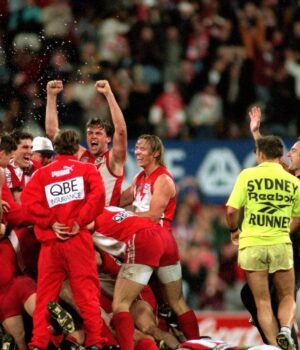
The roar gathered. The umpire fired out one finger to signal a behind, and absolute bedlam ensued at the SCG. The Bombers were distraught. The Swans were ecstatic.
It was over. Two seasons removed from the wooden spoon, the Swans were in their first grand final since South Melbourne’s infamous “Bloodbath” decider against Carlton in 1945.
Lewis recalls the feeling when Lockett took the grab.
“Call it presumptuous, but the moment he marked it, I knew we were going to play in a grand final,” he says.
What about Plugger’s groin, the distance, the pain, the effort required?
“None of it became relevant because he’s Tony Lockett,” Lewis says.
“We would pick him from anywhere, any angle, any distance. Because that’s what he does. Not only was it his job, but the belief we had in him when he had the ball in hand, kick a goal or convert and finish was just amazing.”
The aftermath
Sydney’s Tony Lockett pushed himself to the limit for the most important behind of his career that put the Swans in the grand final. (Supplied: AFL Photos)
Luff was quick to the party.
“We’re like, ‘That’s going to score.’ And then the excitement hit us. And I was one of the first ones to jump on Plugger, and then everyone else just piled on top,” Luff says.
“And what I do remember is Plugger on the bottom going, ‘Get off me, get off me.’ He was so sore from his groin that everyone jumping on didn’t help his cause.
“Then [we] got up and we’re like, ‘We’re in the grand final. We’re in the grand final.’ It was ecstatic. It was fantastic.”
Lewis turned to Stafford in the square to find he was already off running.
“I get in a bit late on the pile on, and all I can do is pat a few blokes … because I was too busy celebrating down the goal square looking for a bit of love from teammates who’d already done the bolt,” he says.
Dale Lewis says the surge of euphoric Swans fans onto the SCG after the 1996 prelim was the precursor of the “Buddy moment” in 2022. (Getty Images: AFL Photos/Michael Willson)
The euphoric crowd of Swans fans surged onto the ground.
“That’s the precursor to the Buddy moment [Lance Franklin’s 1,000 goals] in terms of the crowd getting on the ground at the SCG,” Lewis says.
“You didn’t want to get off [the ground], but you wanted to get off because you wanted to get into that little room downstairs and soak it all in with each other and just go, ‘F***, how good is this. We’re in one.'”
Lloyd’s dream turns ‘nightmare’
Back at the Bombers team hotel, Matthew Lloyd was in his room with his parents. Players were coming in, but the morphine was wearing off.
Once people had gone, Lloyd asked his parents to help him to the bathroom, where he passed blood.
Essendon’s Dr Bruce Reid came, and Lloyd says he was “rolling around in bed, just the worst pain of my life.” Reid asked him if he had shoulder pain.
“I stopped for a second, and I said, ‘Yeah, really strong shoulder pain.’ I just remember him saying, ‘Get him an ambulance. He’s got a ruptured spleen’,” Lloyd recalls.
Scans showed a large tear in his spleen, and a litre and a half of blood. It could have been fatal if left longer. As scary as this was, Lloyd had to come to terms with what it meant for his footy career.
“I knew going into this game, the reserves had qualified for the grand final,” he says.
“I thought, ‘Well, I’m going to play in that because I qualify for that or I’m going to play in the AFL grand final,’ and then it turned into my nightmare.”
Lloyd lost eight kilos, was bedridden for a time and could not do anything physical for three months. But in 1997 he burst out with a 63-goal season.
“I lived and breathed footy, no interest in going to parties,” Lloyd says.
“My dad played 29 games for Carlton, and from the moment I was three or four, I had a footy in my hand, and it’s all I ever wanted to do … and I was no different with my rehab; I was willing to do anything to play AFL footy.”
That determination saw Lloyd finish as Essendon’s top goal-kicker and eighth in VFL/AFL history, with 926 majors.
While Lloyd was suffering through a ruptured spleen, the other Bombers were dealing with a season cut short.
He says the players filing through his hotel room that night let him know coach Kevin Sheedy had exploded like never before after the game.
Lloyd was told Sheedy was pointed in his criticism of the team and of individuals, not just for the loss but for the way they lost and a perceived lack of toughness.
Three years later, a dominant Bombers team came up against Carlton and lost in the prelim. Lloyd says it still hurts today.
“In 1999, [Sheedy] was very different. He [went], ‘OK, how I’m going to go to sell to these boys the hurt and what we’re going to do in 2000 and this should steel us for 2000.’ But in ’96, he wasn’t like that.”
Essendon, including Lloyd, had to wait until 2000 for the flag, as they tore through the AFL going 24-1, including three finals by a ridiculous combined margin of 230 points.
For Sydney’s Dale Lewis (centre), the ultimate grand final success eluded him, but the prelim win remains unforgettable. (Getty Images)
For the Swans, the euphoria became a magic grand final week and a dream first quarter and a half – but then the Kangaroos put their foot down, and North ran away with it to win by 43 points. Lockett kicked six, but it wasn’t enough. Sydney had to wait until 2005 for the drought to break.
Luff, Lewis and Lockett never won a flag, although Plugger made history with an untouchable 1,360 goals.
It is now 30 years, but Dale Lewis, for one, has not forgotten that night.
“I can see it now. I get a little bit emotional about it,” he says with a slight crack in his voice.
“I can see that [night]. I can see the looks in a couple of guys’ eyes. I know who I turned to. You look at it, and you go, ‘Unbelievable’.”