

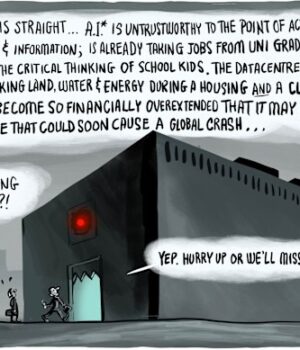
source : the age
To submit a letter to The Age, email letters@theage.com.au. Please include your home address and telephone number. No attachments, please include your letter in the body of the email. See here for our rules and tips on getting your letter published.
Matt Canavan blames the “feminisation of the school curriculum” for pushing boys towards toxic online material (″Contos sounds alarm on manosphere″, 3/9). Does this mean that we should also blame young female teachers, many of whom are considering leaving teaching, because they are being targeted by boys making disgusting suggestions and displaying disrespectful behaviour in the classroom and school grounds? His suggestion that the school curriculum is pushing boys towards the manosphere is ludicrous. Revolting people like Andrew Tate and other online personalities use their platforms to make money by targeting young males using outrage and extreme political and misogynistic views. This is what schools need to address. As to getting more male teachers, Canavan must think he has come up with a unique idea, but that problem has been around for decades and while there are various reasons for the lack of male representation, the pay scale is a major factor. Teaching just does not pay enough compared to other professions.
Helen Ross, Northcote
Parents, be the No. 1 role models
Benjamin Preiss penned a thoughtful article on parenting in today’s world (″The complex task of parenting as social media reigns″, 31/8). While I do not envy today’s parents with the challenges they are facing, parenting children has always been a very difficult and stressful job. Every generation has had its challenges and difficulties. As humans we grow and mature in similar ways to what we always have done and this includes significant transitions during adolescence. For most of us (and our children) maturity to adults brings a better understanding of who we are and where we fit in. Parents need to realise that they are the most influential models of their children and strive to be good parents rather than ″friends″ . Good role models, including examples of how to deal with modern social media, are very important.
Shaun Quinn, Yarrawonga
Mentorship as a preventative action
The revelations (″Schoolboys expelled for misogyny and threats″, 2/9) that the influence of the manosphere ideology is infiltrating secondary schools to the extent that boys are refusing to show respect and follow directions from female teachers – culminating in the expulsion of boys from school – should ring alarm bells with all who strive to uphold gender equality and respect as a guiding principle of life. One can only imagine the effect this has on the mental health of female secondary teachers. For this reason, the actions and statements from our elite sportsmen, social influencers and music artists are so important in modelling proper respect for women.
One way to counteract this insidious counter culture would be to flood schools with high-profile young men to mentor male students and model respectful relationships. To those who receive the adulation and financial rewards of fame in our society should come the responsibility of modelling respect for women, social inclusion and the debunking of misogynist philosophies. Let’s take preventative action now rather than relying on expulsions and sanctions after the event.
Graeme Lechte, Pascoe Vale
Women and girls deserve proper response
The expulsion of two Sandringham College boys for threatening female staff comes as a recent Monash survey found nearly 80 per cent of teachers had seen or experienced gendered violence. Both indicate that hostility towards women and girls among teenage boys is worsening. Something has to change. The federal government’s instinct is to review and strengthen consent and respectful relationships programs. That may be the right thing to do. My concern is that after a decade of these programs we still have little solid evidence that they work, and there is a plausible risk that boys who feel lectured about the failings of their sex go looking for somewhere they feel welcome, and find it in the toxic online manosphere. I don’t know whether that is happening. Does anyone? That uncertainty is the thing to fix. We should fund proper trials, compare approaches, and be willing to drop what does not work. Existing programs should continue while we find out, but the girls and women bearing the cost of this abuse deserve a response built on evidence.
Paul Henry, Murrumbeena
THE FORUM
Power to the people
Jemena notified us in early August about “essential maintenance” works in our area (“Suburban fury stalls data centre power pole plan”, 3/9). Great we thought. Preparing to ensure supply over summer. We should have been more suspicious. There was a massacre of our street tree canopy, cutting of outdated cables left trailing in our front yards and street closures.
Maintenance day arrived. Cars were moved early, a warm alternative place to spend the day found and a women’s book group was re-scheduled.
What did Jemena define as “essential maintenance”? Fifteen-metre concrete poles to carry 22,000 volts. Ugly new poles on every corner and some extra ones in between. It’s new infrastructure, Jemena – for data centres. I know why Jemena didn’t inform us. We leftie/greenie Yarravillians would not have co-operated. We would have parked our cars in the street.
We could have sneaked out in the dark and filled in the holes with rubbish. And my older women book group might have staged a sit-in protest (with chairs) but no removal of our tops!
Do you blame us?
Rae Swan, Yarraville
Underground thinking
In all the research trips taken by politicians, I wonder if any of them have thought to ask how every European city, large and small, has managed to put its electrical services underground. This allows uncluttered sky and street views with trees that retain their natural shape and provides a calm and attractive environment, all within the challenge of narrow, often cobblestone streets without footpaths, centuries-old buildings and limited access.
We did put the NBN underground, and now my heart sinks when I see proposals such as the new pylons in Yarraville.
Heather Barker, Albert Park
Yikes, Yarraville
As if Yarraville has not had enough huge trucks running through their streets, now there’s massive electricity poles. Yarraville is a place of narrow streets, so good on the community for standing up.
However, this may be just the tip of the iceberg: what suburb could be next? I would like to see the company trying to install them in Brighton.
If the government sits on its hands lord knows what Melbourne will be like if these data centres need massive amounts of power. These huge poles could end up anywhere. The government needs to listen to the people. We are the ones who will pay the price.
Forward thinking is needed here otherwise government can expect a backlash.
Nola Cormick, Albert Park
Good after bad
During a recent visit to the Latrobe Valley One Nation announced its Victorian energy policy. Its Victorian leader, Warren Pickering, said he would not allow Loy Yang A power station to close in 2035 as planned. The reason this closure date has been chosen is obvious: the company that owns it knows it would be grossly uneconomic to maintain what, by then, will be a highly unreliable coal-fired generating plant that’s more than 50-years-old. To extend its life beyond 2035 the Victorian government would have to underwrite its ongoing uneconomic operation. In other words, Victorian taxpayers will have to pour good money after bad. How much and for how long is unknown because Pickering didn’t say.
Kevin Bailey, Croydon
Not prepared
Do our politicians understand the science of climate change? There is a difference between understanding the science and grasping what 2.6°C of warming will actually mean for life on Earth (″Pacific anger at Australia after climate target failure″, 3/9). Our governments acknowledge that climate change is happening and that further warming will create serious risks. Yet the political discussion is often framed around emissions targets, renewable energy, economic costs and achieving net zero. These are important, but they can obscure the much larger issue. A world around 2.6°C warmer than before industrialisation would resemble conditions experienced millions of years ago. We have never had to maintain modern cities, agriculture, water supplies and infrastructure in a climate this warm.
This raises a fundamental question: are our politicians really planning for the climate we are heading towards? Reducing emissions remains essential, but it is only part of the challenge. We also need to prepare for how a hotter and more unpredictable climate will affect our communities, ecosystems, food production and water supplies. Politicians may understand the numbers, but understanding what those numbers mean for everyday life is another matter. That gap deserves much greater attention.
Paul Caine, Glen Huntly
Worlds apart
Perhaps your correspondent (Letters, 3/9) inhabits a different world? “Sure, fix the roads. Then what? Stop building the SRL? Then what?” That would be enough to swing votes down this end of the woods. Killing off SRL East releases billions for desperately needed infrastructure in the western suburbs; and our hospitals, schools, libraries, nurses, teachers, national parks and environmental remediation – and not just potholes.
As for “Victoria, as the most progressive state in the nation”, why not simply tell those who are fed up to ignore widespread crime, violence and corruption? Looks like we’ll need the LNP assisted by One Nation to tackle the “heavy lifting”.
James Richardson, Langwarrin
Everyone a winner
So my home is worth less than it was a year ago? Great! Just possibly, with a lot of hard saving, my Gen Z daughter might have a fighting chance of getting into the market one day. And if I want to upgrade my home, the proportionate reduction in the sale price will be really helpful. What’s not to like? Investors might lose out? No worries, they will hang onto their tax benefits thanks to grandfathering. Everyone’s a winner.
Chris Millgate-Smith, Sandringham
Better planning needed
My sister recently decided to downsize so we went looking at apartments and townhouses. It was illuminating as to how bad design could be.
My favourite was the (empty) bathroom-laundry space where you could not open the washing machine door due to the adjacent toilet. But allowing more of the sort of profit-driven rapid development that the planning minister is proposing with rapid fire four dwellings on a block subdivision will mean more of this rubbish development.
Instead, we need a process between councils and the state to identify and develop sites with increased density, suitable for long-term living. Near where I live a 1-hectare block was sold a couple of years ago. It could have been developed into 16 to 20 well-designed apartments or town houses with a central area of shared open space, preserving some existing trees. But it was subdivided into eight ″luxury″ blocks. Currently, there are three treeless Mcmansions, a medical centre and an application for a large childcare centre despite one directly across the road. Located near shops and transport it is the sort of opportunity lost to provide well designed, climate friendly housing.
We need government that looks for better opportunities rather than quick fixes.
Clancy Briggs, Berwick
Bereft of ideas
The federal government is adding fuel to a global catastrophe while giving token support to the plight of our Pacific neighbours. Sadly neither the Coalition nor One Nation have policies that would see them do better.
Kevin Fahey, Red Hill
Dream of humanity
It seems so morally conflicted that while everyone is desperate to save lives in Nepal, others are desperate to destroy lives in the Middle East and the Ukraine and elsewhere. Humanity first.
Marisa Spiller, Harrietville
Changing banks
Re the Commonwealth Bank’s 13-year slugging of fees for an inactive card (″CBA charged customer fees on an unactivated card for 13 years″, 2/9), so much of corporate customer service is anonymous and heartless.
After 50 years as a loyal CBA customer who never once missed a credit card payment, I fell short by a single day last month. The bank’s response to half a century of fidelity? An immediate $80 penalty.
It was the straw that broke the camel’s back.
After five decades, I changed banks.
Jodie Brown, Northcote
Erosion of quality
According to numerous articles I have read in The Age, people are losing base-level jobs due to AI, financial fraud cases are increasing due to AI, students and job applicants are cheating using AI, cases are thrown out of court due to legal staff using AI, young people are not learning how to reason, analyse and construct arguments or proposals due to relying on AI.
If the majority of people don’t want huge data centres because they cost jobs, they drain huge amounts of resources at the expense of the community, and the centres require mega power poles cutting through residential areas, could someone please justify why we must be subjected to all this?
Our quality of life is being eroded, not improved.
Julie Christensen, Blackburn Nth
Chipping away at us
What a pity our common sense hasn’t kept up with our intelligence.
AI and much of what it is producing is taking away what it is to be human.
Robyn Williams, Sale
AND ANOTHER THING
Power poles
Those Jemena power poles in Yarraville (″Suburban fury stalls data centre power pole plan″, 3/9) will look terrific with added Christmas decorations, props for all seasonal events and celebrations.
Margaret Skeen, Ocean Grove
If the data centres are using their own or recycled power, why do they need giant power poles in suburban streets?
Barbara Lynch, South Yarra
Congratulations to the residents in Yarraville who are protesting against the ugly power poles. Keep up the good fight.
Mary Fenelon, Doncaster East
I didn’t realise “cloud” storage meant data centre power poles had to actually touch the cloud.
Paul Custance, Highett
Furthermore
Donald Trump and his war against Iran seems to be channelling Mark Twain giving up smoking. Making peace is the easiest thing in the world: Trump has done it dozens of times.
Kevin Prince, Trieste, Italy
Imagine. One Nation demanding energy freedom for all – solar, batteries and plug-in vehicles. Instead, years of high power bills due to public funding of decrepit coal power plants (″AGL warns Hanson coal power plan will lift power costs″, 3/9).
Jenny Henty, Canterbury
RIP holding global warming to 1.5degrees. Those who have allowed fossil fuel pollution to grow over the past 40 years despite the warnings bow your heads in shame (″Pacific anger at Australia after climate target failure″, 3/9).
Jenny Smithers, Ashburton
Will Anthony Albanese explain to the Pacific Island Forum in Palau why his government has approved 36 new or expanded fossil fuel developments since coming to power?
Ian Bayly, Upwey
Finally
Surely, a major cause of the potholes must be the unnecessarily large cars, vans and trucks pummelling their way down the streets these days.
Jacki Burgess, Port Melbourne


