

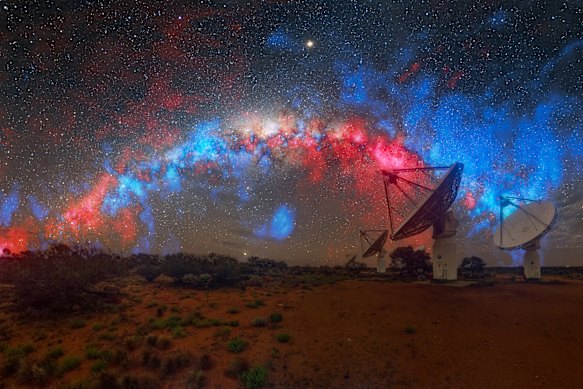
source : the age
Scientists have released the largest and most detailed maps ever made of the universe’s magnetic fields, using data from Australia’s strongest radio telescope to visualise the hidden force that may help govern the structure of the entire cosmos.
The project casts crucial light on a final bastion of cosmic mystery: how these giant magnetic structures influence the formation of galaxies, the birth of stars, the roaring of radioactive “space weather” and the lifespan of our home galaxy.
The map is five times larger than all previous efforts to visualise the universe’s magnetism combined, said lead author Dr Alec Thomson, a CSIRO scientist who works at the SKA Observatory in Western Australia.
“That gives us the best view we’ve ever had on magnetic fields throughout the universe,” Thomson said.
“We can see further than we’ve ever been able to see before, and we can see the Milky Way in 10 times better detail.”
Intergalactic magnetism could be as crucial to the architecture of space as gravity, influencing the flow of material through space and shaping the evolution of the universe as we know it.
Magnetic fields are generated when electrical charges move – such as electrons flowing through a wire.
The electrically conductive molten metal in Earth’s core, for example, generates a vast magnetic field which shields the planet from space radiation and solar flares.
Without it, our atmosphere would be stripped away by cosmic wind and our planet would be as barren as Mars.
Over the past few decades, we’ve begun to understand magnetic fields are also generated by the spinning of the galaxies and the blasts of supernovae.
That contributes to a complicated web of magnetism that wends throughout the entire universe.
About 99.9 per cent of visible material in the universe by volume is plasma, or charged gas, which can be channelled and manipulated by magnetism.
“That’s why magnetic fields have such a strong influence on how that material moves around the universe and inside galaxies,” Thomson said.
Large-scale simulations of the universe show galaxies are not flung randomly across space, but gather in clumps linked by filaments, resulting in images which look like neurons in the brain or tangly redback spider webs.
Gravity plays a major role in this structure, but magnetism could be another key architect.
Magnetic fields also slow down the formation of new stars by a factor of three, acting as a foil to gravity as it clumps together gas and dust. The fields also underpin how gusts of electromagnetic interstellar winds blast from stars and into space.
Thomson and his co-authors have released the map data publicly so others may use it to find out more about these phenomena.
The new maps were made using data from CSIRO’s ASKAP radio telescope, 750 kilometres north-east of Perth.
Light speeding towards Earth from far-flung galaxies is warped as it passes through magnetic fields.
The scientists processed data captured by the telescope to deduce exactly how light waves twisted on the way to Earth. Working backwards, the researchers could then locate and map out the magnetic fields.
Scientific images produced by the project’s team show the magnetic fields as they would appear from Earth.
“Red is where magnetic fields are pointing towards us and blue is where magnetic fields are pointing away from us,” Thomson said.
The maps also show magnetic fields thrown off by nearby galaxies, called the Magellanic Clouds. Professor Naomi McClure-Griffiths, chief scientist of the SKA Observatory and co-author of the new research, is scrutinising how magnetism affects the interaction of these neighbouring galaxies with the Milky Way.
The astrophysicist is also keen to investigate how magnetic fields affect “galactic cannibalism”, the process by which galaxies siphon gas from smaller galaxies to use as raw material to form new stars.
The magnetic fields of the Milky Way and a galaxy it wants to “eat” may repel each other, slowing down this feeding process that helps keep the galaxy going.
“If that process is slowed down by magnetic fields, then it has implications for the lifetime of our own galaxy,” McClure-Griffiths said.
The researchers hope their mapping data accelerates fundamental discoveries about the formation and architecture of the universe – and how space became a magnetic realm in the first place.
The initial data is called the Rapid ASKAP Continuum Surveys (RACS). Add the new part of the project – Spectra and Polarisation In Cutouts of Extragalactic Sources – and you get SPICE-RACS, a name that evokes a mundane object but represents some of the most immense and mysterious structures that exist.
Thomson said the maps were “just the start” and major breakthroughs are to follow in coming years.
The Examine newsletter explains and analyses science with a rigorous focus on the evidence. Sign up to get it each week.
 Angus Dalton is the science reporter for The Sydney Morning Herald.Connect via X or email.