SOURCE :- THE AGE NEWS
A second Australian missing in the Nepal flood disaster has been found safe on the Tibet side of the border as Foreign Minister Penny Wong expressed “grave concerns” for the 42 citizens still unaccounted for.
Department of Foreign Affairs and Trade officials contacted the person, whom the government has not identified, on Tuesday to offer consular assistance and put them in touch with family members.
“It’s hard to imagine the sense of relief their loved ones must be feeling after what will have been an incredibly harrowing few days,” Wong said in a statement on Tuesday afternoon.
“Despite this second piece of welcome news in recent days, we must remain realistic about the days ahead.”
Another Australian, Cara Severino, 26, contacted her parents on Friday after two days hiking through the devastated area. She was located by consular officials in Nepal on Saturday, who drove out from Kathmandu to meet her.
More than 1000 people have died and more than 4400 are missing in Nepal and Tibet after a glacial collapse unleashed floods and debris across the border region last Wednesday, with rescue teams struggling to reach isolated communities.
Wong said search-and-recovery teams faced extremely challenging conditions.
“Communications remain difficult, infrastructure has been destroyed, and many areas are still difficult to reach. As each day passes, our grave concerns for those still unaccounted for inevitably grow,” she said.
Chinese authorities have previously said six Australians were missing on the Tibet side of the border. A Chinese Foreign Ministry official had no further information at its regular press briefing on Tuesday.
Earlier on Tuesday, Wong was unable to confirm whether NSW hiker Michael Keats had died in the tragedy after his partner identified him on Monday as the first Australian victim.
Wong said she respected the family’s right to make statements about his wellbeing but noted the government had yet to receive confirmation from Nepalese authorities. Keats remains among the 42 Australians about whom the government is seeking information.
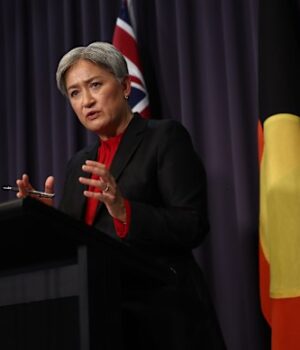
Wong, who is acting prime minister, said the government was doing everything it could to get information out of the remote and mountainous region.
“We’ve been working around the clock to gain information, to provide support, to work to ascertain any information about the Australians who are missing. We’ve deployed additional Australian personnel to Nepal. We’ve engaged with China and with Nepal, both at foreign minister level but also regularly at official level,” she said at a press conference in Canberra.
“I’m also realistic about this. When you have the thousands of people missing that you have, and you’ve seen yourselves the difficulty, the challenge Nepali authorities have in identifying who is missing and identifying who is deceased. Obviously, official confirmation is challenging at this time”.
The number of people unaccounted for has risen sharply as rescue efforts entered a sixth day.
Almost 800 foreign nationals are still missing, according to Nepal’s National Disaster Risk Reduction and Management Authority and Chinese authorities.
A RAAF jet left Australia on Tuesday morning, delivering humanitarian supplies to the region, including hygiene, shelter and solar kits. Wong said the government also offered to send more Australian personnel to help in search-and-rescue activities but was asked by her Nepalese counterpart to prioritise supplies.
Meanwhile, at a press conference on Saturday, Nepal’s Foreign Minister Shisir Khanal said his nation was facing a disproportionate burden from climate change as he called for a “global effort” to address the issue.
Speaking from the sidelines of the Pacific Island Forum on Tuesday, Prime Minister Anthony Albanese said investigations into the disaster’s cause were a secondary issue to the search-and-rescue missions and the identification of Australians lost in the aftermath.
“There will be time to examine the science and what has occurred here. My thoughts are solely focused, at this point in time, on the families and on the extraordinarily difficult time that we’re going through, and offering our support to Nepal,” Albanese said.
“Those debates will take place but I don’t think, from Australia’s perspective, now’s the time. My focus is very much on people who are incredibly traumatised by not knowing what has happened to their loved ones.”
The catastrophe was triggered on Wednesday by a glacial collapse that sent ice, mud, rocks and fast-moving water surging through a valley in Nepal, wiping out settlements and cutting off villages from road access. Videos showed people attempting to flee as water and debris swallowed buildings, tore down bridges and power lines, and swept away vehicles. Victims are believed to remain trapped beneath rubble, mud and water.
Key infrastructure was damaged in the disaster, including at least 12 hydropower projects in Nepal’s Nuwakot and Rasuwa districts, according to the Independent Power Producers’ Association, Nepal. It said at least 900 workers were unaccounted for from hydropower projects alone.
Nepal’s military had continued efforts to rescue people stranded in tunnels at several hydropower projects, Nepal Army spokesperson Raja Ram Gautam said. Teams from China, India and South Africa were assisting the army at different sites.
 Nick Newling is a federal politics reporter for The Sydney Morning Herald and The Age.Connect via X or email.
 Brittany Busch is a federal politics reporter for The Age and Sydney Morning Herald.Connect via email.