Source : ABC NEWS
That Australia wrapped up the Durban Test in such a resounding fashion on day five was, on the one hand, a quite spectacular validation of the selection strategy that plunged an entire cricket nation into conspiracy theories and conniptions last week.
- DAY 5 WRAP: Australia defeats South Africa by 214 runs on day five in Durban
- DAY 5 QUICK HITS: Carey’s classic starts the rot and Hoff finishes it off
Viewed another way, it simply added weight to the confidence bordering on arrogance that Pat Cummins’s world-beating bowling attack maintains that it can win any game, against any opposition, from any position, on every corner of the globe.
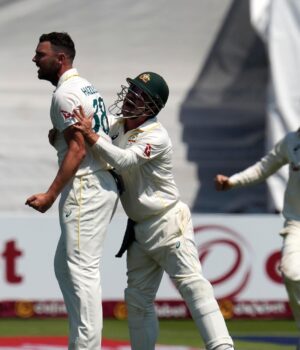
Though South Africa pushed the contest well into the second session, and ever-so-briefly prompted speculation of a draw, Josh Hazlewood performed a quite ruthless clean-up job with 6-49 from 16.5 overs — his 15th five-wicket haul in Tests and his career-best figures. It hastened a 214-run victory for the tourists in a game they began entirely on the back foot.
Hazlewood’s bundle included an assortment of his specialities: he broke the crucial partnership of the day by removing Wiaan Mulder after 25 overs of patient accumulation in the morning session; his delivery to clean bowl Marco Jansen was almost unplayable; the snorter that soon after sent Simon Harmer packing had reared up nightmarishly from a decent length.
The savage beauty of Harmer’s dismissal brought to mind a piece of sponsor content featuring Hazlewood that was floating around earlier in the week — one of those cutesy interviews where the star athlete is interviewed by a bright-eyed little kid. The interlocutor asked the burly quick for his favourite thing about being a paceman.
“Intimidating batsmen”, Hazlewood replied without hesitation. Welcome into the mind of an Australian fast bowler, kid.
As far as Australia goes, quite against most predictions, almost everything went right. But it is strange to consider the way a team that continues to set the world standard was, in this instance, composed from so many moveable and removable parts: opening batsmen variously underprepared and out of position, a number three on a very unpopular final chance, a four on borrowed time, a five who normally opens, a six who should be at seven and a seven who had recently been, well, at sixes and sevens.

Matt Renshaw (left) was player of the match for his 272 runs and two wickets. (AP Photo: Themba Hadebe)
Outside the Durban formation, Cameron Green, Josh Inglis, Scott Boland, Cooper Connolly and Michael Neser would not feel presumptuous mentally slotting themselves into a plausible XI.
Nathan Lyon, meanwhile, was less threatening in the second innings than spin dabblers Matt Renshaw, Beau Webster and Nic Maddinson, although it was not in the end a memorable game for the slow bowlers.
These are good problems for Australia to have, of course, and to get through a heavy schedule of Tests in the next 12 months, it will need to draw upon its reserves and pay particular attention to the workloads of its quicks.
In the immediate term, at the very least Australia will probably look to tinker with its batting order and switch Travis Head and Matt Renshaw, the latter of whom was the most popular man of the match in recent memory after adding a two-wicket cameo of off-spin to his batting masterclass.
How does South Africa regroup from such a comprehensive loss?
Perversely, compared to Australia, a larger percentage of its line-up is set in stone: opener Aiden Markram and number three David Bedingham were the shining lights in both innings, while skipper Temba Bavuma and gun all-rounders Wiaan Mulder and Marco Jansen are undroppable.
Anrich Nortje, the man most would have earmarked to be replaced by Kagiso Rabada for the second Test, was far and away the Proteas best bowler.
Markram was the batting standard-bearer for the Proteas on day five with another innings of tremendous substance — a lone hand of 75, which made him the only half-centurion of the game other than Renshaw.
Statistically speaking, when playing Australia Markram is twice the batsman who otherwise averages 35 in Tests. He just needs a few more mates.
The most straightforward change for the Gqeberha (formerly Port Elizabeth) Test starting on Sunday would be the demotion of wicketkeeper-batsman Kyle Verreynne, a walking wicket at present.
Given the premium on players who can shift the momentum of a game in a single session, South Africa could only gain by replacing him with 20-year-old Lhuan-dre Pretorius, a rising star of the T20 world whose five centuries in 15 first-class games include a century on Test debut last year. Stylistically, think Rishabh Pant. Physically, also think Rishabh Pant.
Most enticingly, there is also the fearsome spectre of Rabada, the only undisputed great South Africa currently possesses and a past tormentor of the Australians.
The sight of him limbering up in the nets throughout this game has been tantalising. South Africa would do well to take his lead and be more attacking with the ball from here onward.
Another unknown is whether South African fans will rally around the Proteas and make life less comfortable for the Aussies.
Australia was not met with any sort of hostile crowd in Durban. (AP: Themba Hadebe)
In Durban, spectators were a non-factor. By Cape Town, they will surely be out in greater numbers and taking up Proteas coach Conrad Shukri’s pre-tour advice to “give [Australia’s players] some stick, but respectfully so”.
A few decades ago a South African newspaper offered a slightly less generous assessment of this dynamic, lamenting the experience of the touring Australian cricketer: “They must wonder if our game parks are fenced.”