

SOURCE :- THE AGE NEWS
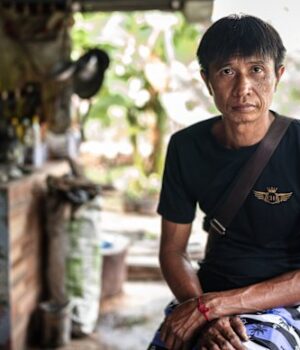
Ban Bo, Thailand: In the evenings when he’s back from work, Thongchai Donhomla still catches hints of his daughter’s perfume. It drifts from her room as a comfort, he says, reminding him her spirit might still be nearby.
But now she needs to go, and to be at peace, he says from his sparse home in the small town of Ban Bo, in north-east Thailand’s Kalasin province. “The spirit can’t have grudges.”
The living, though, need not be so forgiving.
Donhomla and the other grieving family members of 17-year-old Thanchanok Donhomla in Ban Bo want her alleged killer, Australian Simon Peter Carman, to face justice fairly and, if found guilty, dealt with to the fullest extent Thai law still allows: execution.
“A life for a life,” says 75-year-old Mee Boonsert, one of two great aunts who played central roles raising Thanchanok when her biological mother left when she was just a baby.
Carman, 45, is accused of murdering Thanchanok, or Cake, as she was known, in the early hours of June 25 near the tourist and expat hub of Pattaya, about 600 kilometres from her hometown.
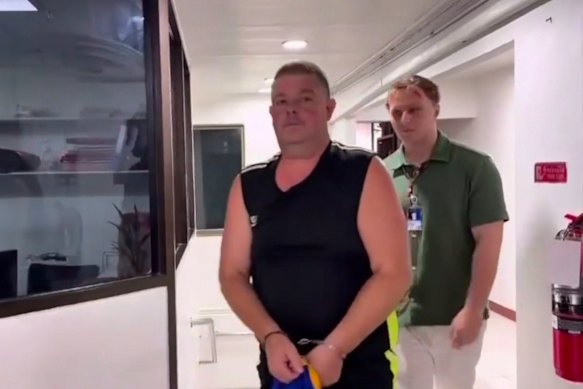
Family members raced to Pattaya when told she was missing, only to learn on the way that her body had been found jammed inside a suitcase and discarded in the long grass by railway tracks.
Her aunt, Miruntree Thanachai, went to the alleged crime scene – Carman’s squalid $330 per month unit – to help with a ritual to prompt the spirit home.
She noticed piles of filthy dishes and clothes. “He was a dirty man,” she says. Most curious, however, was the “three or four” women’s handbags and other items of what appeared to be women’s clothes.
The pair allegedly met at 3am, and “both parties agreed to engage in sexual services”, according to the official police report, seen by this masthead. Cake’s family are troubled by this detail. She had never been a sex worker, “and what father would allow his daughter to do that work?” Donhomla says. Neither did she take drugs, he says, and when at school she had been a bright student. As far as they knew, she went to Pattaya for what was supposed to be a “short” holiday.

“Cake had a transgender friend [from a neighbouring district] come and stay with her at my house, and she asked her if she wanted to go to Pattaya,” Donhomla says. “She [Cake] wanted to go. She said she wanted to see the beach. She asked us for some money and, though we didn’t have much, we gave her what we could.”
Like many fathers, Donhomla found it hard to disappoint his daughter. But he explains this was compounded by the shame and guilt he felt stemming from a four-year stint in prison from 2019 for drug offences. The time away left Cake, and the other members of the family who relied on his meagre income, destitute.
With her father in prison and biological mother gone from her life, Cake was teased and bullied, prompting her to drop out of the regular curriculum and replace much of her learning with other school-approved activities, the family says.
“I couldn’t be there for Cake, so when I came back from prison I wanted to give everything to her that I could,” Donhomla says.
He works as a farmhand, earning, on average, the equivalent of about $250 per month, far below the Thai minimum wage.
“Sometimes she would ask for a new phone, but these are expensive and I couldn’t afford it. I felt bad I couldn’t provide for her,” he says.
Armed with the equivalent of about $40 from her father and $80 from her great aunts, Cake went with her friend on a bus to the neon lights of party-town Pattaya on June 16. She promised to bring back clothes for her six-month-old cousin Wayu.
Donhomla says she called him a couple of times, including to ask for top-ups of money, but not at all in the four or five days before she went missing, which he says was unusual.
Once in Pattaya, Cake met up with another friend, a transgender woman whom Donhomla had never met or seen before. He says this is the person who appears in photos confronting the Australian at his squalid condominium unit on June 26 when Cake had failed to return. By that time, she had already been dumped by the railway tracks in a suitcase.
Donhomla raced to Pattaya when told his daughter was missing. During the journey, he got the devastating news she had been found dead.
“I was shocked, I couldn’t accept it,” he says. “I didn’t know what to do. I couldn’t eat.”
The family has not only been robbed of Cake, but a sense of security about the future. Who will care for her father and great-aunts when they can no longer care for themselves? Little Wayu is now the extended family’s only future provider.
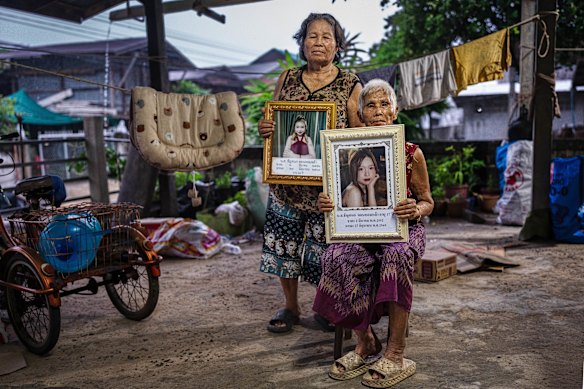
Police in Pattaya say Carman has claimed self-defence, that she came at him with a knife in a fight over money.
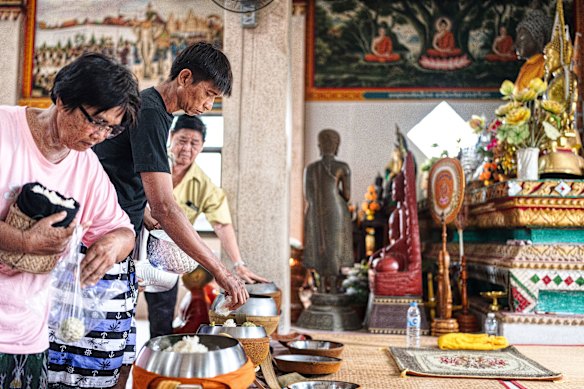
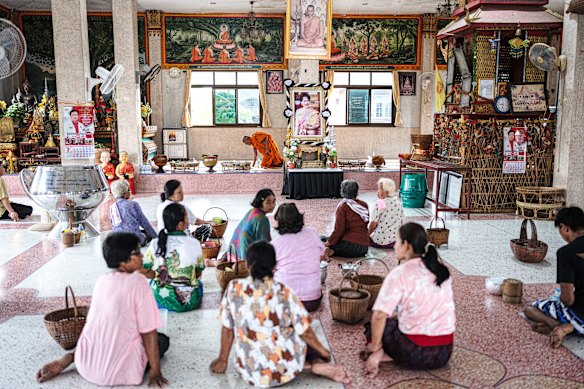
Cake’s family brought her home to Ban Bo on Monday night last week inside a police van. She was cremated on Tuesday morning and her remains interred in a small gold urn placed in the base of Buddhist temple’s perimeter wall.
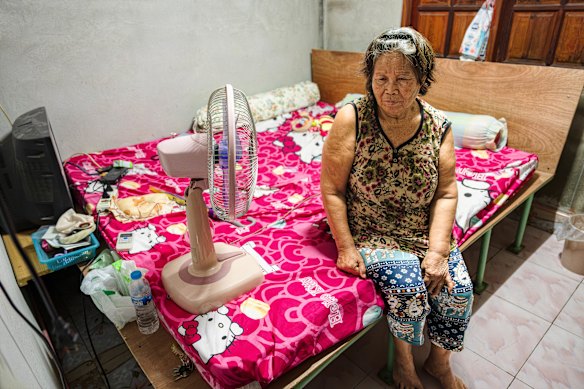
Her room is now bare but for a miniature dresser, sepia-coloured old photos of family, and a social media ring light kit, which her father says she barely used. Most of her other possessions were cremated alongside her body, in line with the family’s beliefs. One day, the smell of perfume will be gone too.
A date has not yet been fixed for Carman’s first court appearance.


