Source : INDIA TODAY NEWS
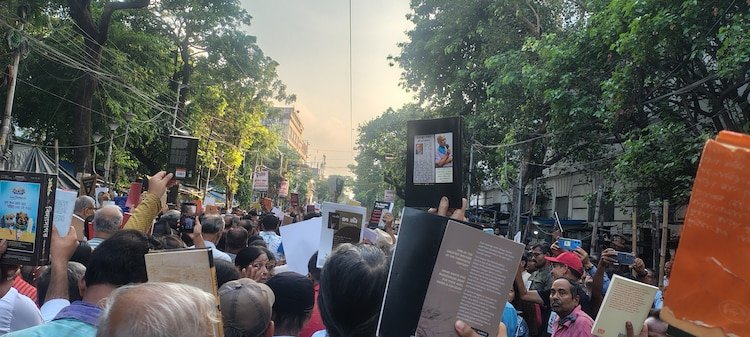
“It was an incredible experience,” said 26-year-old Tista Sanyal, a medical officer at Kolkata’s Manipal Hospital. Tista recently joined a rally in the city’s College Square area, walking alongside nearly a thousand people, holding a book in her hands.
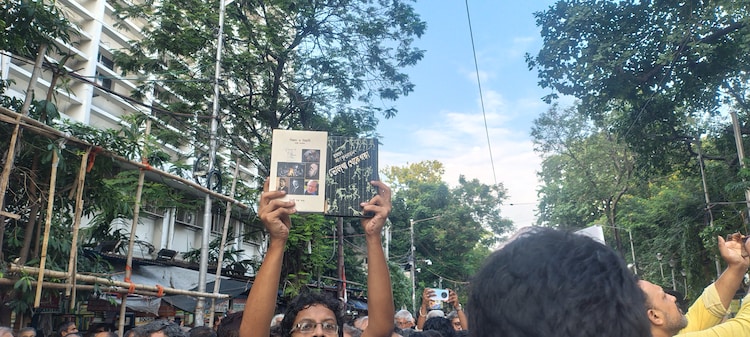
“What particularly struck me was the participation of people across all age groups and social backgrounds. Everyone brought a book they considered an important read or a symbol of resistance in the present day, holding it aloft as if to announce a collective spirit of resilience,” she told IndiaToday.in.
advertisement
What seemed almost unthinkable in Kolkata became a reality during this year’s Durga Pujo. Bookstalls put up by several Left parties were vandalised across the state. Books were torn and thrown around, while people associated with the stalls were allegedly assaulted by members of right-wing groups.
In Kolkata’s Jadavpur area, a bulldozer arrived to demolish a stall put up by the CPI(M), with legal concerns cited as the reason. In Bangaon, North 24 Parganas, authorities disallowed a stall from continuing, again citing legal grounds. In Dum Dum, a right-wing student leader threw books on the ground, tore them apart and beat up an elderly man who tried to resist.
The incidents triggered a backlash that cut across party lines. A TMC MLA visited a CPI(M)-organised bookstall and bought a few books to express solidarity. The BJP, too, was quick to distance itself from the vandalism, with Swapan Dasgupta saying the “incidents have lowered his head in shame”.
On October 31, a march to save books was organised at College Square. It drew people from different age groups, including Gen Z, a generation often stereotyped as having short attention spans and little inclination to read books.
Why does reading continue to hold such significance in Bengal, even in the 21st century? And why did the vandalism provoke such a strong reaction, including among younger people? Equally, how did people view the argument put forward by several right-wing groups that the bookstalls were selling works by foreign political and philosophical thinkers such as Karl Marx and Mao Zedong, allegedly at the expense of Indian icons like Swami Vivekananda and Sri Ramakrishna Paramahansa?
FORMING THE SOUL
There is a peculiar practice in Bengali households. Touching a book with one’s feet is considered a sin. If someone accidentally does so, they must pick it up and place it on their forehead in a gesture of obeisance. For many Bengalis, including some atheists, the practice has become a muscle memory that is difficult to shake off.
A book, in this understanding, is not merely a collection of pages bound between two covers. It is a means of acquiring ‘Bidye’ (knowledge or wisdom). Disrespecting a book, therefore, is seen as disrespecting knowledge itself.
Former bureaucrat, MP and historian Jawhar Sircar believes this reverence has deep historical roots. Speaking to IndiaToday.in, he said the rise of the Bengali intellect was closely associated with the emergence of modern education and the community’s willingness to engage with ideas from across the world.
“The Bengali middle class looked towards Western education, not to become subservient to the West, but to understand the progress it had made. Education and books were intertwined in this first attempt to bring what we may call the first light into India. Interestingly, even conservative Hindu families supported English education,” he said.
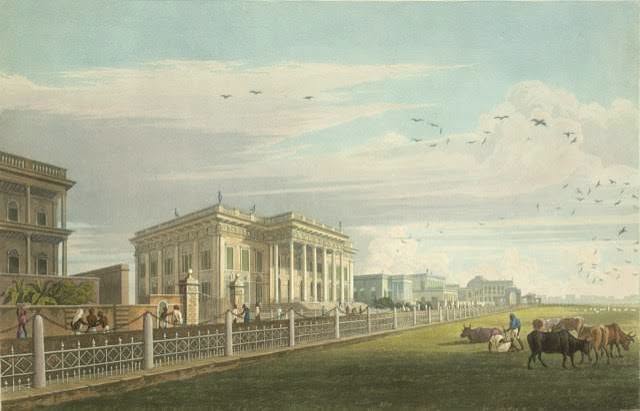
Sircar pointed to the establishment of the Calcutta Textbook Society in the 1820s as an important milestone in the spread of reading. The society sought to make books available cheaply using modern printing technology and Bengali typefaces, opening up access to knowledge for aspiring students, including those from villages.
“The Textbook Society reflected the aspirations of Bengali society as early as the 1820s — its hunger for international knowledge, not Western imperial thought. People were reading Spinoza, Nietzsche, Goethe, Victor Hugo and Montesquieu. These were international intellectual traditions, not an endorsement of Western imperialism,” he said.
For Sircar, this engagement with ideas from beyond geographical and ideological boundaries is what makes the attack on the bookstalls particularly disturbing.
“The political Left does not have a monopoly over books. When they kicked the books, they did not kick the Left; they kicked our soul,” he said.
An Assistant Professor of English, who did not wish to be named, makes a similar argument. He believes Bengal’s intellectual tradition has historically been shaped by its willingness to engage with different schools of thought, whether Indian or international.
“The attack on books is an attack on the source of liberal thinking. Bengal has always been a vast field for thinking beyond geographical boundaries. Bengalis have historically been keen to know what people from the rest of the country and the world are contributing to the fields of literature, art and culture, music and even politics,” he told India Today Digital.
He described this tradition as one of ‘polyvocality’, where multiple voices and intellectual traditions can coexist, sometimes peacefully and sometimes through disagreement.
“At the same time, we read Tagore, Chaitanya Mahaprabhu and Ramakrishna Paramahansa. So, a bunch of fanatics attack bookstalls; they attack the very idea of liberal thinking,” he added.
THE BIGGER POLITICAL QUESTION
For some Left activists, the vandalism was not entirely unexpected.
“I was not particularly surprised when bookstalls came under attack. The signs were clear before Durga Puja, when several Left activists and party members sensed that something bad was going to happen during this year’s Puja. Several leaders from the ruling party made it clear that the stalls would not be spared, asking why the Left would sell books written by Vladimir Lenin and Joseph Stalin. We were mentally scared, but prepared as well,” Indradatta Basu, a PhD student at Presidency University and a CPI(M) party member, told IndiaToday.in.
Bookstalls have long been part of the Durga Puja landscape in Bengal, particularly since the Left’s political rise in the state. Growing up in a small town nearly 30 kilometres from Kolkata, this author remembers stalls coming up close to Puja pandals, where people would stop while pandal-hopping to browse through books and occasionally buy them.
That familiar scene was disrupted this year. Several leaders belonging to the state’s ruling party openly threatened to prevent book stalls from being set up near pandals, arguing that the Left was not religious and promoted atheism. Posters bearing slogans such as ‘Ebar Pujoye Bam Bodh’ (Left will be slayed in this year’s Puja) also appeared on Kolkata’s streets.
Author-journalist Snigdhendhu Bhattacharya believes the change was driven by a hardline political push within the BJP’s state unit, which emboldened its more hardline cadres.
“I do not think it was planned by the RSS. Rather, it came as part of Chief Minister Suvendu Adhikari’s plan to emerge as the most hardline leader among all in West Bengal. He enjoys strong support among the most hardline and fanatic sections of the party in the state, and that is the reason they went to vandalise the stalls,” Bhattacharya told IndiaToday.in.
He added that the Sangh and older BJP leaders such as Samik Bhattacharya and Swapan Dasgupta tried to contain the damage after realising that the vandalism had not gone down well with sections of society.
Sircar, meanwhile, views the incidents through a sharper ideological lens, describing them as a tussle between the ‘literate Left and the illiterate Right’. He argues that literacy and rationalism have traditionally been associated with the Left, while sections of the Right have been less receptive to intellectual engagement.
However, he clarified that his defence of the bookstalls was not an endorsement of the Left parties that organised them.
“I am not defending the Left parties that put up these bookstalls. I see them as a symbolic presence of intellect,” he said.
A GENERATION THAT STILL READS
Amid the vandalism and political confrontation, the October 31 march offered a different picture. For many who participated, it was evidence that Kolkata had not given up on reading, even as the ways in which people consume literature continue to change.
“There was something meaningful about seeing people walk together. Not just with slogans but with books in their hands. I do believe people still value books and reading. Perhaps how people consume literature is changing, but the curiosity hasn’t disappeared,” said Kaninika Majumder, a content creator and activist.
The participation of younger people was particularly striking. Sara Lahiri, an English Honours student at Sanskrit College and University, told IndiaToday.in that books continue to offer her an escape from the constant churn of social media.
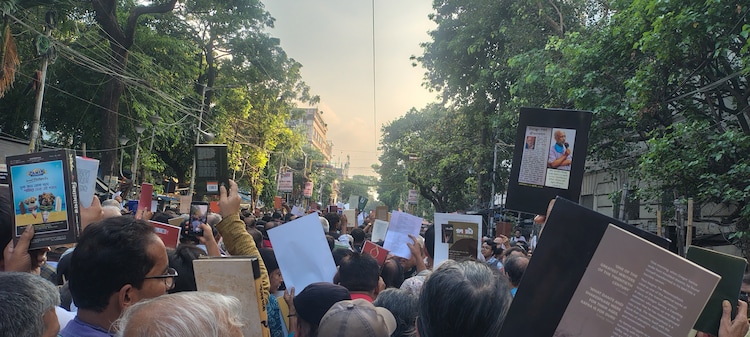
“We live in books and see life through the mirror of their existence. In this Insta/Facebook reel world, books, to me, feel like a silent relief to a world I cannot reach. So, when I saw people from our generation walking beside me, I felt that the value of books still lives fresh in us,” she said.
While the BJP has consolidated its position in Bengal’s political landscape, the reaction to the bookstall vandalism suggests that cultural issues continue to resonate deeply with sections of the state’s population.
When Bageshwar Baba called Bengalis ‘pakhandis’ over their non-vegetarian eating habits during Durga Puja, it triggered widespread criticism. The attacks on bookstalls have now opened another front of cultural discontent. The turnout at the October 31 rally and the conversations it sparked suggest that the incidents touched a nerve far beyond the Left’s political support base.
This may not translate into an electoral shift. But the reaction carries a message that political parties would do well to understand: a community’s cultural identity cannot be taken for granted. In Bengal, books have long represented more than reading. They stand for a way of thinking, questioning and engaging with the world. And when that space is threatened, the resistance is not necessarily about defending a political party. It is about defending something people believe belongs to them.
– Ends
SOURCE :- TIMES OF INDIA