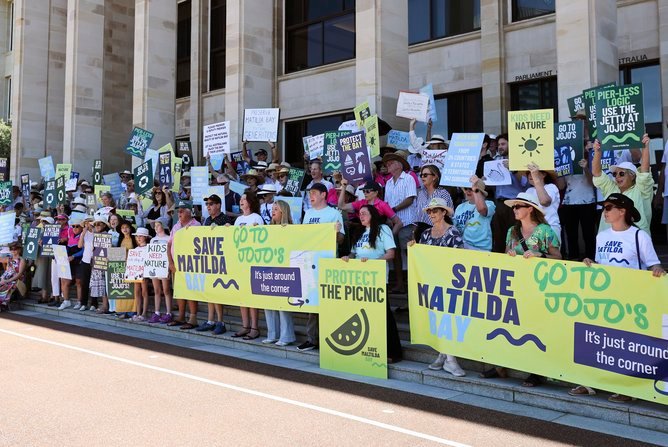
Source : Perth Now news
Hopes the State Environment Minister would step in to stop the contentious Matilda Bay ferry terminal from going ahead have been dashed.
Matthew Swinbourn has dismissed objections to the State Government’s plan to build new jetties and terminals at Matilda Bay and Applecross as part of its expanded Metronet service.
The government’s appeals convenor received 60 appeals over a Department of Water and Environment Regulation decision in February, which would enable the first stage of construction to go ahead.
The DWER decision permits up to 0.3ha of near-shore native seagrass and microalgae to be cleared to make way for jetties and terminals to be installed at each location. The clearing area is limited to two ‘envelopes’ at Matilda Bay and near the Raffles Hotel at Applecross.
Mr Swinbourn this week backed DWER’s assessment, and said he had accepted an advisory committee recommendation to dismiss the appeals. The Minister’s decision is final and cannot be appealed.
“I agree with the appeals committee that the threat of serious or irreversible environmental damage is low because the key impacts from both are temporary and highly localised, and there are no impacts to threatened flora or fauna because of the clearing,” Mr Swinbourn said in his determination.
Objections to the terminals have been raised on indigenous, environmental and safety grounds. The Safety on Swan group, which represents nine organisations that use the bay, claims the $29.9 million Matilda Bay terminal poses an unacceptable risk of injury, environmental damage and loss of heritage.
The Federal Department of Climate Change, Energy, the Environment and Water is currently considering a native title claim submitted by a local, unnamed Noongar woman, covering the waters of Matilda Bay, from near the Blue Boat House to near the Matilda Bay Reserve Boat Ramp.
According to this application, under the Commonwealth’s Aboriginal and Torres Strait Islander Heritage Protection Act the proposed ferry terminal and supporting infrastructure “poses a threat to a culturally and spiritually significant site”.
Most of the 60 appeals against the DWER decision argued the well-used and beloved bay is the wrong location for a ferry terminal.
It was claimed DEWR had approved the seagrass clearing without adequately assessing the impact on local biodiversity, and that clearing and silt disturbed in construction could harm key conservation areas, including Pelican Point reserve.
Opponents also said construction would cause an “unacceptable” cumulative loss of ecologically important seagrass in the Swan-Canning estuary.
Mr Swinbourn said the seagrass affected by the project was typical of the Swan-Canning estuary and did not contain any priority flora. Removing 0.63ha would comprise just more than 0.1 per cent of the total 590ha of seagrass estimated to be in the estuary.
“This very small loss would not impact on the overall health of the seagrass in the estuary and concerns about cumulative loss are not warranted,” he said.
Mr Swinbourn said the likelihood of ongoing sediment release from the site was extremely low. He noted advice from the appeals committee that natural coastal processes would stop any small amounts of sediment released from clearing at Matilda Bay from reaching Pelican Point reserve.
“No direct impacts of the clearing, including on the conversation area at Pelican Point, are expected,“ he said.
Mr Swinbourn agreed that DWER’s assessment of the clearing application had considered only the construction of the jetty and ferry terminals and did not include the effect of ferries operating at the bay.
He said the transport department was required to submit a development application to run ferries to the terminals, and this process could adequately address concerns about their impact on the bay.
The design of the terminals is subject to a competitive tender process, which has started.