

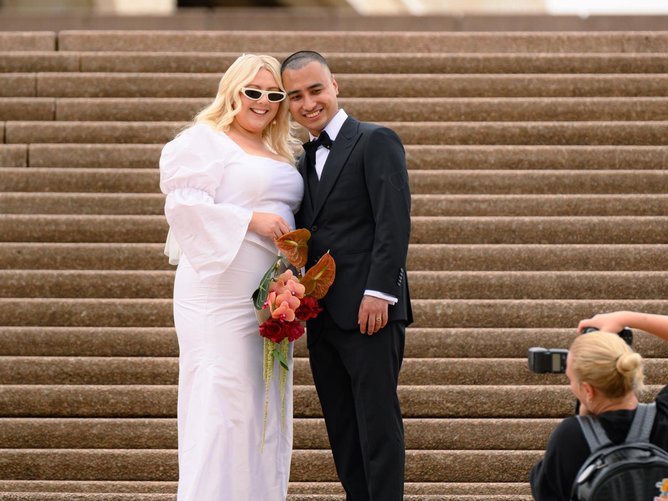
Source : Perth Now news
When it comes to weddings, some things are timeless – a white dress, a sleek tuxedo, a custom cake and a couple of rings.
Other things, however, have slowly started to disintegrate from tradition – be it putting a coin in the bride’s shoe for luck, serving a groom’s cake or making a grand exit at the end of the night.
As the cost-of-living crisis continues to squeeze the wallets of everyday Australians, another wedding tradition may be in the rearview mirror – guests bringing gifts.
These days, guests are far less likely to lug an enormous gift to a wedding chapel.
No more Thermomix sets, crystal vases and ugly home decor that is destined to be regifted.
Instead, guests are increasingly attending weddings armed with a single envelope stuffed with cash or a gift card.
Traditional wedding gifts long forgotten
While many wedding trends go in and out of favour, it seems that old school wedding gifts are no longer a priority.
And there’s a very real reason why those tying the knot are asking for cash over a toaster, a 2026 study from the Australian Institute of Family Studies reveals.
More than 80 per cent of couples live together before walking down the aisle, with the number of Australians living in a de facto relationship almost tripling over the past four decades.
Love For All founder and celebrant Svetlana Jovanovic said wedding gift expectations had evolved in the past few decades, with couples making a “clear move toward cash, gift cards or contributing to experiences”.
“It used to be very focused on setting up a home together, appliances, crockery, bedding and all of that. That made sense when marriage often marked the beginning of building a household from scratch,” she told NewsWire.
“Now, couples are usually already living together or have blended households before the wedding, so the gifting has naturally shifted with that.”
How much is appropriate to give at a wedding?
The average amount of money given to newlywed couples at their wedding is anywhere between $100 and $200, according to PocketWell. However, this depends on how well you know the couple and how many guests are contributing to the gift.Etiquette expert Jo Hayes told NewsWire there was an easy way of determining an appropriate amount to slide into an envelope for a couple’s big day.
“What is the assumed/anticipated/expected amount the couple is spending, per head, on
the reception? That is the ballpark baseline figure for how much one should spend on a
gift,” she said.
“(For example), if the reception venue is typically $150 per head, that is your go-to guide for a minimum gift spend.”
However, she said a gift between $40 and $60 was appropriate for those attending the wedding of a colleague or someone they didn’t know very well.

Changes in wedding gift etiquette
In recent years, cash, gift cards and contributions to a honeymoon fund have become the standard for many couples; however, as the cost-of-living crisis worsens nationwide, some guests just can’t afford parting with hundreds of dollars to celebrate a couple’s nuptials.
This is amplified if a wedding takes place over several days or requires interstate or overseas travel.
As weddings become more expensive, some guests are showing up to weddings empty-handed.
“The biggest change I’ve seen is that guests don’t turn up to the ceremony with gifts anymore,” NSW celebrant and wedding MC Bec Page told NewsWire.
“Almost everyone arrives with a card. Inside it’s either a voucher, some cash, or they’ve already contributed to an online wishing well and the card just has beautiful well wishes written in it.
“The wrapped present on a gift table has basically disappeared.”

Ms Jovanovic told NewsWire that while it wasn’t very common for guests to rock up to weddings empty-handed, it had become more common as everyday Australians faced financial pressure.
“That said, most people still want to acknowledge the couple in some way, even if it is something small or symbolic,” she said.
“Traditionally, it is still considered courteous to bring something, even if it is just a card, but weddings are becoming much more inclusive of different circumstances.
“Some couples are very open about prioritising presence over presents, especially knowing the effort people make to attend.”
Ms Hayes said not giving a gift at all would be considered “stingy”, even in the midst of a cost-of-living crisis.
“A guest ought to give the couple a gift. It’s basic good manners,” she told NewsWire.
“The cost-of-living crisis, be what it may, does not excuse people from giving a wedding
gift.”
Ms Hayes said there were alternatives for not giving cash on the big day.
“I’ve known people who have bought a beautiful wedding card and written a message explaining exactly this: ‘We’re in a tight spot financially at the moment, and apologise that we can’t afford a lovely gift for you’,” she said.
That’s not to say those who can’t afford wads of cash can’t come armed with a thoughtful gift.
“Cost of living has taken the guilt out of gift-giving,” Ms Page said.
“A ‘good gift’ now is a thoughtful one, not an expensive one. Guests are getting more creative and more personal, and couples genuinely love that.”


