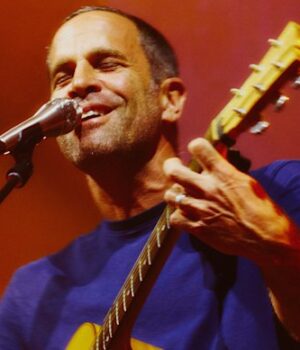
Source : the age
As the house lights crept up, Jack Johnson ambled – does he move at any other speed? – down the centre aisle of a New York City movie theatre.
It was a rainy Monday night, and SURFILMUSIC, a documentary about the singer-songwriter’s enviously low-cortisol life, had just screened at Angelika Film Centre. At 51, Johnson hovers an inch or two below the rarefied air of household-name status. His catalogue of unassuming beach pop is a staple at many a white-walled brunch spot where drinks come in jam jars.
Banana Pancakes, his song about, among other things, the tyranny of getting out of bed, has more than 750 million streams on Spotify. He is the soundtrack for a Sunday drive in a sensible hybrid vehicle, and, these days, his original devotees are, like him, navigating the turns of midlife. Surprisingly (or not), some of their kids have become Jack Johnson fans, too.
Facing the Angelika crowd, he flashed a smile as he scanned the room for questions. A young guy raised his hand. His wedding day was approaching, he said, and he was curious if Jack and his wife, Kim, had any relationship advice. Also, he wanted Jack to know that he and his fiancee had picked one of Jack’s songs for their first dance.
Also: that Jack was invited to their wedding.
Also, could Jack sing it for them?
This hyper-familiarity, a collapsing of distance, is nothing new for Johnson. (Millions love Oasis; it’s difficult to imagine someone trying that move on Liam Gallagher.) Two-and-a-half decades into his career, Johnson emanates the energy of an old buddy who never moved away. He is not edgy, nor is he prone to provocation. Rather, he represents a challenge to the laws of time and physics: What if everything pleasant just stayed the same forever?
The morning after the film screening, Johnson shuffled into the lobby at the Gansevoort, a hotel in Manhattan’s trendy Meatpacking District. Though he carries an almost anonymous presence, he was approached for an autograph the moment he stepped onto the sidewalk. He sat with his hands in his lap and shoulders sinking into his athletic frame, and, over many cups of coffee, was exceedingly polite with the waiting staff. He is the type of star who, even during his run of four consecutive platinum albums in the 2000s, preferred to hop in the front seat when being driven.
This Johnsonian simplicity, or the performance of it, has lately become aspirational. Jack Johnson Summer – the movie, a companion soundtrack, a tour – is cruising along with a simple philosophy: Count the ways you can touch grass.
Over the past couple of months on social media, a meme has bubbled up: “Before you try to spike my cortisol, just know that I’m having a Jack Johnson summer.”
The phrase accompanies all manner of bucolic images: waking up in a tent, biking with pals, sparking up at a municipal golf course. Bennett Artman, a Gen-Z content creator who leads biking expeditions and posts, uploaded his own “Jack Johnson summer” montage (grilling burgers, drinking a beer) as part of a larger effort to counter “rage bait” with “hopecore” videos, which he’s noticed have grown in popularity.
In a clip encompassing a grab-bag of ills that Johnson can soothe, a different user issued a joking proclamation: “Let’s Jackmaxx! Let’s dopaminemaxx to some Jack! Iran, Israel, Russia, North Korea, USA – sit in a circle, bonfire on the beach, toes in the sand, Jackmaxxing. DNA spinal tap of Jack. Of happiness.”
Though (mostly) a joke, the viral video captures something real: Legions of people feel trapped in a cesspool of stress, anxiety, anger, declining mental health, diminishing attention spans made worse by the pandemic and, more recently, a feeling of being pummeled by AI slop.
Meanwhile, Johnson is off catching waves, noodling tunes, teaching kids about sustainability and compost. If you wondered where he went, he’s been here the whole time. Does he think the rest of us are nuts? Could life really be as simple as unobtrusive tones and a plethora of vitamin D?
In one of the first scenes of the documentary, Johnson appears in an office chair. It’s a jarring sight, like seeing King Charles in a Pizza Hut. When pressed about it, he lightly scoffed at his perceived image. “Somebody told me about that term,” Johnson said, referring to “Jackmaxxing.” He smiled, but made it clear he wasn’t keen on being reduced to a caricature.
“This idea of what I am, the barefoot guy on the beach,” he began: “A lot of that is true, but I’m very much a guy who’s raising teenage kids in the modern world, and I totally understand the pros and cons of social media and the world that we’re living in,” he said.
Although Johnson himself is not a slave to the algorithm – his team handles his social accounts – he insists he’s also not Rip Van Winkle. He sees Instagram Reels and memes via texts from his friends. He and Kim haven’t set restrictions for their children, and have instead given them a mantra: Try to produce more than you’re consuming.
In late June, Jack Johnson’s Jack Johnson summer included an afternoon in Asbury Park, a night on the water at Jones Beach, and a stop at the waveless yet serene Saratoga Performing Arts Centre, where teens roamed in baggy jeans and earth-tone tees.
For the bulk of Johnson’s career, his wife and kids have accompanied him on tour. Kim left her teaching job to become one of his managers. Sitting backstage in Saratoga, she emphasised that her husband was far from an aloof rock star.
“I think he’s one of the most grounded people I’ve known in my life, and he helps ground me so much,” she said. “But I don’t want to say he’s totally disconnected from the world.”
She described him as well-read, someone who likes to talk politics and current affairs, a guy who often plays devil’s advocate when chopping it up in conversation.
Johnson can be surprisingly dry and self-deprecating. At the film screening, he waxed about growing up on the North Shore of Oahu, ensconced in the unhurried rhythm of the ocean. “I kind of blame that for why my songs are so slow and boring,” he said.
When he’s home in Hawaii, he says he can easily go weeks without picking up a guitar, but he must get in the water.
Were it not for a surfing accident at age 17 that left him with a head injury and broken front teeth, Kim said, he probably would have pursued a pro surfing career. During his recovery, he was briefly on the path of a “straight” life, and his dad wanted him to become an actuary. At University of California, Santa Barbara, he studied maths before eventually switching to film. But the surf accident also increased his interest in songwriting.
Throughout much of his 20s, though, music was still a hobby, and Johnson saw the world through a camera lens. He developed a close relationship with filmmaker Emmett Malloy, collaborating on a pair of surf docs, Thicker Than Water and The September Sessions. (Malloy also directed the new film.) When Malloy became an in-demand music video director, he brought along Johnson as a secondary cameraman on shoots for bands like Blink-182, Foo Fighters and Limp Bizkit. When working on the video for Limp Bizkit’s Break Stuff, Malloy recalls, rap-rocker Fred Durst expressed interest in signing Johnson.
“I think he’s one of the most grounded people I’ve known in my life, and he helps ground me so much.”
Kim Johnson
“I mean, it would have been a whole different trip,” Malloy said with a chuckle.
In SURFILMUSIC, singer-songwriter Ben Harper, one of Johnson’s mentors, crystallises something many people seem to miss about his friend: “It takes a great deal of intensity to actually sound simple and pure.”
Backstage in Saratoga, Johnson and his bandmates warmed up in a rehearsal room dotted with black and white photos of Pete Seeger, Tina Turner and other stars who had graced the venue. Zach Gill, his piano player and old college friend, offered up hot toddies. Johnson eventually took the stage in the same thing he’d been wearing all day: a mustard yellow tee, faded jeans and thongs.
Fans bopped and swayed and threw their arms around each other. When Johnson arrived at his hit Sitting, Waiting, Wishing, he instead sang a few bars of Turner’s What’s Love Got To Do With It. He covered Sublime’s druggy ’90s anthem Badfish, and his guitar sounded, rather pleasingly, like liquid. A cool breeze blew through the Saratoga pines. Suddenly, everyone was Jackmaxxing.
Although the crowd spanned generations, from middle schoolers to Gen Xers like Johnson, a huge swath of attendees appeared to be in the prime of their teen years. A trio of skater-looking dudes passed a joint. Some guys stood in circles in bright polos while eyeing circles of girls in cowboy boots and denim skirts.
As the night drew to a close, the backing band left the stage, and Johnson took requests for an acoustic set. He played Constellations, a song that nods to his late father’s love of stargazing. Though his dad died in 2009, Johnson can still toggle between referring to him in the past and present tense.
“My dad is a sweetheart, but he was a very eccentric guy,” Johnson said over coffee. Jeff Johnson, was, in his son’s telling, someone who could fix anything, who could sail by the stars. Johnson found it harder to sing in front of his dad than his mom. “He wasn’t a gruff guy, but he wasn’t the quickest to give out compliments,” Johnson said. One night in the early 2000s, during a run when Johnson’s shows started to become larger, Jeff asked his son if fame was what he really wanted. It was a question he never forgot.
Johnson is still chasing something. “I don’t pretend to have any kind of big answers for anybody,” he said. “I think every once in a while, if I’m lucky, I’ll get at a feeling that we all have. But I don’t have any big solutions for the problem.”