

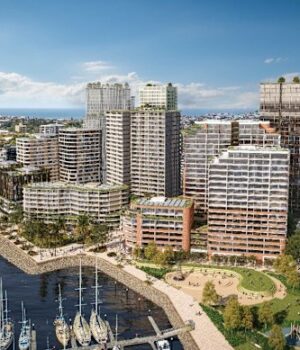
source : the age
For decades, towering cranes and large-scale construction sites have been a symbol of Sydney’s housing boom.
Now, that same building activity is spreading up and down the NSW coast, as Newcastle, Wollongong and the Central Coast record an unprecedented wave of high-density development driven by population growth, affordability pressures and NSW government planning reforms designed to boost density in areas previously restricted to low- and medium-rise housing.
The scale of the development is increasingly prompting residents, councils and community groups to question whether infrastructure and essential services can keep pace – and whether coastal communities can absorb growth without losing the character that made them attractive in the first place.
Across the three regions, the NSW government has set a target of almost 30,000 new homes by 2029 – 11,100 in Newcastle, 9400 on the Central Coast and 9200 in Wollongong – as part of its commitment to deliver 377,000 homes across the state.
But a Herald analysis of projects already moving through the planning system suggests the eventual number could be substantially higher.
More than 16,000 apartments are now proposed through state-significant planning projects alone, including 6341 apartments across 24 developments in Newcastle, 6317 across 22 projects in Wollongong and 4233 across 18 developments on the Central Coast.
The state’s transport-oriented development program is adding thousands extra, with more than 20,000 homes approved or under assessment around transport hubs and town centres.
Some projects are on a scale more commonly associated with Sydney, including the proposed 1110-home Newcastle Quay redevelopment, a 1500-home development on Gipps Street in Wollongong, and the 39-storey Central Coast Quarter project in Gosford.
The transformation is already visible on the skyline, with crane index data by Rider Levett Bucknall showing 139 cranes were operating across Wollongong during the first quarter of this year, up from 83 a year earlier, while Newcastle recorded 125 cranes and the Central Coast had 44.
UNSW City Futures professor Chris Pettit said factors contributing to the construction boom included housing demand driven by outward migration from Sydney.
“Since COVID, many Sydneysiders have relocated to regional NSW, and that, combined with land being generally cheaper than Sydney, has made larger construction projects viable,” he said.
Planning Minister Paul Scully said Newcastle, Wollongong and the Central Coast were “crucial centres for growth” as the government worked towards its housing targets.
“As someone who was born, raised and now represents Wollongong, it is a growing and dynamic city, but one that also faces the same housing challenges as other parts of NSW,” Scully said.
NSW government forecasts show the pressure for more housing is unlikely to ease, with Wollongong’s population forecast to increase by 36,915 people to 270,460 by 2036, making it the state’s fastest-growing regional centre.
The Central Coast is forecast to gain 30,800 residents, taking its population to 393,544, while Newcastle’s population is projected to rise by 20,188 to 199,735.
Illawarra buyer’s agent Josh Hynes, who assists Sydneysiders relocating to the region, said modern working arrangements and Sydney’s housing prices had accelerated demand.
“Over the last few years, hybrid work has become more common – if you only have to travel into the office two days a week, suddenly living outside Sydney becomes realistic,” Hynes said.
“Instead of being stuck commuting for two hours from western Sydney to the CBD each day, people are realising commute times aren’t much different on the coast and that property is significantly cheaper.”
But there are signs the demand driving the coastal boom is weakening the affordability advantage that brought people to the regions, as higher-income workers from Sydney place pressure on housing availability and rents.
Domain data shows median house values reached $1.15 million in the Illawarra in the June quarter, up 16 per cent over the year; $1.06m on the Central Coast, up 6 per cent; and $1.04 million across Newcastle and Lake Macquarie, up 9.5 per cent. Units are also becoming more expensive, with median values of $730,000 on the Central Coast, $765,000 in the Illawarra and $758,000 in Newcastle and Lake Macquarie.
Chris Ferreira, head of planning at Urban Property Group, which is developing the Central Coast Quarter project in Gosford, argues affordability pressures strengthen the case for increasing supply.
But concerns are mounting that growth is outpacing existing infrastructure and services.
This month, about 150 members of Wollongong community campaign group Wrong for the Gong rallied in the CBD, calling for a halt to further high-rise approvals until additional government investment is delivered for roads, schools and hospitals.
Leigh Forsyth, who attended the demonstration, said residents were concerned about the scale of change. “We have proposals as tall as 40 storeys, which is unprecedented for Wollongong, and over the next six or seven years there’ll be an extra 6500 people living in Wollongong, and already our infrastructure is not keeping pace.”
The pressure is already being felt at local schools. Wollongong resident Mark Johnston, a member of the P&C at Wollongong Public School, which his son attends, said the campus is already struggling, with 579 students against an official enrolment cap of 462.
“It’s the oldest public school in Wollongong, it’s nearly at capacity in terms of using all the rooms, and has little land to expand any further,” Johnston said.
“A lot of parents are concerned about how the school is going to have capacity to accommodate the extra intake when all these extra planned towers go up.”
Healthcare has emerged as another pressure point, with the latest quarterly Bureau of Health Information data showing the Central Coast Local Health District recorded the lowest proportion of emergency department patients treated on time in NSW, at 49.8 per cent. The Illawarra and Hunter New England districts also trailed the state average, recording 66.7 per cent and 68.2 per cent respectively.
Earlier this year, Central Coast Local Health District chief executive Jude Constable warned in a submission to the NSW government that it “cannot be assumed” the local health system had capacity to absorb increased demand generated by large-scale development.
Wollongong Lord Mayor Tania Brown said the boom has created a difficult balancing act for local councils caught between state housing targets and responding to community concerns about the scale of development.
“Most of the larger developments are approved via the state-significant channel, where developers are asking for far more than what was allowed through our long-held planning controls,” Brown said.
“That’s where we’re starting to get the pressure, because our community is concerned at too much height and density happening – you can already see it changing the look and feel of the city.”
Central Coast Council director of environment and planning Luke Nicholls said greater investment in community infrastructure would be critical as the region’s population grows.
Transport was a particular priority, he said, with NSW Transport figures showing punctuality on the Central Coast and Newcastle rail line at 77.7 per cent last financial year, compared with 90.8 per cent across Sydney’s suburban rail network.
Scully said investment was already accompanying development, and the government was spending $81 million a day across regional infrastructure, while introducing measures to speed up housing delivery.
Business Hunter chief executive Bob Hawes welcomed the growth, saying construction was the Hunter’s third-largest contributor to gross domestic product, and new energy and defence projects were broadening the region’s job market.
“It’s allowed more people to live and work here, particularly younger people who might have had to relocate to Sydney in the past,” Hawes said. “We’re a growing city, and that’s why the new housing is so critical.”
Pettit said the debate unfolding across the three regions was becoming increasingly common across NSW as the state continues to work towards meeting its ambitious housing targets.
“It’s the challenge for all NSW: how do you accommodate the population growth without losing the qualities that make people want to live there?”
The Morning Edition newsletter is our guide to the day’s most important and interesting stories, analysis and insights. Sign up here.
 David Barwell is an urban affairs reporter for The Sydney Morning Herald.Connect via email.

