

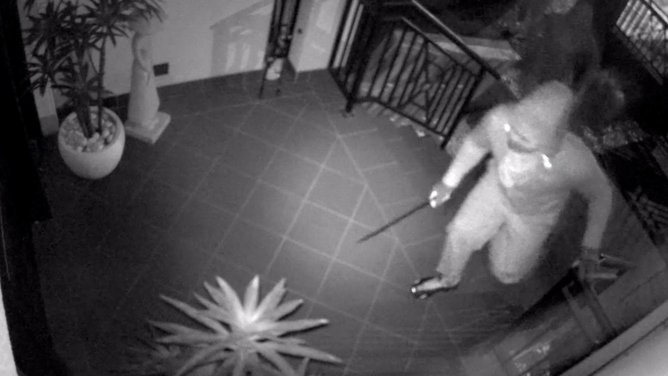
Source : Perth Now news
Teenagers as young as 13 are stepping away from traditional wet work for Sydney gangs and branching out on their own to commit “very serious, nasty crimes”.
The new trend is centred around independently organised groups of teenagers, some of whom have never previously had contact with the criminal justice system.
In numerous instances, the young people participating in these crimes arm themselves with machetes.
One weekend, two severed limbs
Three weeks ago, a quiet street in Sydney’s west was thrust into chaos when a band of four individuals clad in hooded jumpers and carrying bladed weapons kicked in the front door of a residential property in the dead of night.
The group had seemingly targeted the lavish, two-storey Greenacre home to conduct a “traditional robbery”, but what happened inside the residence added a disturbing layer to an already terrifying incident.

A 23-year-old man living inside the home with his mother, father, and two little brothers had his hand savagely cut off by one of the group before “an amount” of cash was stolen and the group fled the scene.
Everything about the incident, from the getaway vehicle to the targeted mutilation to the choice of outfits would typically indicate a potential link to organised crime, but NSW Police has stressed there is no such link and the victims were nothing more than “a decent family”.
Even more shocking, the four alleged perpetrators are all teenage boys and three of them have never had run-ins with police.

The following day, a second break-and-enter by four young men – one carrying a machete and another a firearm – took place just after 8pm in Merrylands.
According to police, a 22-year-old man living at the home lost his thumb, and his attackers “stole a sum of cash before they ran from the home”.
Despite the uncanny similarities and closeness in both time and place between each of the brazen attacks, police said there was no link.
On Wednesday night, a store in Kempsey on the state’s Mid-North Coast was allegedly robbed by a machete-wielding 16-year-old, and in January, a 15-year-old boy allegedly slashed the arm of another teenager with a machete on the Light Rail in Sydney’s CBD.
‘Emerging trend’
NSW Police Youth and Crime Prevention commander Phil Hallinan said “an emerging trend” was developing in the characteristics of youth crime.
“We are concerned that young people, some as young as 13, 14, all the way up to 17, are becoming involved in very serious, nasty crimes across Sydney,” he said.

“It’s been an emerging trend for us as an organisation. Traditionally, we would see young offenders graduate their way through crimes, starting with minor assaults or stealing before then progressing to the more serious offending.
“We have an emerging issue where young people who are not previously known to police for any adverse matters are now committing very serious crimes.”
Central Queensland University criminologist Xanthe Mallett echoed Detective Superintendent’s Hallinan’s description of this new behaviour, telling NewsWire the Greenacre incident was “not a standard break-and-enter”.
“This kind of violence is not normal, this is not a standard break-and-enter … it is rare that we’re seeing these kinds of really violent break-and-enters at all,” Ms Mallett said.

Six youths have been arrested following a brawl at Flinders Street Station on Saturday night.
“We’ve seen a lot of problems around youth crime and youth gangs in various states and territories but I would say this does seem unusual.
“There will understandably be some fear around this, given the level of violence, but it is an anomaly rather than run-of-the mill activity that we should be overtly fearful of. I wouldn’t want to see anybody panicking.”
Ms Mallett said home invasions were generally committed by people hoping to avoid human contact, and even in the event of a break-and-enter, perpetrators typically did their best to avoid a violent confrontation.
“The purpose of a normal home invasion is theft of property. Generally speaking, the people perpetrating those events do not want to come into contact with homeowners because there’s a risk they could be identified or be caught,” she said.
“Nevertheless, this is an incident where a young man has lost his hand, and we’ve seen other cases where people have lost their lives, so it can, and does, happen, but it’s certainly not the common outcome in Australia.
“Generally speaking, what they want to do is get in and out without actually being seen.”


Weapons of choice: Why machetes?
Victims advocate Howard Brown said he wasn’t surprised teenagers were experimenting with new forms of criminal behaviour, calling the escalation a combination of underdeveloped maturity and access to serious weaponry.
“This might sound ridiculous, but in the good old days kids might turn up at your door with a baseball bat. There would obviously be quite serious injuries, but you wouldn’t have amputations and fatal injuries,” he said.
“I think the kids see (the machete) as being a far more intimidating implement to use, and because it is far more intimidating they anticipate greater compliance.
“We’ve been somewhat fortunate that it hasn’t escalated to the point where they are carrying firearms, but unfortunately that’s probably going to be the natural progression.”
NED-15123-Mapping-NSW-machete-crime-in-2026
Machete violence in NSW
Assault and robbery incidents involving a knife have been on a downward trend consistently in NSW since 2006, but in the last three years that has changed.
Between April 2023 and March 2026, the annual number of people charged for assault or robbery with a knife has risen from 333 to 378.
While exact statistics on machete crime are more difficult to discern, a knife under NSW law is considered to be any form of blade, so machete violence is included within those statistics.
According to NSW Police correspondence, there have been seven separate machete-involved assaults this year, mostly across regional NSW and western Sydney, and another seven incidents in which a machete has reportedly been used to threaten an individual or has been uncovered during a police search.
In NSW, laws around the purchase and possession of machetes are far less stringent than neighbouring Victoria, where a highly publicised spate of attacks resulted in a statewide ban on the sale and possession of the lengthy blades in September 2025.
Machetes are typically used as tools for clearing dense vegetation, and in NSW they are classified as “controlled weapons”.