Source : Perth Now news
Testing newborns for sepsis will be faster and more accurate under a world-first blood test being developed in WA that could save the lives of thousands of babies every year.
Neonatal sepsis is a serious infection that can kill babies or cause lifelong disabilities if not picked up quickly.
A decade ago, while sharing beers at a pub, researchers Andrew Currie from Murdoch University and Tobias Strunk from the Child and Adolescent Health Service resolved to focus their energies on developing a speedier test to diagnose sepsis in newborns.
Thanks to ongoing funding from Telethon, the process they pioneered could be in hospitals within two years.
Clinical Professor Strunk said babies born premature were particularly vulnerable to sepsis.
“An untreated infection can have catastrophic outcomes,” he said. “(This test) will accelerate the response. It will allow us to inform the parents as well of what the likely outcome is, and to implement the right therapy.”
“It is likely that an earlier diagnosis, earlier treatment, will result in fewer deaths, but also those that do survive have a better chance of intact survival because, unfortunately, sepsis treated late may also have late effects that only emerge sometimes years after the baby has survived.”
Mum of five Emma Bourke knows only too well how vulnerable pre-term babies can be, with all of her children arriving before their due dates.
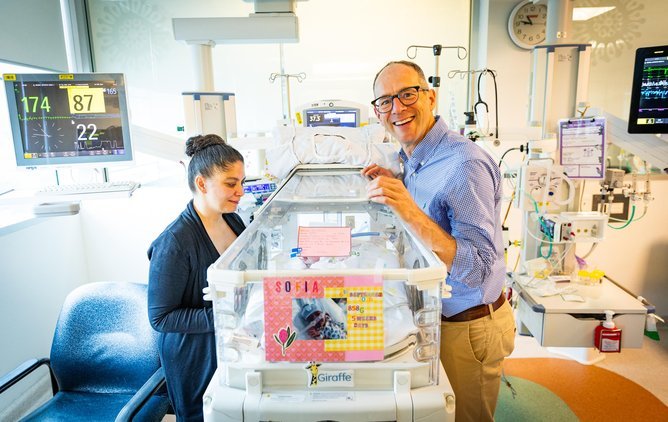
Little Sofia became the earliest of them all when she was born on September 6, after just 25 weeks of pregnancy and a rushed trip to hospital in the back of an ambulance.
“She was a very big shock to us all,” Ms Bourke said. “But the best Father’s Day gift ever.”
Initially unwell, Sofia was given antibiotics for suspected sepsis. Ms Bourke said the confronting experience was “quite scary”, knowing the risk of infections for such a premature baby.
But she is now doing well in the Neonatal Intensive Care Unit at King Edward Memorial Hospital.
Professor Currie said sepsis was a difficult disease to identify.
“It presents in many different and very subtle ways,” he said. “It’s incredibly hard for clinicians to know what they’re actually looking at. And so, this test is really about providing that certainty as fast as possible.
“At the same time, we’re very aware that many infants who are suspected of sepsis don’t have it, and they get antibiotics anyway.
“So we’ve got to stop that unnecessary antibiotics. One, because it has an impact on their development, but two, obviously it can lead to antimicrobial resistance across the entire hospital system.”

The new test, which uses a small machine to detect blood bio-markers, will improve the accuracy of sepsis diagnosis in babies from 60 per cent to 95 per cent.
And it will provide a result at the bedside in under 30 minutes, instead of needing to be sent off to a lab for a diagnosis that could take hours.
Minister for Medical Research Stephen Dawson said the sepsis test would make “a world of difference” to newborns, backed by funding from Telethon and the State Government.
“Unfortunately, sepsis can lead to organ failure or indeed death,” he said. “So it’s really important that our doctors have the best tools available to understand what’s wrong with these children as quickly as possible, so that they can be treated and can be looked after.”